How we chose
Queue 2.3 reassessed current Australian models by projection architecture, published accuracy, useful range, self-levelling, receiver and mounting options, local pricing and exact-product evidence. Manufacturer specifications, professional testing and owner feedback remain distinct evidence.
Bosch Professional GLL 3-80 3 × 360° Line Laser
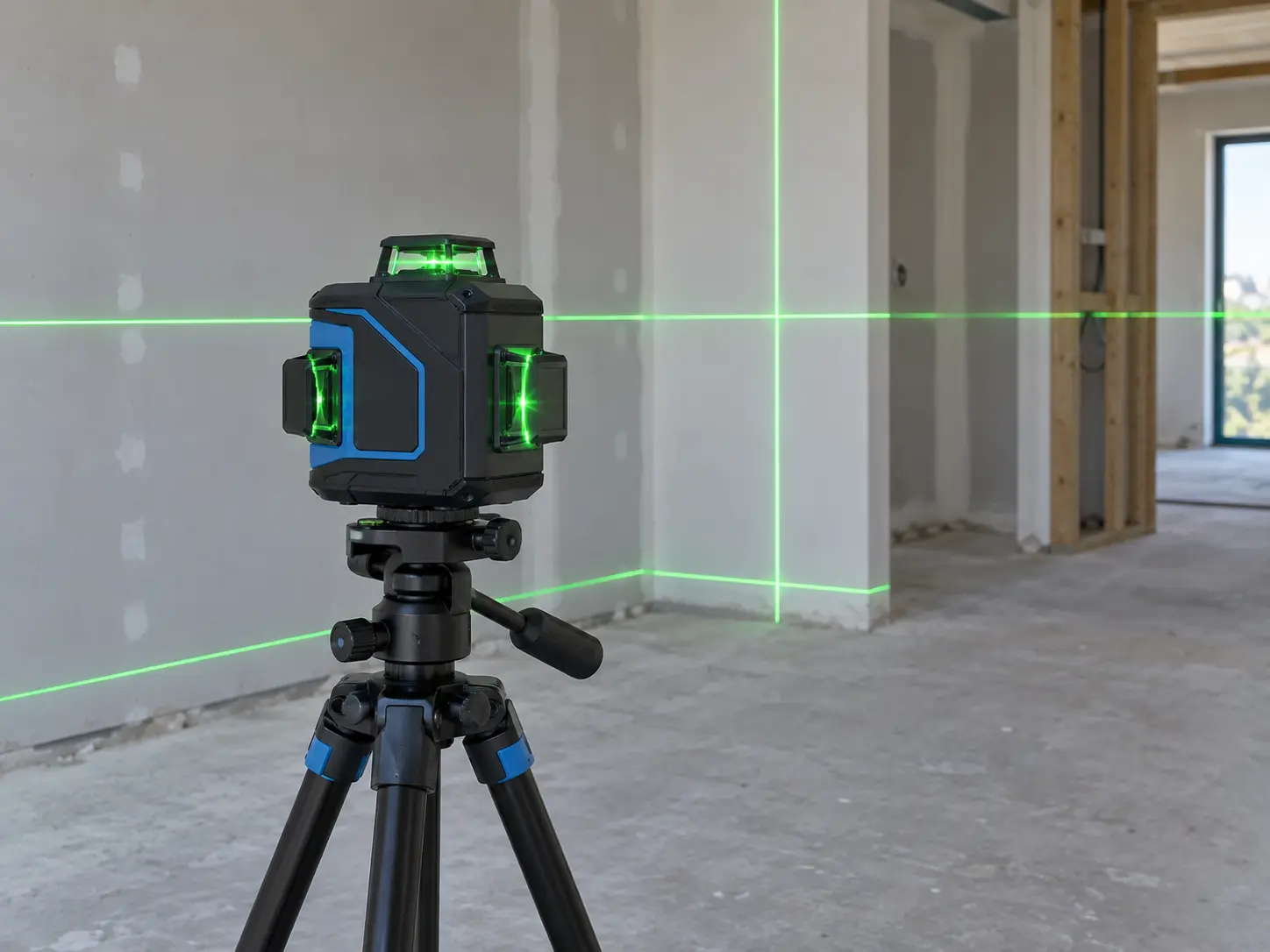
Illustrative editorial image, not an exact product photograph.
The locked Bunnings GLL 3-80 Professional (I/N 0028289) is about $398–$416. It self-levels within roughly ±4°, carries an IP54 rating and supports a compatible receiver for longer-range or brighter-site work. Published accuracy sits in the ±0.2 to ±0.3mm/m class depending source and mode wording.
This is the standard GLL 3-80—not the GLL 3-80 C, green-beam GLL 3-80 CG or a 12V kit. Bluetooth, mobile control and CG-specific features are not being transferred to this model.
Strong professional/test context; exact-product Australian customer pool is extremely small
The exact Bunnings listing has 4.0/5 from one review. The Tradie Magazine’s positive Australian test of the related GLL 3-80 CG platform supports professional context around line clarity, accuracy and layout productivity, but its green beam and Bluetooth features do not become evidence for this locked standard model.
Pros
- Three complete 360° planes
- Strong published accuracy
- Receiver-compatible
- IP54 housing
- Excellent full-room flexibility
Cons
- About $400+
- Overkill for basic household jobs
- Receiver and tripod can add cost
- Outdoor visibility needs realistic expectations
- Only one exact-product Bunnings review
Ryobi 25m 360° Green Line Laser
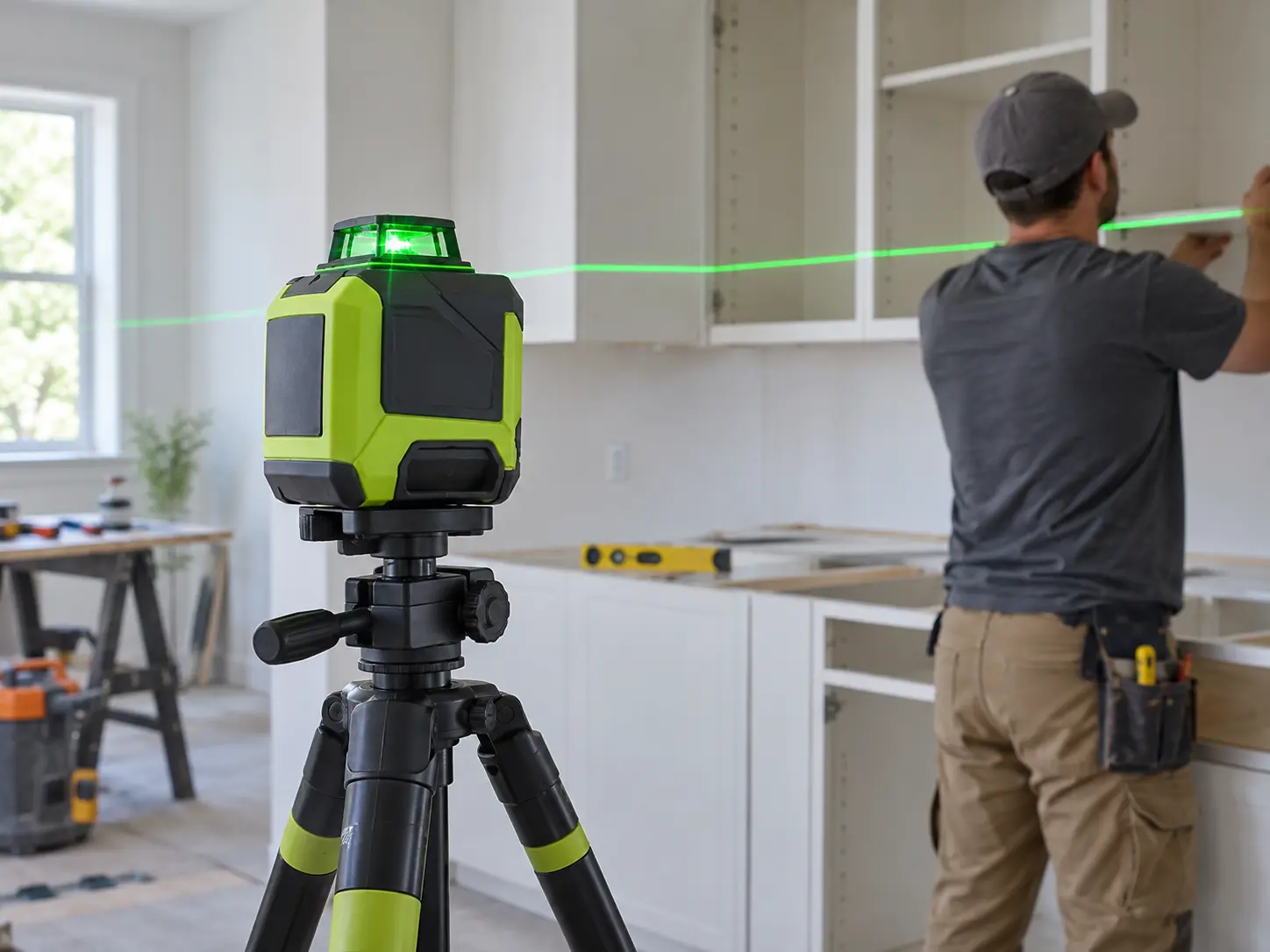
Illustrative editorial image, not an exact product photograph.
At $199.99, Bunnings I/N 0437574 projects a green horizontal 360° plane plus a vertical line to 25m. It self-levels, provides out-of-level indication, has a 1/4-inch mounting point and includes four AA batteries.
Its ±0.5mm/m specification is less precise than the Bosch, and it has only one 360° plane. For cabinetry, shelving, picture rails, tiling and general indoor renovation, that remains a useful and understandable compromise.
Strong exact-product Australian retailer evidence
Bunnings shows 4.6/5 from 36 reviews. Common themes include a bright indoor line, straightforward setup, useful tripod or pole mounting and good value for cabinetry and shelving work.
Pros
- Useful full horizontal 360° line
- Bright green indoor beam
- Strong exact-product review pool
- Simple AA batteries
- Good renovation value
Cons
- Only one 360° plane
- Less precise than premium trade models
- No included receiver
- Full-sun visibility remains limited
- Not integrated with a rechargeable tool platform
Ryobi 15m Green Cross Line Laser RLL15GN
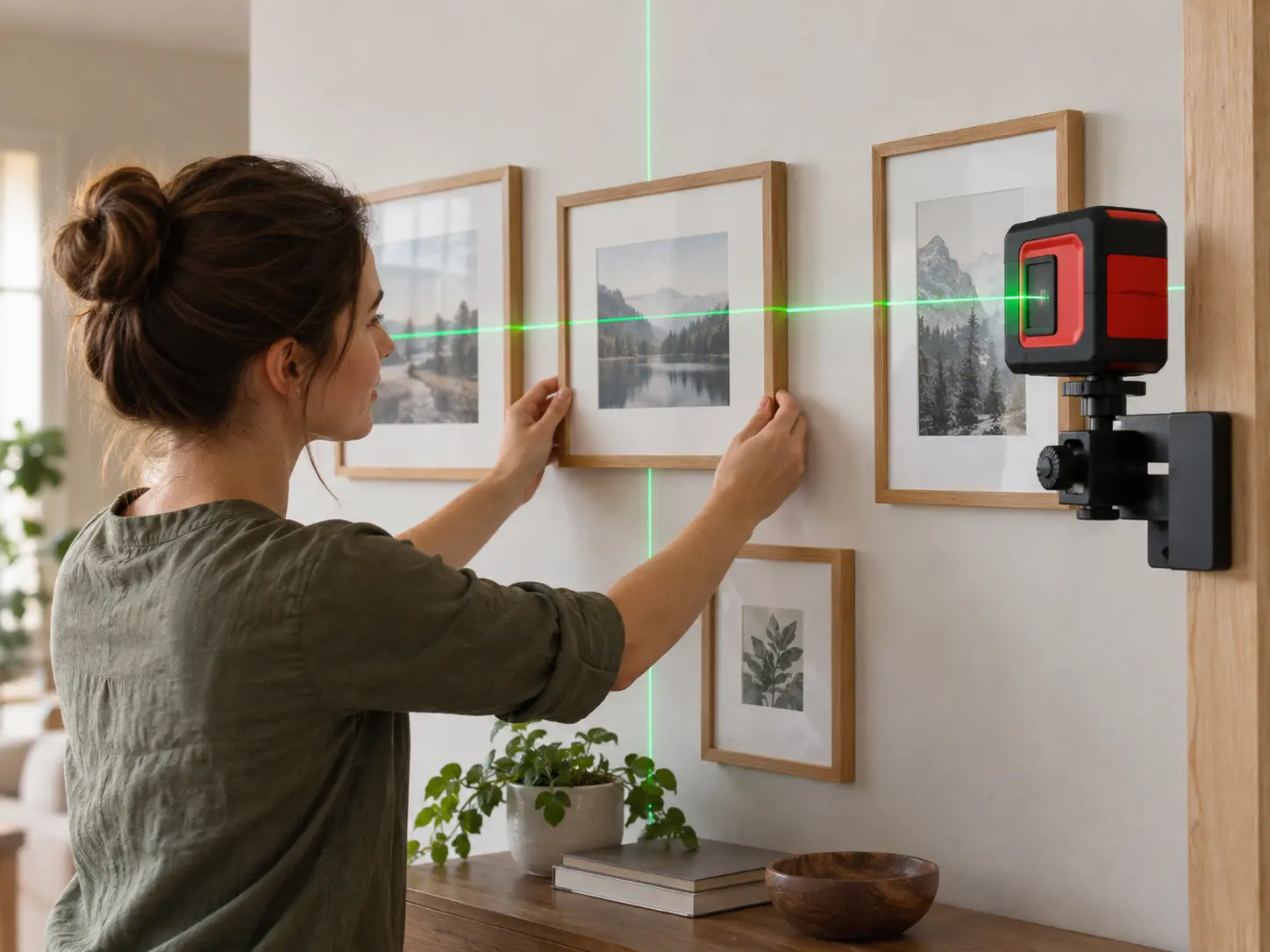
Illustrative editorial image, not an exact product photograph.
RLL15GN (Bunnings I/N 0437572) projects green horizontal and vertical cross lines to 15m, self-levels, indicates when it is out of level and includes a clamp bracket, 1/4-inch mounting point and two AA batteries.
The limitation is architectural, not hidden: this is not a 360° unit. Repositioning is necessary when transferring references around a room, and it is not a replacement for a receiver-compatible three-plane trade system.
Extensive exact-product Australian/ANZ feedback
Ryobi Australia shows about 4.7/5 from 44 reviews. Bunnings separately shows about 4.5/5 from about 42. The pools are not merged. Feedback supports the model’s visibility, ease of use and household value.
Pros
- Affordable green line
- Simple self-levelling
- Clamp and tripod thread
- Extensive exact-product feedback
- Good for basic layout work
Cons
- No 360° projection
- Shorter 15m range
- Requires repositioning
- Outdoor visibility limitations
- Not intended for trade-scale layout
Cross-line, 360° and 3 × 360°
A cross-line laser places one horizontal and one vertical reference on the wall in front of it. A 360° unit carries a line around the room, which is faster for cabinetry, tiles and level transfer. A 3 × 360° model adds two full vertical planes, making ceilings, framing and perpendicular layout easier.
Green, red and outdoor use
Green is usually easier to see indoors, but it does not make a beam clearly visible in full sun. Visibility is not the same as detection: a compatible receiver can locate a pulsed beam when the line itself is difficult to see.
Understanding accuracy
An accuracy figure of ±0.5mm/m means potential error grows with distance. It does not make a consumer laser a survey instrument. Check calibration before critical work and avoid comparing numbers without matching the stated conditions.
Self-levelling limits
Self-levelling works only within the specified tilt range. When the unit sits too far out of level, it should signal an error or flash rather than correcting indefinitely. Start from a stable, roughly level surface.
Mounts, poles and tripods
Placement often matters as much as the laser. A tripod, magnetic bracket, clamp, pole or ceiling mount can put the plane at the exact working height and prevent repeated improvised setups.
Also considered
The $299.99 AEG Three Green Line Laser with plumb-down point is a strong alternative with 4.8/5 from 12 Bunnings reviews. DeWalt’s 18V XR 3 × 360° kit suits existing XR owners but costs about $628 and has only a tiny local exact-model sample. The Bosch GLL 3-80 CG adds green beams and Bluetooth at a higher, more variable price; those features do not apply to the locked standard GLL 3-80.
Which one should you buy?
Choose the Bosch GLL 3-80 for repeated full-room layout and professional three-plane flexibility. Choose the Ryobi 25m 360° for the best balance of price, room-wide horizontal coverage and Australian evidence. Choose the Ryobi RLL15GN for straightforward single-wall DIY work.
Frequently asked questions
What is the best laser level in Australia?
The Bosch Professional GLL 3-80 is the best overall choice here for serious renovation because its three 360° planes support fast horizontal, vertical and perpendicular room layout.
Is a 360° laser level worth it?
Yes when you frequently transfer a level around a room for cabinets, tiles, ceilings or picture rails. A basic cross-line model is cheaper and sufficient for occasional single-wall jobs.
Is a green laser better than red?
Green is generally easier to see indoors, but it is not automatically more accurate and can still disappear in bright outdoor light.
Can laser levels be used outdoors?
They can, but direct line visibility may be poor in daylight. For reliable longer-range work, choose a compatible pulsed laser and receiver rather than relying on beam colour alone.
How accurate should a laser level be?
It depends on the job and distance. Read the mm-per-metre specification: small errors accumulate over longer runs, so critical cabinetry or trade layout benefits from tighter published tolerance.