Comparison
| Feature | EcoFlow DELTA 3 Plus | Jackery Explorer 1000 v2 | BLUETTI AC180P |
|---|---|---|---|
| Award | Best overall | Best value / lightweight 1kWh pick | Best for extra capacity |
| Worth Buying score | 9.3/10 | 9.1/10 | 8.9/10 |
| Researched price | About $1,199 promotional; direct stock was sold out / pre-order | About $699 promotional; reference about $799 | About $1,169 at True Gear; direct reference around $1,599 |
| Battery | 1024Wh LiFePO₄ | 1070Wh LiFePO₄ | 1440Wh LiFePO₄ |
| Continuous AC output | 1800W | 1500W | 1800W |
| Surge / boost | 3600W surge; X-Boost up to 2400W for supported loads | 3000W surge | Power Lifting up to 2700W for supported resistive loads |
| Weight | About 12.5kg | About 10.8kg | About 16kg |
| AC outlets | 4 Australian outlets | Current AU configuration | Multiple AC outputs |
| USB-C output | 2 × up to 140W | Dual USB-C PD up to 100W class | USB-C included; check exact port limits |
| Solar input | Up to 1000W | More modest than EcoFlow; check exact compatibility | Up to 500W; 12–60V DC / 10A |
| AC charging | Up to 1500W input | About 59 minutes 0–100% in emergency mode under stated conditions | Up to 1440W input |
| Vehicle charging | Strong optional alternator-charger ecosystem | Standard vehicle charging; cable/bundle dependent | Vehicle charging supported; high-output alternator setup not standard |
| UPS transfer | <10ms | ≤20ms | UPS function supported; not medical-grade |
| Expansion | Roughly 1–5kWh | None | No expansion claim used here |
| App | Wi-Fi + Bluetooth | Jackery app | Bluetooth |
| Cycle claim | About 4000 cycles to 80%+ | About 4000 cycles to 70% | 3500+ cycles |
| Warranty | 5 years | 3 years; extra 2 years on qualifying direct purchases | 5 years under current specialist-retailer wording |
| Australian evidence | Strong independent testing; independent owner pool very small | Strong value/spec case; exact owner evidence limited | Strong specialist-retailer feedback; manufacturer pool broader |
| Best for | Flexible camping, backup and expansion | Portable 1kWh value | Longer runtime without moving to 2kWh |
| Main drawback | Expensive; direct availability was limited | Lower output and no expansion | Heavier and slower maximum solar input |
EcoFlow DELTA 3 Plus
- Researched price
- About $1,199 promotional; direct stock was sold out / pre-order
- Battery
- 1024Wh LiFePO₄
- Continuous AC output
- 1800W
- Surge / boost
- 3600W surge; X-Boost up to 2400W for supported loads
- Weight
- About 12.5kg
- Solar input
- Up to 1000W
- Cycle claim
- About 4000 cycles to 80%+
- Warranty
- 5 years
- Australian evidence
- Strong independent testing; independent owner pool very small
- Best for
- Flexible camping, backup and expansion
- Main drawback
- Expensive; direct availability was limited
Jackery Explorer 1000 v2
- Researched price
- About $699 promotional; reference about $799
- Battery
- 1070Wh LiFePO₄
- Continuous AC output
- 1500W
- Surge / boost
- 3000W surge
- Weight
- About 10.8kg
- Solar input
- More modest than EcoFlow; check exact compatibility
- Cycle claim
- About 4000 cycles to 70%
- Warranty
- 3 years; extra 2 years on qualifying direct purchases
- Australian evidence
- Strong value/spec case; exact owner evidence limited
- Best for
- Portable 1kWh value
- Main drawback
- Lower output and no expansion
BLUETTI AC180P
- Researched price
- About $1,169 at True Gear; direct reference around $1,599
- Battery
- 1440Wh LiFePO₄
- Continuous AC output
- 1800W
- Surge / boost
- Power Lifting up to 2700W for supported resistive loads
- Weight
- About 16kg
- Solar input
- Up to 500W; 12–60V DC / 10A
- Cycle claim
- 3500+ cycles
- Warranty
- 5 years under current specialist-retailer wording
- Australian evidence
- Strong specialist-retailer feedback; manufacturer pool broader
- Best for
- Longer runtime without moving to 2kWh
- Main drawback
- Heavier and slower maximum solar input
Continuous output, surge output and manufacturer boost modes are separate. Boost modes do not change the normal continuous inverter rating.
How we chose
Queue 2.3 compared current Australian models by capacity, chemistry, sustained inverter output, charging speed, solar and vehicle options, weight, expansion, warranty and source-specific customer evidence. Worth Buying scores are editorial assessments and remain separate from customer ratings.
Manufacturer capacity, cycle-life, charge-time, surge and boost figures are conditional claims rather than Worth Buying laboratory measurements. Hands-on reviews, retailer feedback and manufacturer-hosted reviews remain separate.
EcoFlow DELTA 3 Plus
Exact model: DELTA 3 Plus · 1024Wh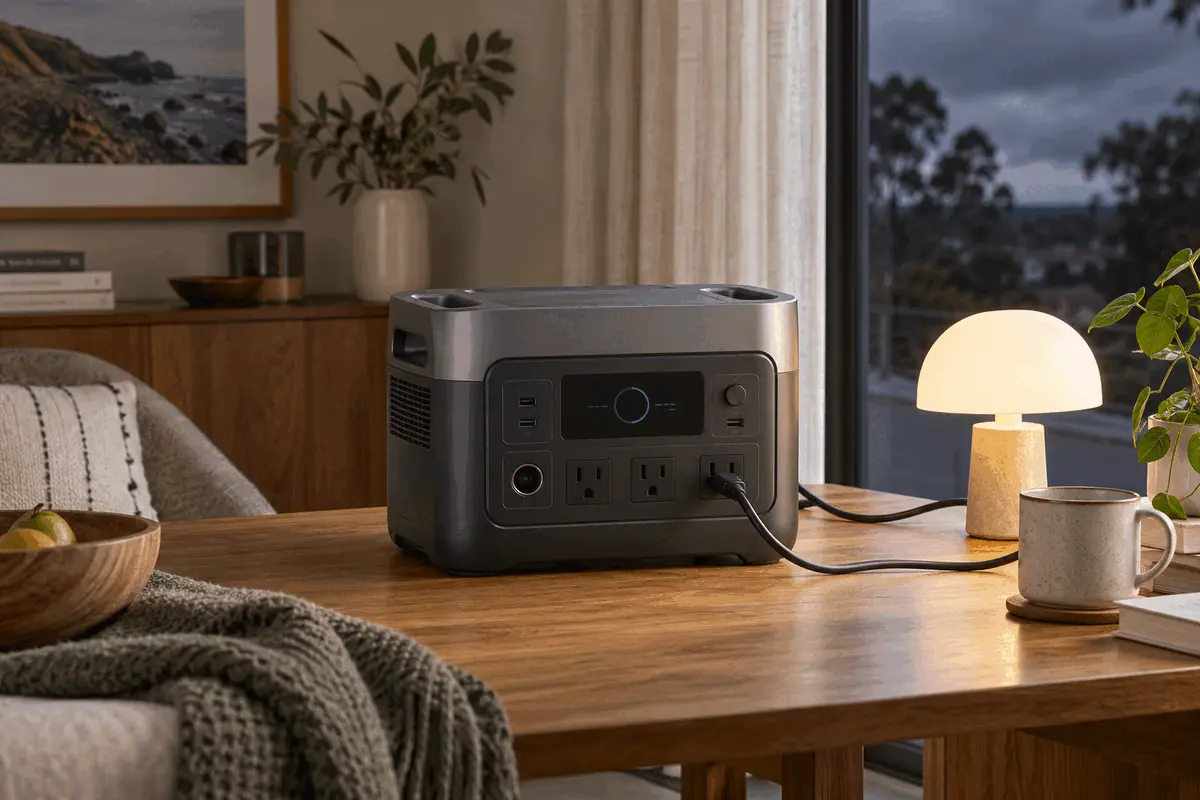
Illustrative editorial image, not an exact product photograph.
The DELTA 3 Plus combines a 1024Wh LiFePO₄ battery with 1800W continuous AC output, 3600W surge, four Australian AC outlets, two 140W USB-C ports and up to 1000W solar input. Compatible extra batteries can expand the system from roughly 1kWh to 5kWh.
EcoFlow lists 1500W AC input and sub-10ms UPS transfer. X-Boost can support selected loads up to 2400W, but that is not 2400W continuous output. The unit weighs about 12.5kg, so it is portable rather than genuinely light.
GadgetGuy's exact-model review scored it 9/10 and recorded about 47 hours from a 72L camping fridge before 10% battery, plus roughly 801W alternator charging in that setup. Those are reviewer results, not guarantees. EcoFlow direct was sold out or on pre-order during research.
Customer evidence
GadgetGuy Australia and Reviews.org Australia provide exact-model hands-on context. ProductReview had one verified exact-model Australian review. EcoFlow's roughly 41 direct reviews are manufacturer-hosted, not 41 independent verified Australian purchasers.
Pros
- Excellent power-to-weight balance
- Fast AC and solar charging
- Expandable battery architecture
- Strong app and alternator ecosystem
- Five-year warranty
Cons
- Expensive
- Direct stock was unavailable during research
- 12.5kg requires meaningful lifting
- Alternator charger costs extra
- Usable AC energy is below nominal capacity
| Battery / output | 1024Wh LiFePO₄; 1800W continuous; 3600W surge |
|---|---|
| Charging | Up to 1000W solar and 1500W AC input |
| Ports / controls | 4 AC, 2 × 140W USB-C, 2 × USB-A, 12V output, Wi-Fi/Bluetooth app |
| Size / weight | About 398 × 202 × 284mm; 12.5kg |
| Price / warranty | About $1,199 promotional; 5 years |
Jackery Explorer 1000 v2
Exact model: Explorer 1000 v2 · 1070Wh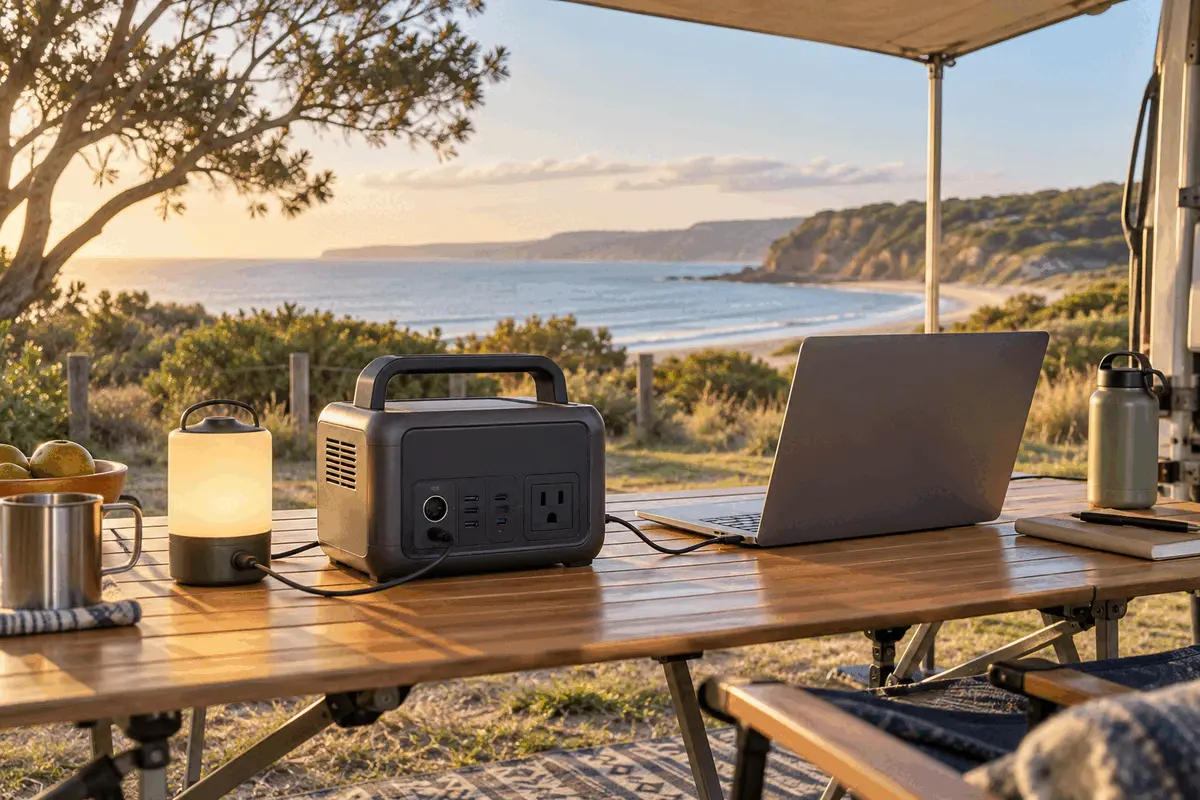
Illustrative editorial image, not an exact product photograph.
The Explorer 1000 v2 stores 1070Wh yet weighs about 10.8kg. Its 1500W continuous output and 3000W surge suit many camping and blackout loads, while dual USB-C PD ports support up to the 100W class.
Jackery claims about 59 minutes from 0–100% in emergency fast-charge mode under stated conditions and UPS switching of 20ms or less. Fast mode should not automatically be treated as the gentlest everyday setting. Capacity cannot be expanded, and solar input is more modest than EcoFlow's.
The warranty is three years, with an extra two-year extension on qualifying Jackery-direct purchases—not five years everywhere. There is no published weatherproof rating, so protect the station from rain.
Customer evidence
Jackery Australia's exact page had four manufacturer-hosted reviews. ProductWise Australia highlighted portability, useful output and camping fit while classifying verified Australian owner evidence as limited.
Pros
- Excellent promotional price
- Low weight for its capacity
- 1070Wh LiFePO₄ battery
- Fast conditional AC charging
- Simple camping-friendly architecture
Cons
- 1500W trails both rivals
- No expansion battery
- No weatherproof rating
- Limited exact-model evidence
- Promotion may change
| Battery / output | 1070Wh LiFePO₄; 1500W continuous; 3000W surge |
|---|---|
| Charging / UPS | About 59 minutes in emergency mode under stated conditions; ≤20ms |
| Connectivity | USB-A, dual USB-C PD up to 100W class and Jackery app |
| Weight / cycle claim | About 10.8kg; roughly 4000 cycles to 70% |
| Price / warranty | About $699 promotional; 3 years plus qualifying direct extension |
BLUETTI AC180P
Exact model: AC180P · 1440Wh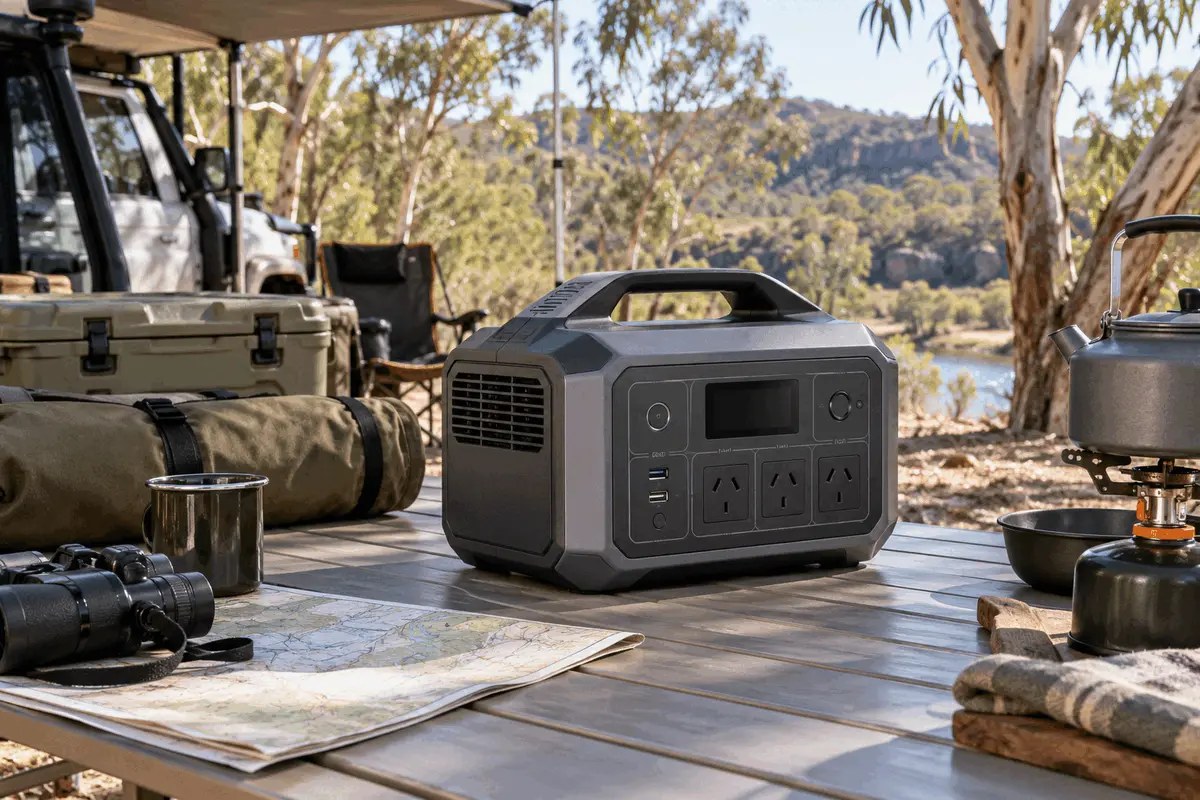
Illustrative editorial image, not an exact product photograph.
The AC180P offers roughly 40% more nominal capacity than the 1kWh picks while retaining 1800W continuous output. Its LiFePO₄ battery, up to 1440W AC input and 500W solar input suit longer camping and backup duties.
Power Lifting supports selected resistive loads up to 2700W; it is not a 2700W continuous rating. At about 16kg the AC180P is substantially heavier than Jackery, and Bluetooth-only app control is less flexible than richer Wi-Fi ecosystems.
True Gear and Mud Tracks provide separate exact-product Australian pools. BLUETTI's 500-plus manufacturer stream appears to mix AC180/AC180P and global submissions, so it is not presented as 500 exact Australian AC180P reviews.
Customer evidence
True Gear showed about 30 exact reviews at 5.0/5. Mud Tracks showed seven at 5.0/5 and marked them 100% verified. One BLUETTI-hosted road-train owner reported DC connectors loosening under vibration; that is anecdotal, not universal.
Pros
- Larger 1440Wh capacity
- 1800W continuous output
- Fast mains charging
- Strong retailer feedback
- Five-year current retailer wording
Cons
- About 16kg
- 500W solar limit
- Bluetooth-only app
- High direct reference price
- Manufacturer review provenance is mixed
| Battery / output | 1440Wh LiFePO₄; 1800W continuous |
|---|---|
| Boost | Power Lifting up to 2700W for supported resistive loads |
| Charging | Up to 1440W AC; up to 500W solar at about 12–60V DC / 10A |
| Size / weight | About 340 × 247 × 317mm; about 16kg |
| Price / warranty | About $1,169 at True Gear; 5-year specialist-retailer wording |
Wh vs watts—and usable energy
Watt-hours describe stored energy. Watts describe power delivery. A 1500Wh station does not automatically run a 2000W appliance if its inverter is rated to 1800W. Nameplate Wh is also not fully delivered through 240V AC because inverter conversion, electronics, standby draw and protection margins consume energy.
Continuous output vs surge and boost
Continuous output determines sustained capability. Surge helps with brief startup loads. EcoFlow X-Boost and BLUETTI Power Lifting support selected appliances but do not increase normal continuous inverter ratings. Check running watts and startup demand.
Solar and vehicle charging
Solar charge rate depends on panel wattage, sunlight, angle, shade, cable loss and voltage/current compatibility. See Best Portable Solar Panels. Standard cigarette-lighter charging is usually slow; high-output alternator chargers cost extra, require installation and must suit the vehicle.
Battery life, weight and safety
LiFePO₄ offers high cycle life and good thermal stability, but manufacturer cycle claims are not guaranteed calendar lifespans. Keep stations dry and ventilated, leave vents clear and stay within rated output. Fast UPS/EPS switching can suit computers and network gear, but these are not medical-grade UPS devices.
Which one should you buy?
Choose EcoFlow DELTA 3 Plus for charging flexibility and expansion. Choose Jackery Explorer 1000 v2 for low weight and value while promotional pricing holds. Choose BLUETTI AC180P when 1440Wh matters more than carrying another 3–5kg.
Frequently asked questions
What is the best portable power station in Australia?
EcoFlow DELTA 3 Plus is our best overall pick for its 1024Wh battery, 1800W output, 1000W solar input, expansion and charging ecosystem.
How big a power station do I need for a camping fridge?
Use the fridge's measured consumption, trip length, heat and recharge options. A 1kWh-class station is a useful general starting point, but fridge demand varies.
What is the difference between Wh and watts?
Wh measures stored energy and helps estimate runtime. Watts measures power delivery and determines whether an appliance can run.
Can I charge a portable power station from solar panels?
Yes, when panel voltage, current, connector and wattage fall within the station's solar-input limits. Real charge rate varies with conditions.
Can a portable power station run a fridge during a blackout?
Usually, if running and startup demand stay within the inverter rating. Runtime depends on efficiency, temperature, door openings and usable capacity.