How we narrowed the field
We verified that each exact model remains current in Australia, then compared the details that change daily ownership: whether a parcel is visible, local recording without a subscription, removable versus sealed batteries, wiring options, detection features, weather protection, smart-home compatibility, warranty and Australian owner feedback. We excluded discontinued clearance models and marked small or unavailable review samples plainly.
A useful doorbell must show both faces and the doorstep. It also needs a strong 2.4GHz connection through the exterior wall, a mounting angle that avoids the road, and notification settings that do not wake the camera for every passing car. Local recording avoids a compulsory monthly bill, but remote alerts and live viewing still depend on the maker's app and online service.
Ring Battery Video Doorbell 2K Plus (2nd Gen)
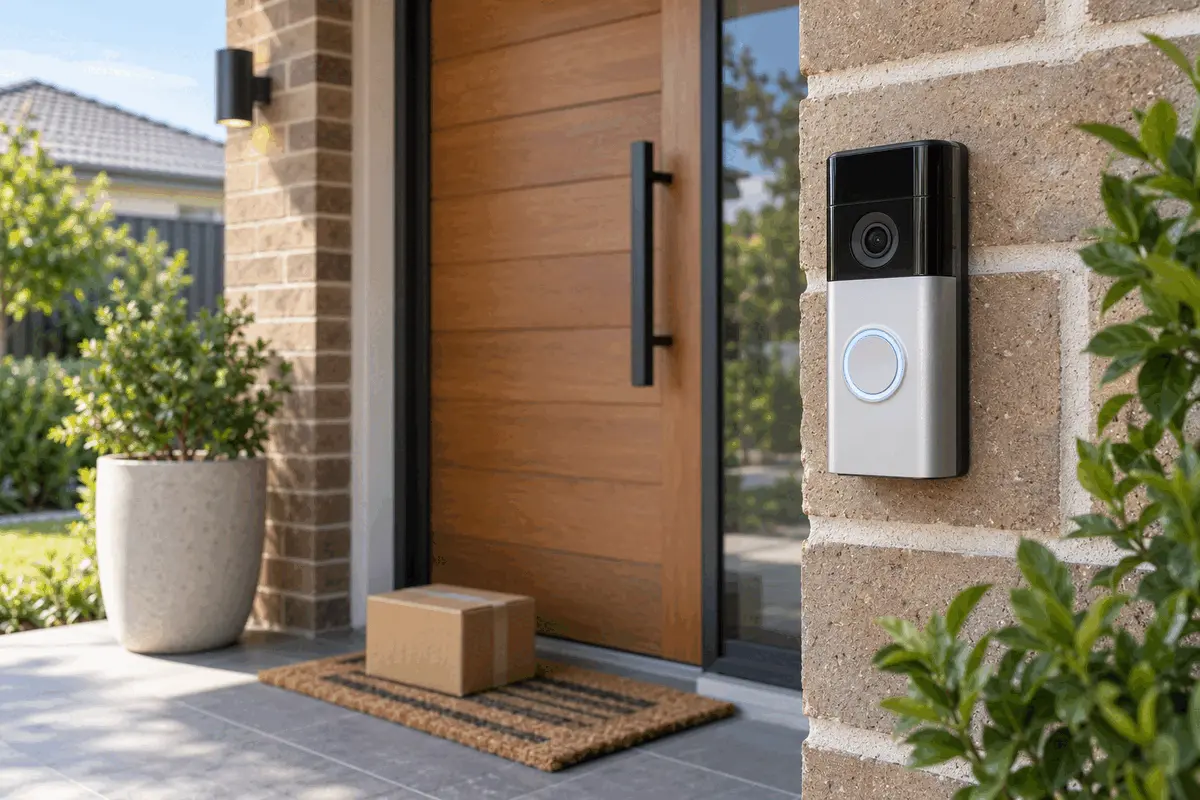
Illustrative editorial image, not an exact product photograph.
The current 2nd-generation Plus is Ring's sensible sweet spot. Its 2K head-to-toe view covers both visitors and parcels, the removable quick-release battery avoids taking the whole doorbell down to charge, and dual-band Wi-Fi gives it more network flexibility than the two cheaper picks. Ring's mature app, Alexa integration and huge accessory range also make expansion straightforward.
The hardware costs $249 direct or $247 at Bunnings when checked. The real price is higher: without Ring Home you can answer live notifications, but missed events are not recorded for later review. Recording, sharing, video history and package alerts require a subscription after the trial. Ring Home Basic has been listed in Australia at $4.95 monthly or $49.95 annually for one device, so five years adds about $250 at today's annual price.
| Model | Ring Battery Video Doorbell 2K Plus (2nd Gen) |
|---|---|
| Video | Retinal 2K head-to-toe video; up to 6× digital zoom |
| Field of view | 140° horizontal / 140° vertical |
| Detection | Motion alerts included; package alerts require eligible Ring Home plan |
| Storage | No local storage; eligible Ring Home subscription required for recorded history |
| Power | Quick Release Battery Pack; compatible hardwiring can maintain charge |
| Connectivity | 2.4GHz and 5GHz Wi-Fi; Alexa ecosystem |
| Weather protection | Weather resistant; Ring does not publish a consumer IP rating for this model |
| Australian warranty | 1-year limited warranty, plus Australian Consumer Law |
| Current Australian price | $249 direct / $247 Bunnings, checked 15 Sep 2026 |
Pros
- Sharp head-to-toe coverage
- Excellent Australian owner score
- Polished, familiar app
- Removable battery
- Dual-band Wi-Fi
Cons
- No local recording whatsoever
- Subscription needed for missed clips
- Package alerts sit behind paid plan
- No Apple HomeKit
- Five-year fee adds about $250
eufy Video Doorbell E340
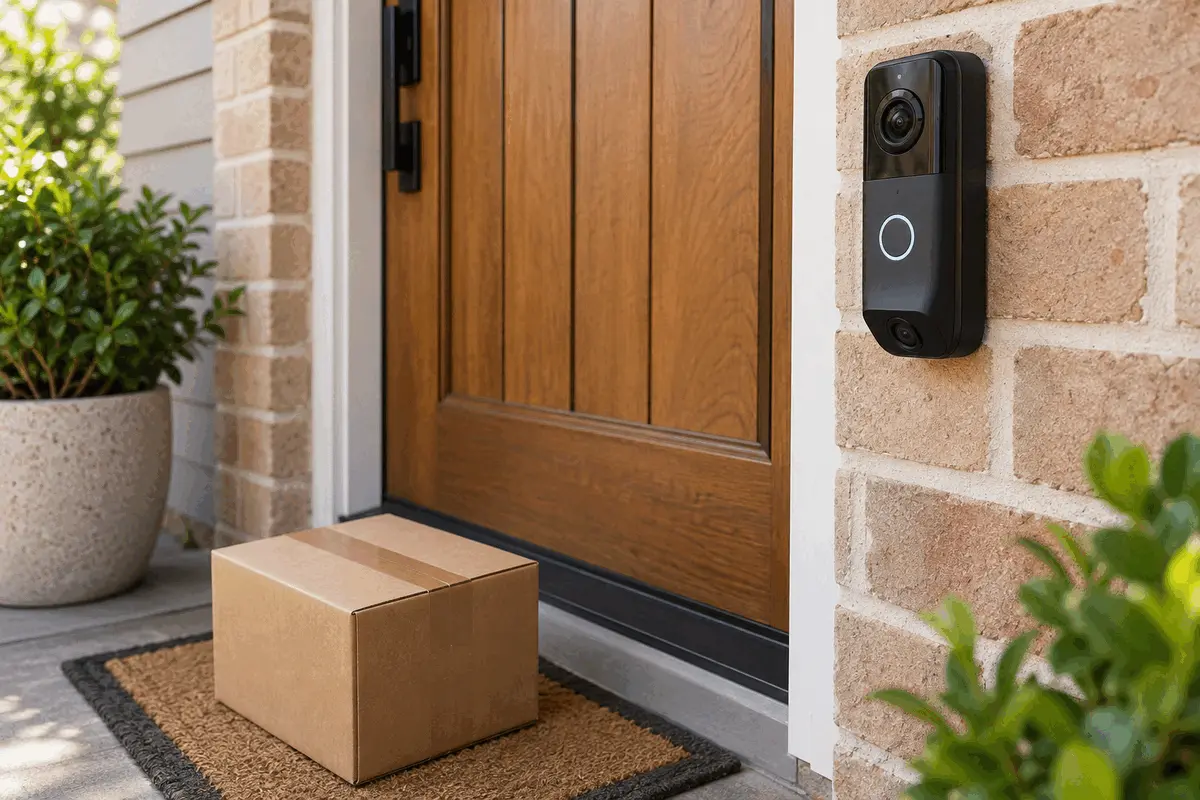
Illustrative editorial image, not an exact product photograph.
The E340's 2K front camera and downward package camera cover the two areas that matter, while dual lights enable colour night footage. It stores clips on 8GB of built-in eMMC and works without a monthly plan. You can install it on battery, connect compatible existing wiring for trickle charging, or add HomeBase 2 or 3 for indoor central storage.
The Good Guys lists it at $349 and eufy's direct price was $349.95 when checked, with a temporary $298.95 promotion visible. It costs roughly $100 more than Ring upfront, but the gap disappears after about two years of Ring Home Basic at today's annual price. It only uses 2.4GHz Wi-Fi and does not support Apple HomeKit, despite one retailer specification incorrectly saying it does; eufy's own compatibility answer takes precedence.
| Model | eufy E340 / T8214T11 |
|---|---|
| Video | 2K main camera with HDR + downward package camera |
| Detection | Human and package detection; Delivery Guard features |
| Storage | 8GB built-in eMMC; compatible with HomeBase 2 and 3 |
| Power | Removable rechargeable battery or compatible doorbell wiring |
| Connectivity | 2.4GHz Wi-Fi; Alexa and Google Assistant; no HomeKit |
| Weather rating | IP65 |
| Australian warranty | 1 year manufacturer warranty listed by The Good Guys |
| Current Australian price | $349–$349.95 regular; $298.95 direct promotion when checked 15 Sep 2026 |
Pros
- Excellent dual-camera coverage
- Strong Australian owner score
- Local recording with no monthly fee
- Removable battery
- Optional indoor HomeBase storage
Cons
- Higher upfront price than Ring
- No Apple HomeKit
- 2.4GHz Wi-Fi only
- Two-way audio can lag
- HomeBase costs extra
TP-Link Tapo D225
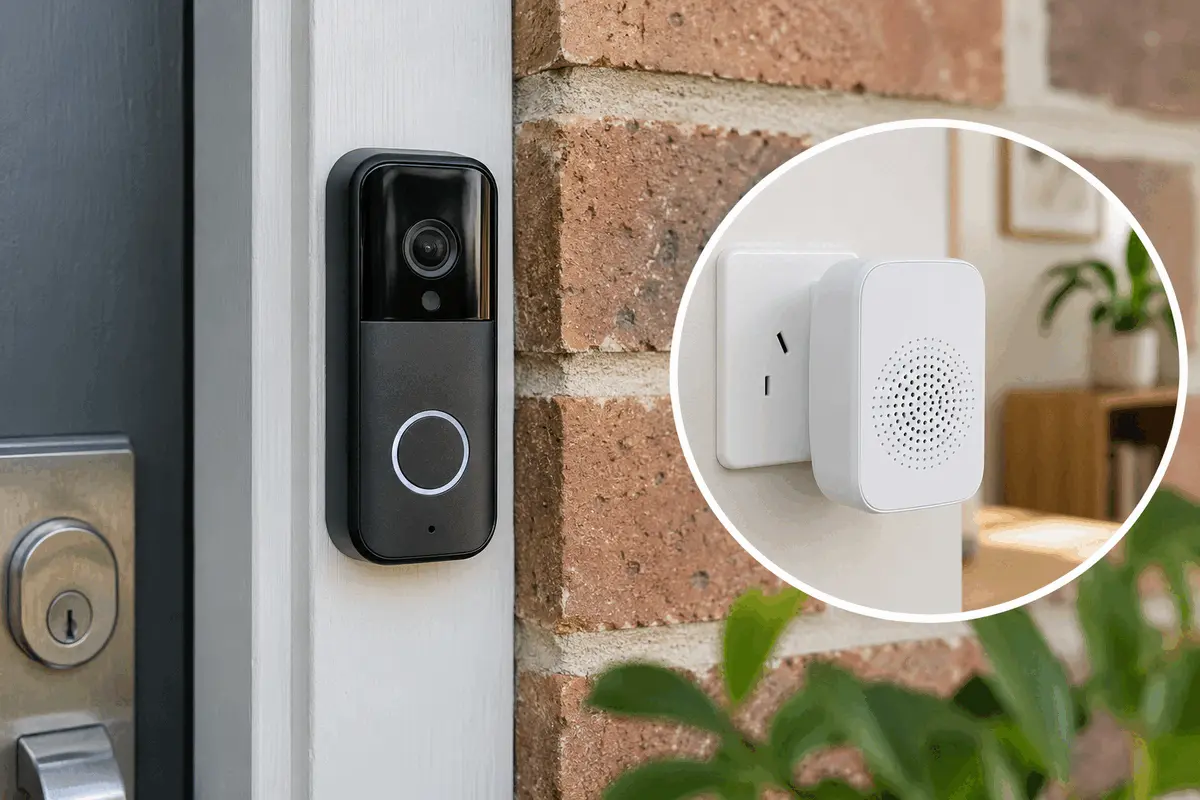
Illustrative editorial image, not an exact product photograph.
The D225 records 2560×1920 video in a useful 4:3 frame, with a 180-degree diagonal and 140-degree vertical field of view. Its large 10,000mAh battery supports easy installation, while compatible 8–24V AC or 24V DC wiring unlocks more responsive operation. Person, pet and package detection are available without paying for Tapo Care.
Local recording supports a microSD card up to 512GB, which is an extra cost, and cloud backup remains optional. TP-Link's up-to-210-day battery statement assumes only 300 seconds of use each day; a busy path, frequent live views, cold weather or weak Wi-Fi will reduce it. Australian stock has varied, so compare the final delivered price and avoid overseas plugs or unsupported imports.
| Model | TP-Link Tapo D225 |
|---|---|
| Video | 2560 × 1920 / 4MP, 4:3 aspect ratio |
| Field of view | 180° diagonal / 140° vertical |
| Detection | Motion, person, pet, vehicle and package detection |
| Storage | microSD up to 512GB; optional Tapo Care cloud |
| Power | 10,000mAh battery or 8–24V AC / 24V DC input |
| Connectivity | 2.4GHz Wi-Fi; Alexa and Google Assistant |
| Weather rating | IP66 |
| Australian warranty | Confirm with local retailer; Australian Consumer Law also applies |
| Current Australian price | Commonly about $150–$200 where stocked, checked 15 Sep 2026 |
Pros
- Wide head-to-toe coverage
- Large 10,000mAh battery
- Useful detection without a plan
- Battery or wired installation
- Up to 512GB local storage
Cons
- No dependable Australian review sample
- microSD card costs extra
- 2.4GHz Wi-Fi only
- Battery claim assumes light use
- Local stock can be inconsistent
Ownership, storage and subscription costs
Ring has the lowest mainstream upfront price here, but it is the only pick with no local recording option. Ring Home Basic adds about $49.95 a year for one device, or roughly $250 over five years if pricing stays unchanged. The eufy includes 8GB of storage and the Tapo needs a high-endurance microSD card. Optional cloud plans or a eufy HomeBase cost extra but are not required for those two to retain clips.
Expect occasional charging unless compatible wiring keeps pace with activity. Clean lenses, review motion zones, keep firmware current and enable two-factor authentication. Position the camera to minimise neighbours and the public footpath, use privacy masking where available, and check local tenancy or strata rules before drilling.
Which one should you buy?
Choose the Ring Battery Video Doorbell 2K Plus for the strongest mainstream app, ecosystem and retailer support—provided you accept paying to retain missed events. Choose the eufy E340 for excellent parcel coverage and local storage without compulsory fees. Choose the Tapo D225 for a lower-cost hybrid installation with excellent vertical coverage. If continuous recording or guaranteed uptime matters, a professionally wired security camera is a better tool than any battery doorbell.
Useful FAQs
Do video doorbells need a subscription?
Not all do. Ring requires an eligible Ring Home plan for recorded history. The eufy E340 includes local storage, while the Tapo D225 supports local microSD recording; optional cloud services can still add features.
Is a wired video doorbell better than a battery model?
Wiring can improve responsiveness and reduce charging, but compatibility must be confirmed. Battery models are easier to install and relocate. All three picks support battery operation, with compatible wiring options varying by model.
Does 5GHz Wi-Fi matter for a doorbell?
Reliable signal at the front door matters more than the band name. Ring supports 2.4GHz and 5GHz, while the eufy and Tapo models use 2.4GHz for longer practical reach.
How should I protect neighbour privacy?
Use motion zones and privacy masking where available, avoid unnecessary coverage of neighbouring property and public paths, and check tenancy or strata requirements before drilling.