
How we chose
Detailed methodology
We assessed current standalone nominal-12V LiFePO4 batteries sold for Australian camping, caravan, camper, canopy and 4WD auxiliary-power use. The comparison considered exact-model capacity, BMS current limits, charge limits, short surge capability, ingress protection, temperature management, dimensions, weight, monitoring, communications, warranty, Australian support, current availability and the strength of exact-model owner evidence.
Worth Buying scores are editorial judgements, not customer ratings. Manufacturer-hosted reviews, independent owner evidence, professional testing and manufacturer specifications remain separate evidence pools.
Serious contenders
REDARC REDLAB Icon 100Ah is a strong Australian premium alternative with IP67 protection, IEC 62619 certification and internal heating, but its higher pricing and lower current capability did not displace the B-TEC G3. Renogy 12V 100Ah Pro has strong technical features and competitive pricing, but Australian after-sales complaints reduce confidence without proving product failure. Invicta Xero 100Ah and Baintech Extreme 110Ah remain credible specialist choices. Amptron Bluedge 100Ah is a technical watchlist candidate whose exact-model ownership evidence was too limited for ranking.
Lithium is not a universal AGM drop-in
A nominally 12V lithium battery can still be incompatible with an existing system. Before buying, verify the alternator arrangement, lithium-compatible DC-DC and mains charging profiles, solar-controller settings, BMS current limits, inverter continuous and surge demand, cable and fuse sizing, isolation, battery restraint, terminal protection, temperature limits, installation environment and the manufacturer's series/parallel rules.
Under-bonnet use is product-specific. Only install a LiFePO4 battery under bonnet when the exact manufacturer explicitly permits it and every stated location, temperature and heat-management requirement is met. The iTECH120X PRO has conditional manufacturer permission; that does not make under-bonnet installation suitable for lithium batteries generally.
iTechworld iTECH120X PRO 120Ah
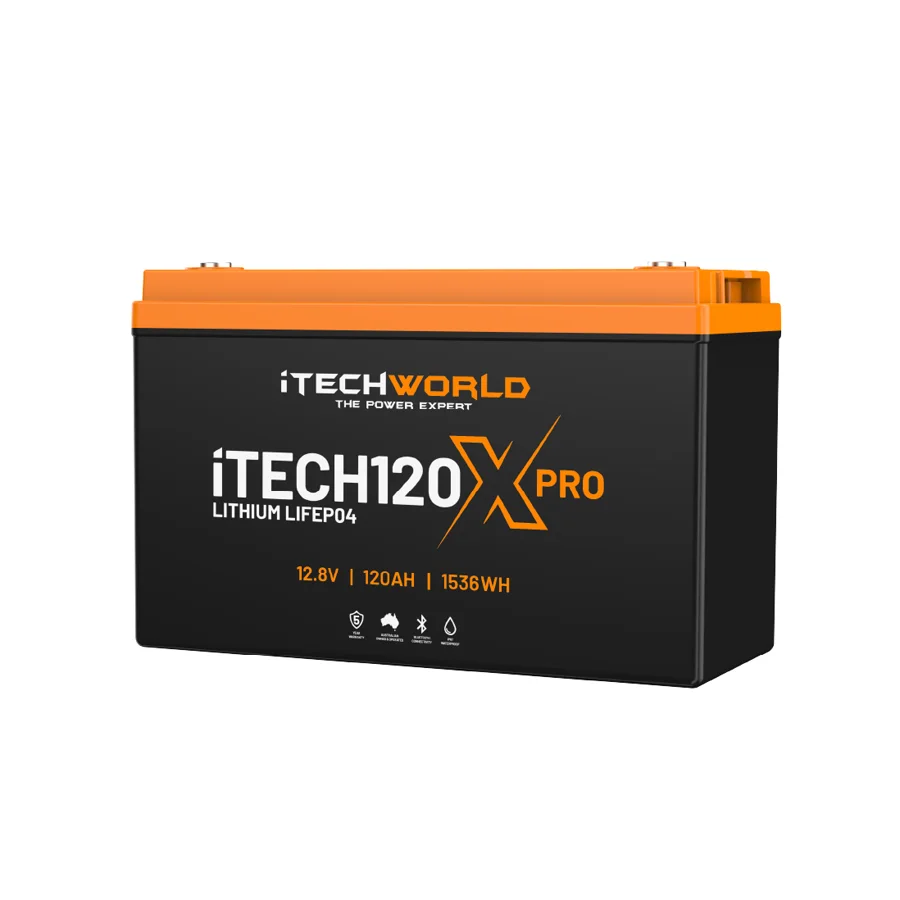
The iTECH120X PRO suits fridge and accessory loads as well as moderate-to-high inverter demand where the complete system is correctly sized. Its combination of capacity, output and protection makes it more flexible than a basic fridge-duty battery without pushing into premium integrated-system pricing.
Extended product analysis
The current specification set lists 12.8V nominal voltage, 120Ah capacity, a 100A maximum charge current, 150A continuous discharge and a short peak around 430A for five seconds. The case uses M8 terminals, measures about 330 × 173 × 215mm and is currently published at approximately 13.2kg.
Bluetooth monitoring provides convenient access to voltage, current, capacity and temperature. IP67 protection is useful for exposed touring environments, but it does not remove the need for secure mounting, terminal protection or compliant cabling.
iTechworld claims more than 5,000 cycles at 80% depth of discharge under its stated conditions. Treat that as a manufacturer claim rather than an independently verified service-life guarantee. Its five-year warranty has full-replacement and pro-rata conditions that buyers should read.
Key details
| Voltage / capacity | 12.8V nominal · 120Ah |
|---|---|
| Charge / discharge | 100A maximum charge · 150A continuous discharge |
| Peak discharge | Approximately 430A for 5 seconds |
| Protection / monitoring | IP67 · Bluetooth |
| Dimensions / weight | About 330 × 173 × 215mm · 13.2kg |
| Warranty | 5 years, subject to current terms |
Evidence treatment
Pros
- Useful 120Ah capacity
- Strong 150A continuous discharge
- IP67 case protection
- Bluetooth monitoring
- Substantial exact-model ownership history
- Established Australian support presence
Cons
- No verified integrated self-heating
- AGM replacement still depends on the full system
- Under-bonnet use has exact installation conditions
- Manufacturer-hosted reviews are not independent
KickAss KA12120XBC-LION 120Ah
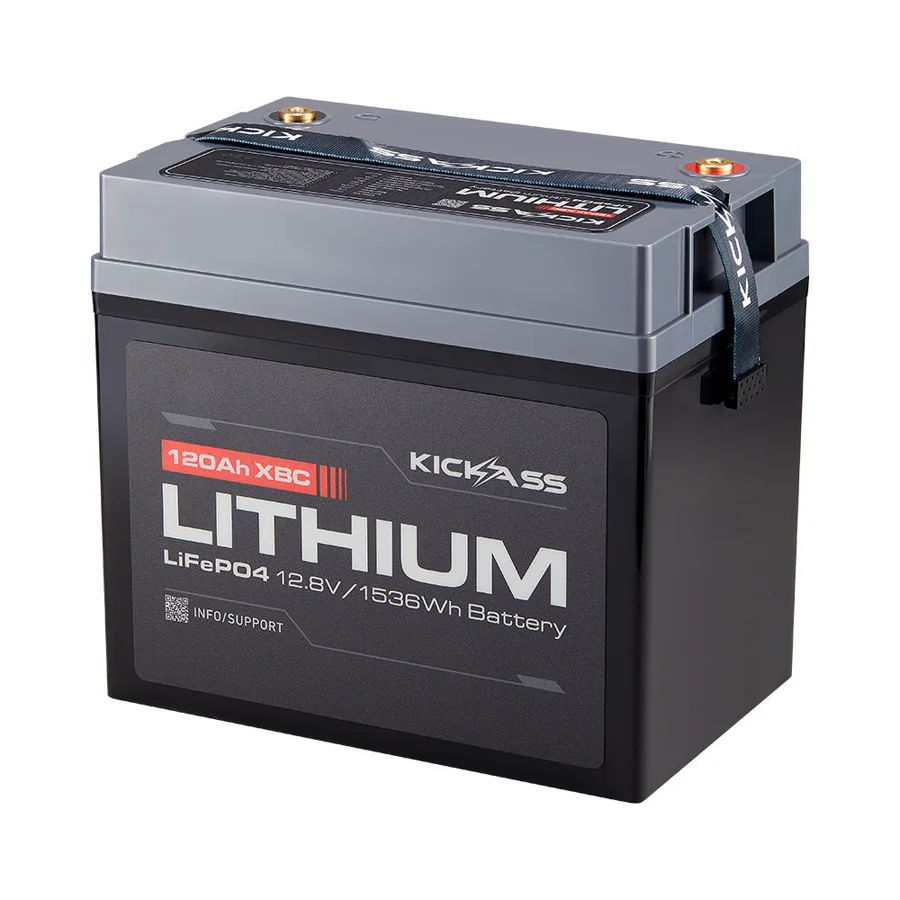
The compact case is smaller than a traditional N70 battery while retaining a claimed 120Ah of usable capacity. It is a practical fit for cost-conscious fridge, lighting, pump and accessory systems, plus moderate inverter loads that remain within the battery and installation limits.
Extended product analysis
KickAss specifies 120A continuous charging and 120A continuous discharge, A-grade prismatic LiFePO4 cells, a protective BMS and IP65 weather resistance. The five-year limited warranty is currently structured as three years full plus two years pro rata.
The exact KA12120XBC-LION should not inherit reviews, reliability claims or complaints from older KickAss 120Ah batteries. Current exact-model feedback is extremely small and recent. That evidence limitation, rather than a demonstrated failure, holds its score below the more established iTechworld.
Bluetooth is not claimed here because current exact-model material does not establish it. Buyers who require app monitoring should use a compatible external shunt or choose a battery with verified integrated monitoring.
Key details
| Exact model | KA12120XBC-LION |
|---|---|
| Capacity | 120Ah claimed usable capacity |
| Charge / discharge | 120A continuous charge · 120A continuous discharge |
| Protection | IP65 · protective BMS |
| Monitoring | No verified integrated Bluetooth claim for this exact model |
| Warranty | 5-year limited: 3 years full + 2 years pro rata |
Evidence treatment
Pros
- Excellent capacity per dollar
- 120Ah usable-capacity claim
- 120A charge and discharge capability
- Compact case format
- Five-year limited warranty
- Current Australian availability
Cons
- Exact model is very new
- Long-term durability is not established
- Very limited exact-model review depth
- No verified integrated Bluetooth claim
- IP65 rather than IP67
Dometic / Enerdrive B-TEC ULTRA 100Ah G3 · EPL-100BT-12V-G3
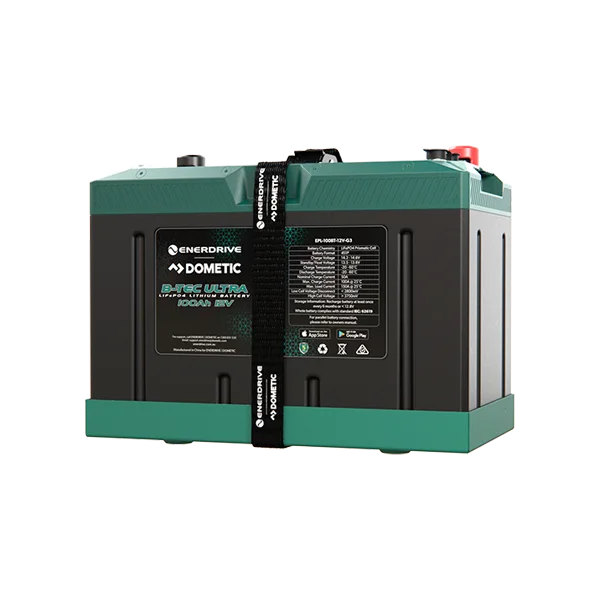
The G3 substantially improves the former G2 proposition. It combines a 150A continuous discharge rating and an approximately 500A three-second peak with IP67 protection, IEC 62619 certification, a built-in cell heater, physical isolation and reset controls, and an integrated state-of-charge display.
Extended product analysis
The 100Ah model supports a 100A maximum charge current and includes Bluetooth monitoring plus CAN/RS485 communications for more integrated builds. A tray and strap are supplied. Current manufacturer specifications list about 12kg and approximately 309 × 213 × 170mm; installers should verify fit against the latest drawing.
The integrated heater allows the BMS to warm cells before low-temperature charging. It is useful for cold-region touring, but it is not a reason to ignore the battery's installation and charging limits.
Dometic/Enerdrive claims more than 6,000 cycles at 80% depth of discharge under its stated conditions. This is a manufacturer claim and cannot be directly compared with another brand's headline cycle number without matching temperature, charge/discharge rates and end-of-life thresholds.
Key details
| Exact SKU | EPL-100BT-12V-G3 |
|---|---|
| Capacity | 100Ah |
| Charge / discharge | 100A maximum charge · 150A continuous discharge |
| Peak discharge | Approximately 500A for 3 seconds |
| Protection / safety | IP67 · IEC 62619 · integrated heater |
| Monitoring / control | Bluetooth · CAN / RS485 · SOC display · isolation and reset controls |
| Dimensions / weight | About 309 × 213 × 170mm · 12kg |
| Warranty | 5 years |
Evidence treatment
Pros
- Integrated low-temperature heater
- IP67 and IEC 62619
- Bluetooth plus CAN/RS485
- 150A continuous and strong short surge
- Useful integrated controls and SOC display
- Strong Australian RV/12V ecosystem
Cons
- 100Ah rather than 120Ah
- Premium pricing
- Exact-model owner evidence remains limited
- Advanced features may be unnecessary for simple systems
What matters when choosing a camping battery
Buying advice
Capacity and usable energy
Amp-hours describe charge capacity, but runtime also depends on system voltage, conversion losses, temperature and every connected load. Compare realistic daily energy use rather than Ah alone.
BMS current limits
The BMS must support the sustained and surge current of the complete load. A 120Ah battery is not automatically suitable for a large inverter.
Charging compatibility
Check alternator behaviour, DC-DC charging, MPPT or solar-controller settings and mains-charger profiles. Correct voltage class alone does not establish compatibility.
Temperature and installation
Low-temperature charge protection, case protection, secure restraint, cable sizing, fusing and terminal covers all matter in a moving recreational system.
Large inverters demand high battery current
A nominal 2000W inverter can draw well over 150A from a 12V battery under heavy load once real system voltage and conversion losses are considered. Verify the battery's continuous and surge ratings, inverter specifications, cable size, fuse size and installation design. Do not infer inverter suitability from battery capacity alone.
Which battery should you buy?
Choose the iTechworld iTECH120X PRO for the best general balance of capacity, output, protection, monitoring and exact-model maturity. Choose the KickAss KA12120XBC-LION when 120Ah value matters most and you accept that long-term evidence is still developing. Choose the B-TEC ULTRA 100Ah G3 for a premium integrated touring or caravan system where heating, communications and technical support matter more than lowest price or maximum Ah.
These are auxiliary and deep-cycle energy-storage batteries, not emergency engine-starting packs. For that separate job, see our best jump starters in Australia.
Frequently asked questions
Is a 100Ah or 120Ah lithium battery enough for camping?
Often, but adequacy depends on daily energy use, fridge duty cycle, ambient temperature, other loads and recharge opportunities. Build an energy budget instead of choosing on capacity alone.
Can I replace an AGM battery with lithium?
Sometimes, but not automatically. Verify the alternator setup, DC-DC charger, solar and mains chargers, wiring, fusing, load current, temperature and the exact battery manufacturer's requirements.
Do I need a DC-DC charger for a lithium battery?
Many vehicle-based auxiliary systems need a lithium-compatible DC-DC charger, especially with smart alternators. The correct answer depends on the vehicle, alternator, wiring and battery requirements.
Can solar panels charge a LiFePO4 battery?
Yes, through a compatible solar controller or MPPT configured for the battery. Check panel voltage/current, controller limits and the battery manufacturer's charging profile.
Can I run an inverter from a 12V lithium battery?
Yes when battery continuous and surge current, inverter demand, cable size and fusing are correctly matched. Large inverters can draw very high current from a 12V system.
Can a lithium battery go under the bonnet?
Only when the exact battery manufacturer explicitly permits it and every stated location, temperature and heat-management requirement is met. Do not generalise one product's permission to all LiFePO4 batteries.
What BMS discharge rating do I need?
It must exceed the realistic continuous load and support short startup surges without exceeding the battery's specified limits. Include inverter losses and simultaneous loads.
Can 12V lithium batteries be connected in series or parallel?
Only as the exact manufacturer allows. Check maximum battery count, matching-age and state-of-charge requirements, wiring, balancing and charging-system compatibility.
What happens when charging LiFePO4 below freezing?
Charging cold cells can cause damage. Use a battery with suitable low-temperature protection or heating and follow its stated charge-temperature limits.
How long will a 120Ah battery run a camping fridge?
There is no reliable single runtime. Fridge size, insulation, thermostat duty cycle, ambient temperature, voltage, door openings and other system loads materially change consumption.