How we chose
We assessed current Australian exact models, local availability, street pricing, kit-versus-skin status, blade length, cutting capacity, motor type, blade speed, configured weight, handle ergonomics, battery platforms, owner evidence, CHOICE testing, warranty, serviceability, runtime claims and overall value. Worth Buying Australia did not physically laboratory-test these hedge trimmers.
Serious contenders reassessed
Ryobi R36XHTR14: an excellent higher-capacity 65cm brushless kit, but the AEG's deeper evidence and lower price produced the cleaner overall case. Makita DUH606Z: is a strong lightweight option for existing LXT owners, though it is tool-only, has a smaller exact-model pool and a 20mm cutting capacity.
Husqvarna 215iHD45: is refined but combines a short 45cm blade with a $539 kit price. DeWalt 54V 660mm: looks exceptionally capable on paper, yet current Australian exact-kit owner evidence was absent. Ozito and Stihl remain credible for budget or dealer-led buyers, but did not displace the three locked recommendations.
AEG 18V FUSION 550mm Hedge Trimmer 4Ah FORCE Kit A18FHTR14
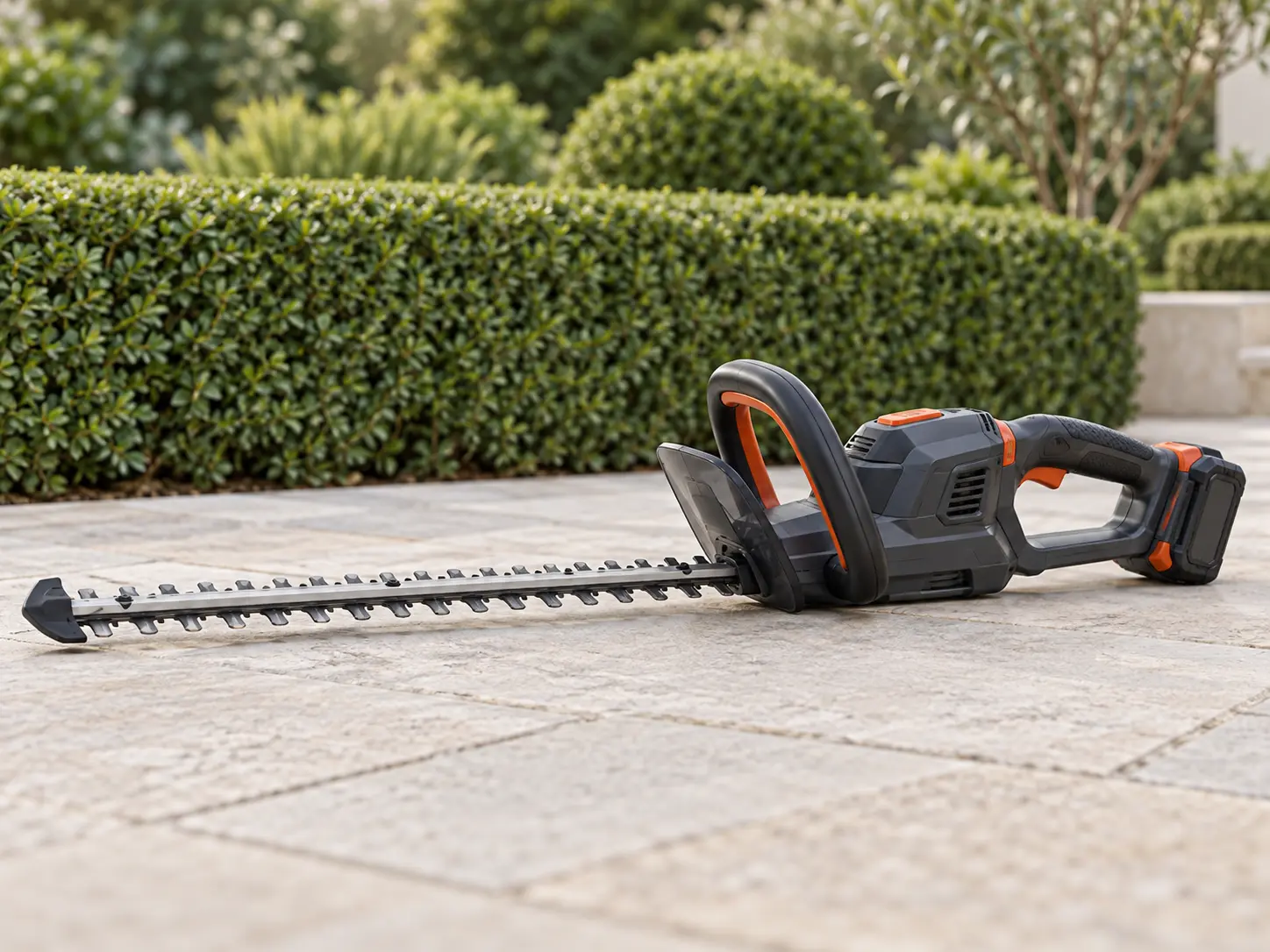
Illustrative editorial image, not an exact product photograph.
The A18FHTR14 kit combines the AHT1852B FUSION brushless trimmer with a 4Ah FORCE battery and 4A charger. Its 550mm dual-action blade, 26mm cutting capacity and 2,700spm specification sit in a useful middle ground: capable enough for mature residential growth without the handling penalty of a 650mm-plus blade.
A three-position rotating rear handle is the important ergonomic advantage. It reduces wrist rotation when working on hedge sides and vertical faces, while the magnesium gearbox casing, blade-tip guard and service access support long-term ownership. The bare tool weighs 3.0kg; CHOICE's configured test weight was about 3.8kg, which is more meaningful when comparing fatigue.
The kit is not cheap, and the 4Ah battery still adds weight to a tool held away from the body. Buyers with tiny hedges do not need this much machine, and people requiring pole reach or repeated cutting of very thick woody growth need a different tool class. The six-year tool warranty also depends on eligible registration; it is not an automatic unregistered term.
Key details
| Exact kit / tool | A18FHTR14 / AHT1852B |
|---|---|
| Blade / capacity | 550mm / 26mm |
| Motor / speed | FUSION brushless / 2,700spm |
| Battery / charger | 18V 4Ah FORCE / 4A charger |
| Warranty | Eligible for 6-year tool and 3-year battery coverage with registration |
What owners say
Pros
- Strong 26mm cutting capacity
- Brushless FUSION motor
- Three-position rotating rear handle
- Mature Australian owner evidence
- Complete 4Ah kit at $429
Cons
- Costs more than basic trimmers
- Shorter blade than Ryobi and EGO
- Battery weight still affects fatigue
- Warranty extension requires registration
- No pole reach
Ryobi 36V 60cm Hedge Trimmer 2Ah Kit R36HTR12
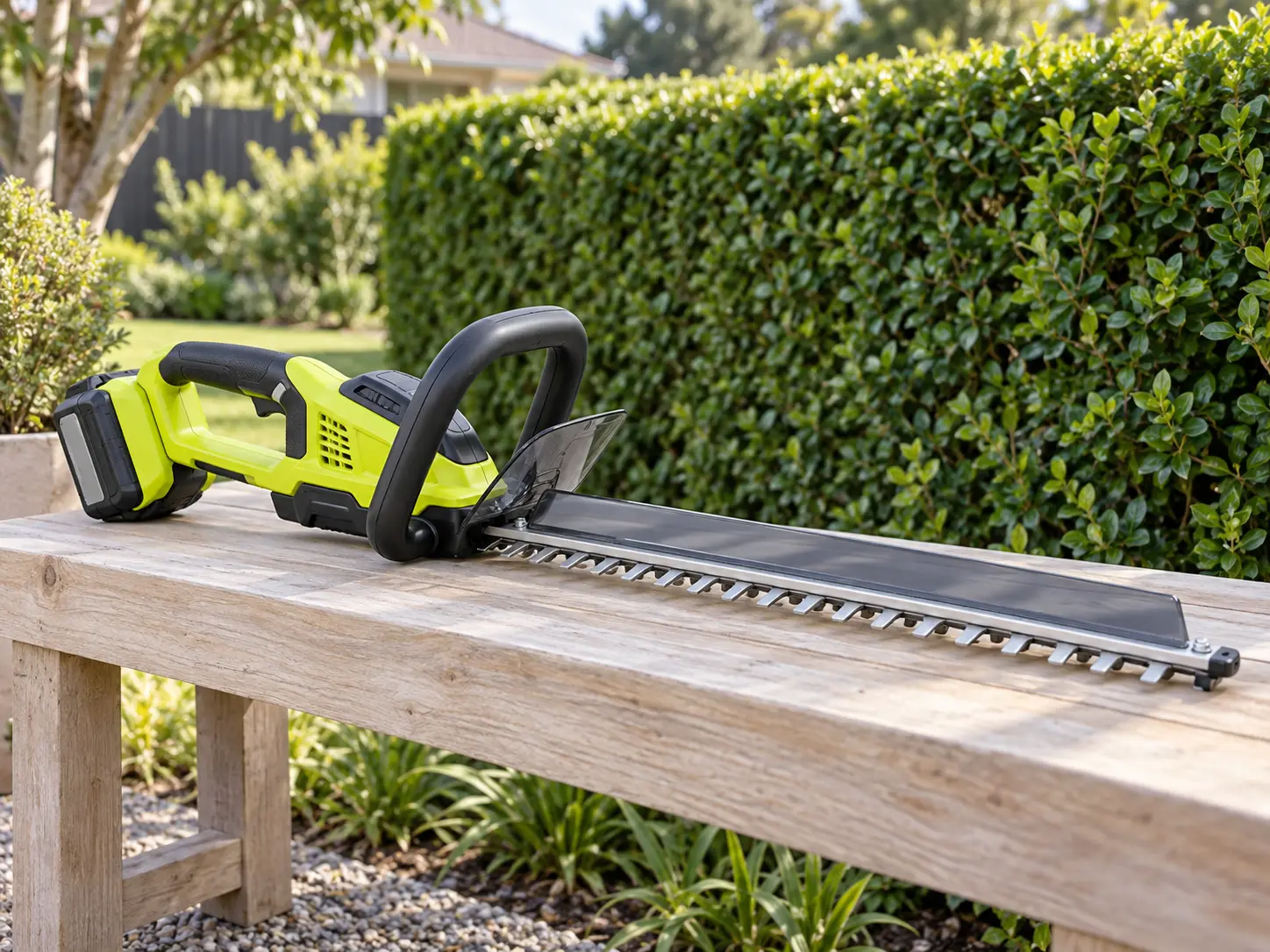
Illustrative editorial image, not an exact product photograph.
The R36HTR12 kit packages the R36HTR10 trimmer with a 36V 2Ah battery and charger. Its 600mm diamond-ground blade reaches farther along straight hedge faces than the AEG's 550mm blade, while the roughly 25mm cutting capacity is sufficient for maintained domestic growth. The Hedge Sweep attachment helps move clippings away from the top surface, and saw teeth near the blade tip are intended for occasional larger stray stems.
The compromise is refinement. This is not a brushless machine, its exact-kit evidence is much younger than the AEG's, and it lacks an equivalent rotating rear handle. The 600mm blade can also feel less nimble when shaping small ornamental shrubs. The included 2Ah battery keeps the package cost down but stores less energy than larger Ryobi 36V packs.
Ryobi's up-to-46-minute runtime statement is a manufacturer claim under stated conditions, not guaranteed continuous heavy cutting. Dense or woody hedges, battery age and repeated work near maximum capacity will change the result. The saw-tip section does not turn the trimmer into a pruning saw or brushcutter.
Key details
| Exact kit / tool | R36HTR12 / R36HTR10 |
|---|---|
| Blade / capacity | 600mm / about 25–25.4mm |
| Motor | Brushed |
| Battery / charger | 36V 2Ah / charger included |
| Research-date price | About $369 complete kit |
What owners say
Pros
- Competitive complete-kit price
- Long 600mm diamond-ground blade
- Useful roughly 25mm cutting capacity
- Hedge Sweep and saw-tip section
- Broad Ryobi 36V garden ecosystem
Cons
- Brushed motor
- Small exact-kit review pool
- Only a 2Ah battery included
- No premium rotating rear handle
- Longer blade is less nimble for shaping
EGO Power+ 56V 66cm Brushless Hedge Trimmer Kit HT2601E
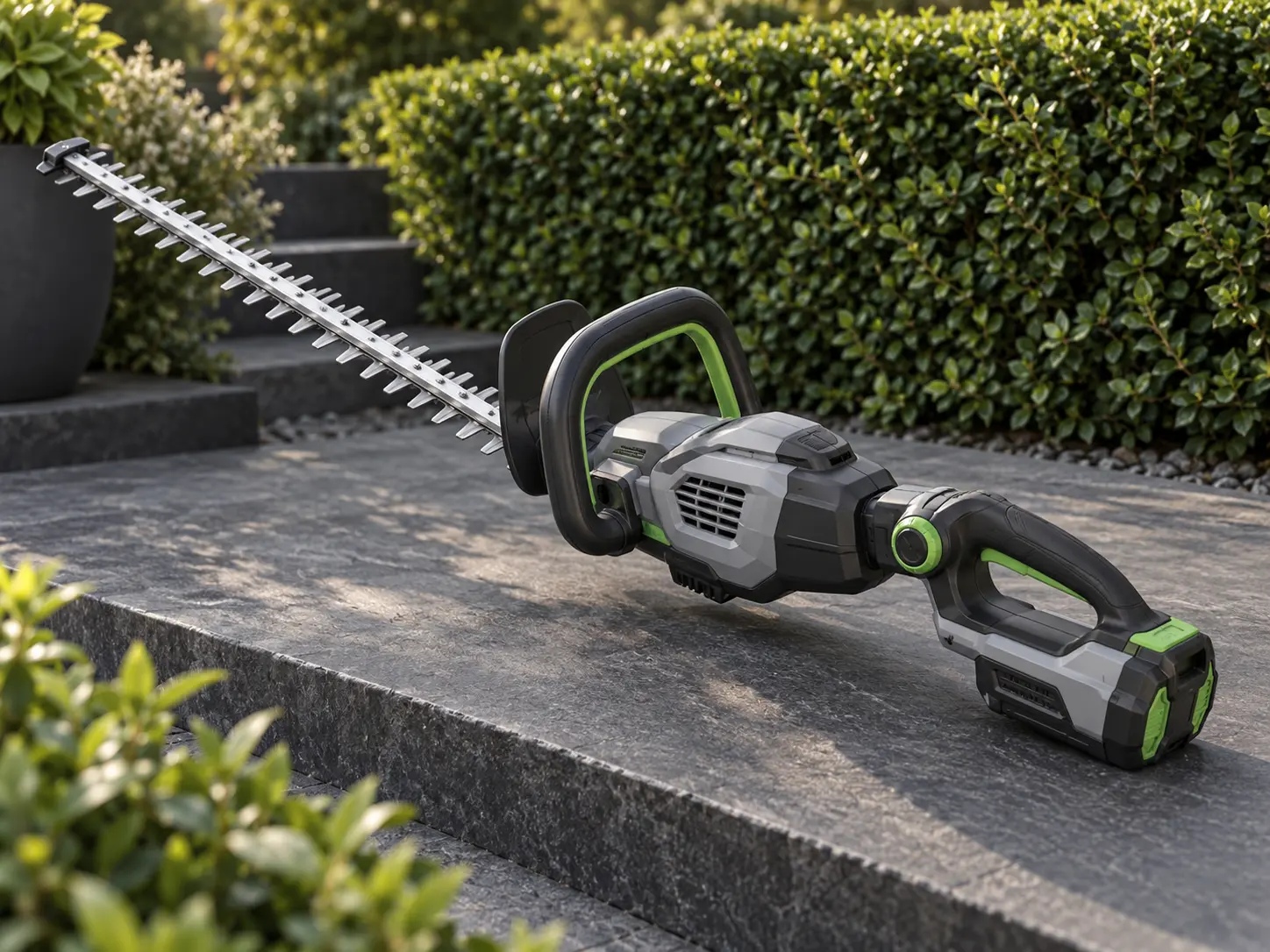
Illustrative editorial image, not an exact product photograph.
The HT2601E kit combines the HT2600E brushless trimmer with a 56V 2.5Ah battery and standard charger. The 660mm dual-action steel blade, 30mm maximum capacity and up-to-3,400spm speed create a meaningful capability step over the other finalists rather than a feature-only upgrade.
A five-position, 180-degree rotating rear handle helps when switching between hedge tops and vertical faces. EGO also specifies an electric brake, IPX4 weather resistance and a fully serviceable gearbox. For long straight hedges, the extra blade reach saves passes; for tight shaping, it can be cumbersome. CHOICE's configured test weight was about 4.6kg, so buyers should not ignore fatigue.
The exact-model Australian owner pool remains thin, replacement 56V batteries are expensive and $550-plus is unnecessary for regularly maintained small hedges. EGO's up-to-60-minute runtime is a manufacturer claim under its conditions, not guaranteed maximum-load cutting. A 30mm tooth gap also does not mean every hard, old branch of that diameter belongs in the blade; loppers or a pruning saw may be safer and more effective.
Key details
| Exact kit / tool | HT2601E / HT2600E |
|---|---|
| Blade / capacity | 660mm / 30mm |
| Motor / speed | Brushless / up to 3,400spm |
| Battery / charger | 56V 2.5Ah / standard charger |
| Warranty | 5-year domestic tool / 3-year battery and charger |
What owners say
Pros
- Long 660mm blade
- Strong 30mm cutting capacity
- Brushless motor and up to 3,400spm
- Five-position rotating handle
- Five-year domestic tool warranty
Cons
- Costs about $559
- Heavier configured weight
- Limited Australian exact-model evidence
- Expensive 56V batteries
- Overkill for small soft-growth hedges
What matters when buying a cordless hedge trimmer
Blade length
Around 40–50cm suits small hedges and detailed shaping. A 55–60cm blade is a strong general-purpose range. Blades of 65cm or more cover long straight hedges faster and add reach, but are less agile in tight spaces. Longer is not automatically better.
Cutting capacity
Maximum tooth gap is not a promise that every old hardwood branch at that diameter should be repeatedly cut. Thick woody growth may be better handled with loppers or a pruning saw. A hedge trimmer is not a branch saw.
Blade speed
Higher strokes per minute can improve speed and finish, but blade geometry, tooth spacing, motor torque and plant material also matter. SPM alone is not a performance ranking.
Rotating rear handles
Handle adjustment is particularly useful on hedge sides, vertical faces and awkward angles because it reduces wrist rotation. Both AEG and EGO provide meaningful rear-handle adjustment.
Configured weight
Hedge trimmers are held out from the body and often above waist or shoulder height. Battery mass, blade length and balance can therefore matter more than on many garden tools. Compare ready-to-use weight, not only the bare tool.
Pole versus handheld
If the hedge top cannot be reached safely from the ground, a pole hedge trimmer is the relevant product class. Do not climb an unstable ladder or overreach with a handheld trimmer simply to gain height.
Battery ecosystem
Existing batteries can change the real purchase cost and make a tool-only model attractive. That should not justify an unsuitable blade length, weight or cutting capacity. Platform fit comes after task fit.
Blade maintenance
Clean, lubricate and inspect blades according to the manufacturer instructions, and arrange sharpening when required. Correct lubrication reduces friction and heat; never improvise maintenance while a battery is installed.
Which one should you buy?
Choose the AEG A18FHTR14 for the best all-round balance of cutting capability, ergonomics, configured weight and mature Australian evidence.
Choose the Ryobi R36HTR12 when value, a 600mm blade and a complete 36V kit matter more than brushless refinement.
Choose the EGO HT2601E when large, mature hedges genuinely justify the longest blade and strongest cutting capacity.
Frequently asked questions
What size hedge trimmer blade should I buy?
Small hedges and detailed shaping favour shorter 40–50cm blades. Around 55–60cm is a versatile suburban range. A 65cm-plus blade is faster on long straight hedges but heavier and less nimble around tight ornamental plants.
How thick a branch can a cordless hedge trimmer cut?
Use the exact manufacturer's maximum cutting-capacity figure as a limit, not a routine target. Plant hardness, age and blade condition matter. Old woody branches near the limit are often better cut with loppers or a pruning saw.
Is 18V enough for a hedge trimmer?
Yes, a well-designed brushless 18V trimmer can be highly capable for residential hedges. Voltage is only one factor; motor design, blade, battery, cutting capacity, weight and ergonomics all affect the result.
Is a rotating handle worth having?
It is useful if you regularly trim vertical hedge faces or work at awkward angles. Rotating the rear grip can keep the wrist in a more neutral position, though it does not remove fatigue from a heavy machine.
Should I buy a pole hedge trimmer instead?
Choose a pole model when the top of the hedge cannot be safely reached from the ground. A handheld trimmer is generally easier to control for accessible sides, tops and detailed shaping, while a pole model trades precision and balance for reach.