How we chose
We assessed current Australian exact models using legitimate local availability and pricing, front and rear recording quality, low-light and HDR capability, frame rate, heat-appropriate supercapacitor architecture, GPS, storage, app and transfer speed, parking-mode power requirements, owner evidence, professional testing, warranty, Australian support and whole-system value. Worth Buying Australia did not physically test these dash cams.
VIOFO A329S 2CH
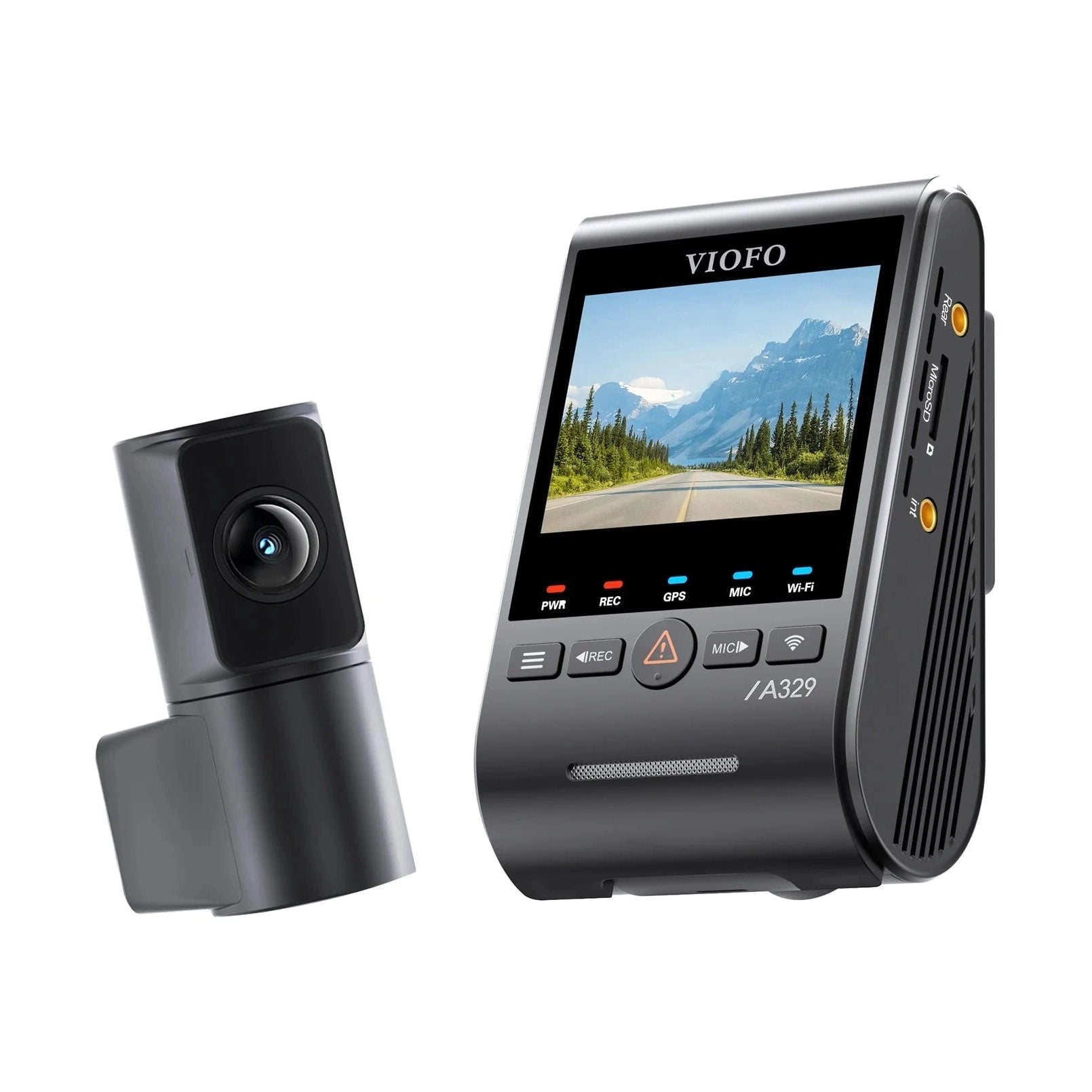
Exact-model product image.
The front camera records up to 4K at 60fps while the rear records at 2K, supported by Sony STARVIS 2 sensors, HDR, GPS and Wi-Fi 6. That combination is particularly useful for downloading large incident clips and for capturing smoother front footage at road speed.
External SSD support is unusually flexible for drivers who need far more retained footage than a conventional microSD card provides. It also adds another cable, device and failure point, so ordinary users may be better served by a suitable high-endurance microSD card.
What owners say
Australian exact-model public owner evidence remains too small for a responsible star aggregate. Current model discussion is positive about recording detail and transfer performance, but it is not presented as a mature Australian owner pool.
Professional evidence
Tom’s Guide tested the A329S family and praised its video quality, day/night performance, Wi-Fi 6, parking features and customisation while identifying price as a major drawback. Dash Cam Guys also publishes hands-on testing, but that is retailer evidence rather than an independent laboratory review.
Pros
- 4K 60fps front recording
- 2K rear camera
- STARVIS 2 and HDR
- Fast Wi-Fi 6 transfers
- GPS and flexible storage
- Hybrid parking capability
Cons
- Shorter warranty than BlackVue
- Limited Australian exact-model owner pool
- Hardwiring or constant power needed for full parking use
- SSD support adds cabling and complexity
- 4K60 creates large files
- No native BlackVue-style cloud ecosystem
VIOFO A229 Plus 2CH
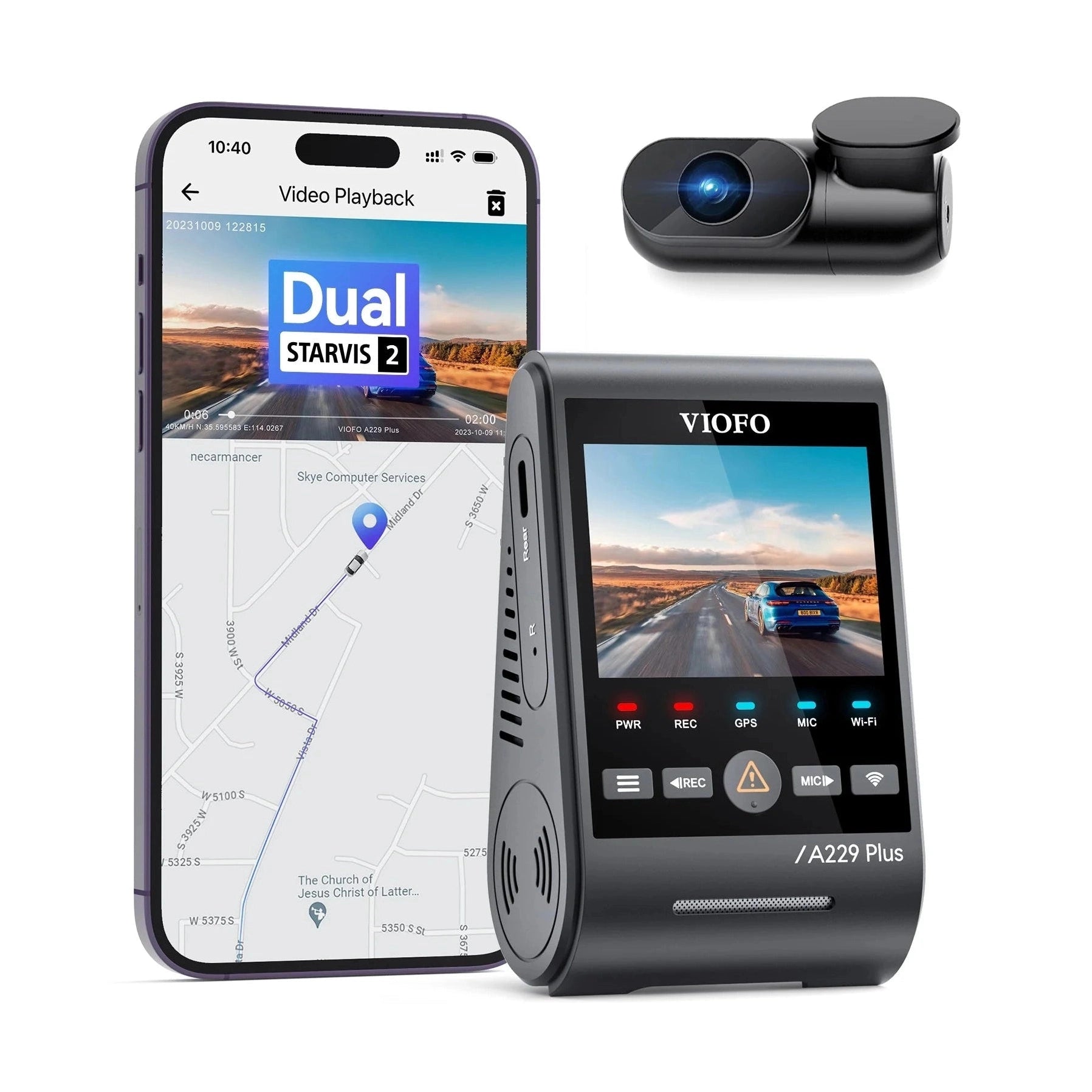
Exact-model product image.
The A229 Plus gives up the A329S model’s 4K60 front recording, Wi-Fi 6 and SSD support, but retains the features most buyers need: 2K front and rear footage, HDR, GPS, 5GHz Wi-Fi and voice control.
Parking recording is not automatic simply because the menu contains parking modes. It needs the correct optional hardwire kit or another suitable continuous-power arrangement with battery protection. Installation cost belongs in the real purchase budget.
What owners say
Australian public exact-model owner evidence is limited, so no star rating or combined review count is displayed. Broader A229-family reputation is useful context, not a substitute for an exact-model Australian pool.
Evidence context
The value case rests on current Australian availability, exact specifications and an established VIOFO product-family reputation. It does not rely on transferring ratings from the A229 Pro, A229 Duo or overseas variants.
Pros
- 2K front and 2K rear recording
- Dual STARVIS 2 sensors
- HDR, GPS and 5GHz Wi-Fi
- Voice control
- Strong price-to-hardware balance
- Optional CPL and parking setup
Cons
- Not 4K
- No premium cloud ecosystem
- Limited Australian exact-model owner evidence
- Hardwire kit required for proper parking use
- Ordinary 18-month warranty
- App is functional rather than premium
BlackVue ELITE 10-2CH

Exact-model product image.
Both cameras record at 4K 30fps using Sony STARVIS 2 sensors. HDR applies to the front camera only. Built-in GPS, dual-band Wi-Fi, H.265/H.264 recording, a supercapacitor and microSD support up to 1TB form a serious local-recording system.
BlackVue Cloud enables remote viewing, notifications and event uploads only when the camera has internet access. Optional LTE hardware, data service, installation and branded accessories can materially increase the real ownership cost.
What owners say
The sole verified exact-model ProductReview owner rated it 5/5 and praised image quality, app retrieval and straightforward installation. One review is far too small to establish reliability or a mature customer consensus.
Broader evidence context
The ELITE 10 benefits from established BlackVue platform, dealer and Australian support history. Ratings from the older DR970X family are not transferred to this model. Mixed reports about power-up, SD-card, app and warranty visits on older generations justify cautious evidence confidence without proving the same faults affect ELITE 10.
Pros
- 4K front and rear recording
- STARVIS 2 sensors
- BlackVue Cloud capability
- Advanced parking modes
- Up to 1TB microSD support
- Three-year Australian warranty
Cons
- About $1,100 is very expensive
- Only one verified exact-model owner review
- Cloud and LTE add complexity and possible data costs
- Rear HDR is not equivalent to front HDR
- Accessories and storage can be costly
- VIOFO offers stronger image-per-dollar value
Dash cam buying guide
Front and rear coverage matters more than a headline resolution
A front-only camera cannot record a rear impact or following vehicle. Dual-channel kits provide broader evidence, but rear-window tint, demister lines, angle and night glare can reduce rear detail.
4K does not guarantee a readable number plate
Resolution helps, but speed, shutter behaviour, light, headlight glare, reflections, compression and the angle between vehicles all affect the frame. A dash cam records evidence; it cannot guarantee every plate will be readable.
HDR and higher frame rates solve different problems
HDR can balance bright plates, headlights and shadows. A higher frame rate can reduce movement between frames. Neither automatically wins in every lighting condition, and maximum-resolution modes may limit HDR or other features.
Parking mode needs the right power setup
Proper parking surveillance normally requires an approved hardwire kit, a dedicated dash-cam battery or another suitable constant-power method with low-voltage protection. Do not bypass vehicle protection or assume the standard accessory socket remains powered.
Use endurance-rated storage
Dash cams constantly overwrite video in a hot environment. Use the model’s supported capacity and a compatible high-endurance microSD card, check it periodically and keep a spare card available when important footage must be preserved.
Australian heat and installation quality matter
Supercapacitor models are preferable to ordinary lithium-battery designs for hot parked vehicles. Route cables away from airbags, avoid obstructing the driver’s view and use a competent installer when trim, electrical systems or hardwiring are unfamiliar.
Cloud features are not free remote access by default
Remote live view, alerts and uploads require a compatible camera plus an internet connection. LTE modules, SIM data, cloud tiers and battery systems can make a premium setup substantially more expensive than the camera price.
Use footage and audio lawfully
Mount the camera so it does not obstruct the driver, secure all cables, and check the laws that apply where you drive and record. Audio, cloud access, footage sharing and workplace or rideshare recording can involve privacy obligations. A dash cam does not replace safe driving.
Which one should you buy?
Choose the VIOFO A329S 2CH for the strongest balance of recording performance, transfer speed, parking capability and storage flexibility.
Choose the VIOFO A229 Plus 2CH when value matters and dual 2K recording covers your real needs.
Choose the BlackVue ELITE 10-2CH when local support, cloud-capable parking surveillance, dual 4K coverage and a longer warranty justify the premium.
Frequently asked questions
Is 4K worth it for a dash cam?
It can improve retained detail, especially when cropping a frame, but it also creates larger files and cannot overcome every low-light, motion or angle limitation. A well-tuned 2K system can still be a strong practical choice.
Do I need a front and rear dash cam?
Not everyone does, but rear coverage records incidents and vehicles a front camera misses. It is especially useful for rear impacts, parking disputes and drivers who spend significant time in traffic.
Will parking mode flatten my car battery?
A correctly configured compatible hardwire kit uses low-voltage protection, but every parked recording system consumes energy. A dedicated dash-cam battery may be appropriate for long parking periods or sensitive vehicles.
How much dash cam storage do I need?
That depends on channel count, resolution, bitrate and how many hours you want before loop recording overwrites older clips. Use a compatible endurance-rated card and follow the manufacturer’s capacity guidance.
Should I have a dash cam professionally installed?
Accessory-socket installation is usually straightforward, but neat rear-camera routing and hardwired parking mode can involve airbags, trim and vehicle electronics. Professional installation is sensible when you are not confident with those systems.