How we chose
We assessed current Australian exact models using CHOICE lab-test presence, reheating and defrost capability, owner evidence, reliability and satisfaction research, availability, price, cavity usability, controls, cleaning, footprint and support. We checked conflicts between large retailer pools and independent owner reports rather than treating every star rating as equal. Worth Buying Australia did not physically test these microwaves.
Serious contenders reassessed
Sharp remains a leading microwave brand, but the current exact-model picture is uneven. CHOICE lists the R395EBS among models to avoid, while independent reports for the SM327FH family and R34DMBK raise corrosion, error, noise, control and lifespan concerns. The R32BST remains credible but does not displace the finalists.
LG MS4296 family has strong Smart Inverter specifications and very large retailer evidence, but materially poorer independent evidence includes rust, early failure and control/display concerns. Samsung MS32DG4504AT/AG has a large positive retailer pool, yet its current professional-test result and ease-of-use assessment weaken its case for the value slot.
Hisense HMAS3411DSV offers 34L, 1100W and inverter power, but exact-model owners repeatedly criticise everyday control and door ergonomics. Westinghouse has credible brand context, yet WMB2522SC is a weak product-level result. Breville BMO870 Combi Wave is feature-rich but belongs in a combination-microwave comparison and carries conflicting long-term evidence.
Anko P90J30AP-F1 is an unusually good $99 performer in CHOICE testing and remains a legitimate cheap alternative. We prefer the Breville as the more rounded long-term value recommendation because its exact generation, brand support and flatbed format create a cleaner ownership proposition.
Panasonic 27L Flatbed Inverter Microwave NN-SF57QSQPQ
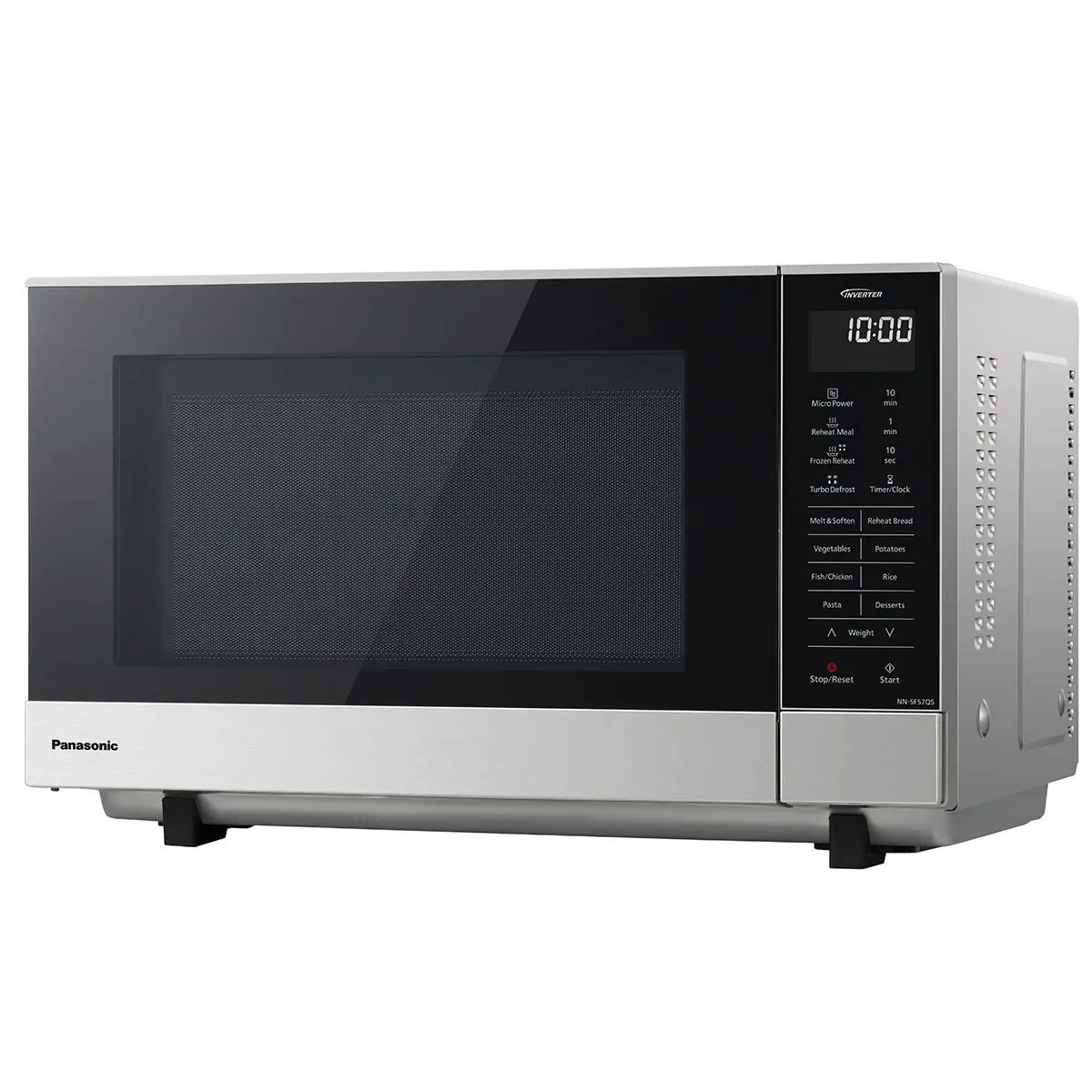
The 27L cavity has no turntable, so rectangular dishes and awkward containers are easier to position and the floor is simpler to wipe clean. Panasonic's inverter varies delivered power rather than relying only on full-power cycling, while six power levels, 17 auto menus, Turbo Defrost, multi-stage cooking and a child lock cover normal household use.
Flatbed does not guarantee more even heating, and this model has no sensor cooking. Its 529mm width still occupies meaningful bench space. Optional trim-kit compatibility also does not make it a generic built-in microwave: the approved trim kit, installation clearances and ventilation instructions still apply.
CHOICE has tested this exact model. Its separate brand research places Panasonic among the leading microwave brands and reports about 95% reliability and 90% satisfaction in its February 2026 work. Those are brand-level figures, not a promise that 95% of NN-SF57QSQPQ units will be fault-free.
What owners say
Positive themes focus on usable space, the turntable-free floor, straightforward cleaning and effective everyday heating. Cautions include the touch controls, price and the fact that flatbed operation can feel unfamiliar at first.
Pros
- Flexible 27L flatbed cavity
- 1000W inverter power
- Strong exact-model retailer evidence
- Exact-model CHOICE test presence
- Excellent current brand reliability
Cons
- Costs more than basic turntable models
- No sensor cooking
- Touch controls are not the simplest
- 529mm width still needs bench space
- Short one-year standard warranty
Breville the Silhouette Compact Flatbed Microwave LMO420BLK
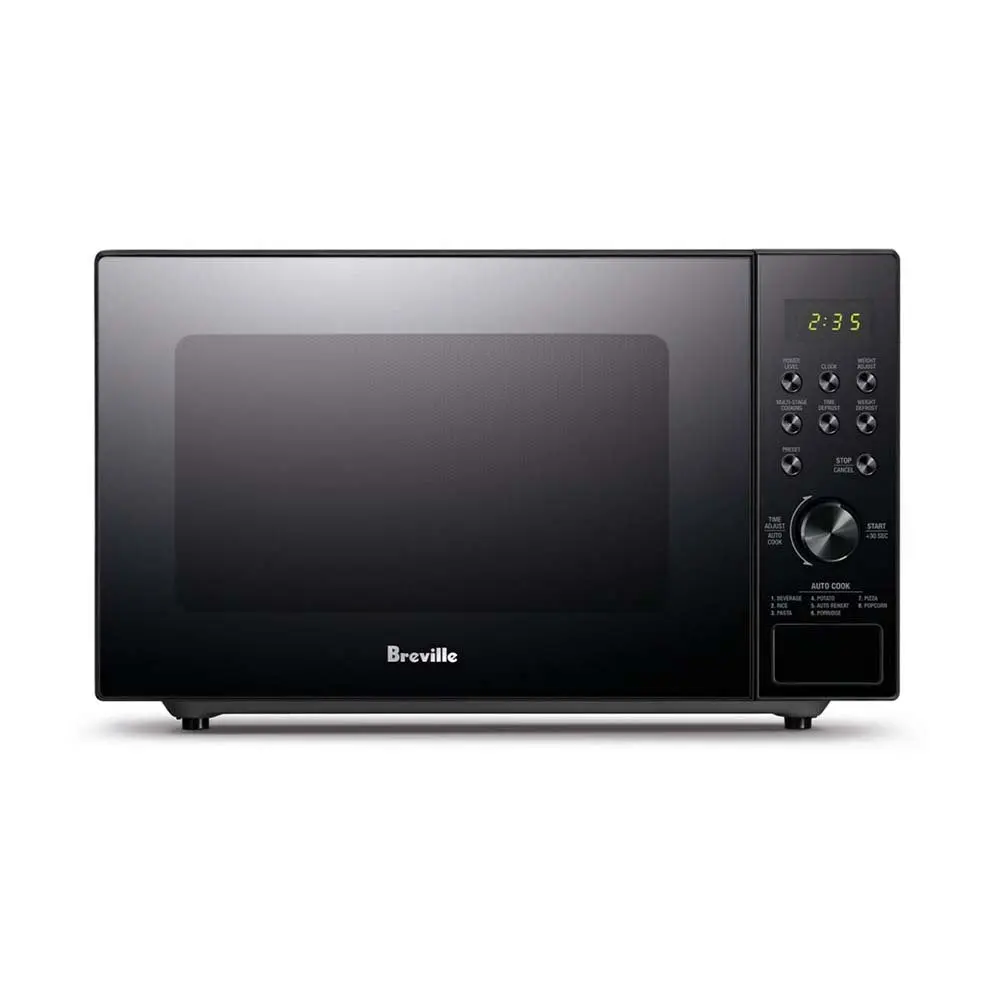
The current Australian SKU is LMO420BLK2JAN1. Its 20L flatbed cavity removes the glass turntable, while a 457 × 362mm footprint is substantially easier to place than the larger finalists. Six power levels, eight auto menus—for beverages, rice, pasta, potatoes, reheating, porridge, pizza and popcorn—and a +30-second instant-start control keep the feature set focused.
Breville says its flatbed layout provides 30% more usable cooking area than its conventional 34L BMO300BSS comparison model. That is a claim about usable floor layout, not proof that 20L is physically equivalent to every 34L microwave. Check the internal space against the plates and dishes you actually use.
The roughly 800W output is lower than the 1000W finalists, so heating can take longer. There is no inverter or sensor cooking, and the public exact-model owner pool remains small. CHOICE exact-model test presence and Breville's Australian product support help, but the evidence limitation is reflected in the 8.9 score.
What owners and professional testing show
Breville's broader microwave-brand reliability and satisfaction sit below Panasonic and Sharp, but still provide credible brand context. Brand survey figures do not replace the missing exact-model owner depth.
Pros
- Compact 457 × 362mm footprint
- Flatbed fits rectangular dishes better
- $189.95 research-date direct price
- Simple +30-second start
- Exact-model CHOICE test presence
Cons
- Only about 800W
- Modest 20L headline capacity
- No inverter or sensor cooking
- Limited owner-review depth
- Still needs generous ventilation clearance
Samsung 40L Microwave with Dial & Button Control MS40DG5504AGSA
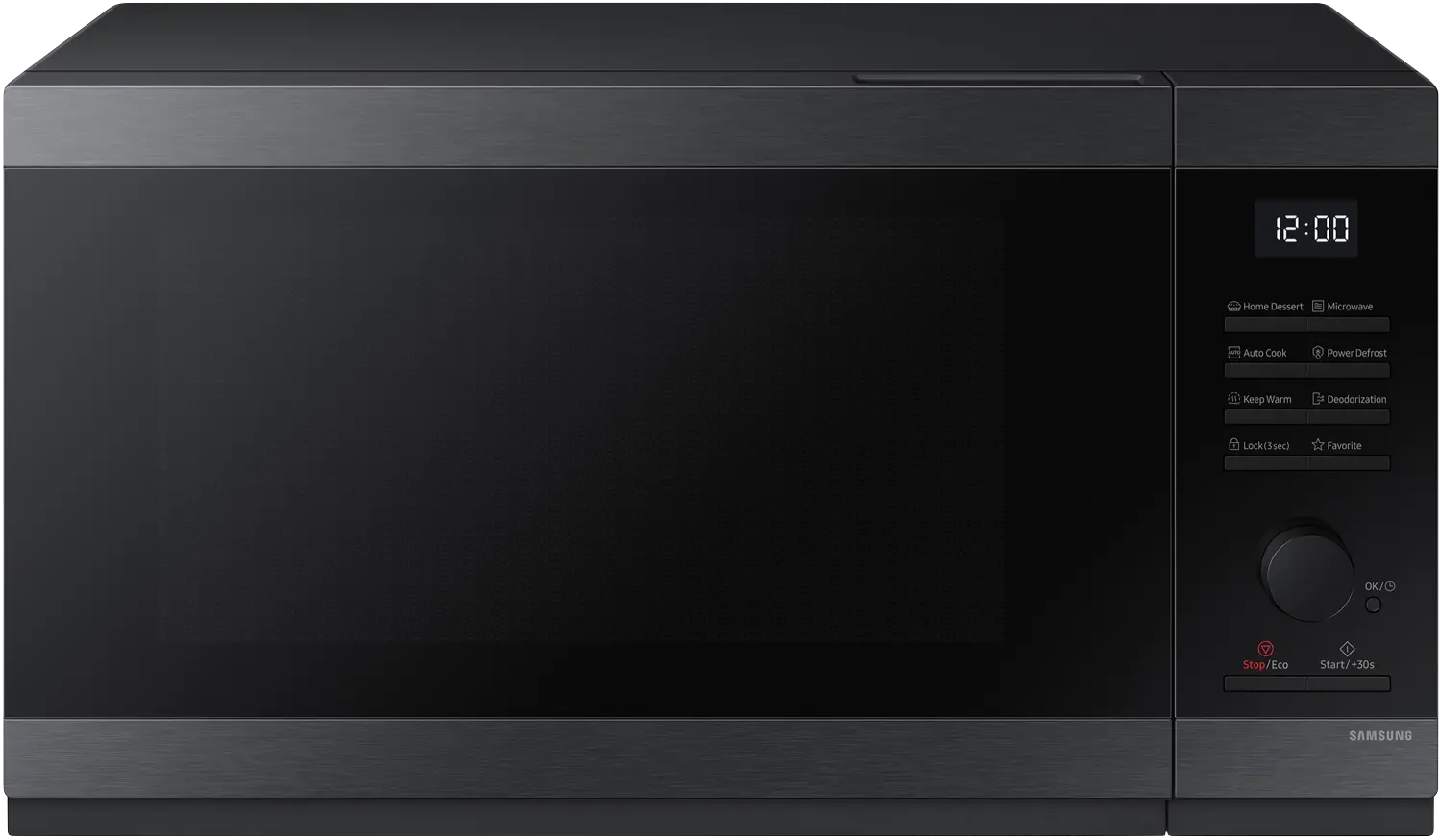
The exact Australian SKU is MS40DG5504AGSA, commonly shortened by retailers to MS40DG5504AG. At 240V it is rated for 1000W microwave output; Samsung specifies 950W at 230V and 1550W power consumption. Seven power levels, Auto Cook, Power Defrost, Keep Warm, sound on/off, child lock and a quick 30-second start cover everyday use. It does not support SmartThings, has no sensor cooking and is specified as manufactured in Malaysia.
The 555 × 488mm footprint is substantial and its 17kg weight makes casual repositioning inconvenient. A 360mm turntable suits oversized plates and bowls, but rotation limits rectangular-dish placement compared with the two flatbed finalists. Owners also report a dim interior light, dark door glass and controls or presets that require familiarisation.
Professional-test suffix check: the publicly identified test listing uses MS40DG5504ATSA, the stainless-finish member of the same MS40DG5504 generation. Samsung publishes the AGSA black model separately. Because the finish suffix is different, this guide treats the test as closely related current-generation evidence and does not claim CHOICE tested the exact AGSA SKU.
What owners say
Positive themes centre on large plates, family capacity, simple quick-start heating, cleaning and price. Critical themes include unintuitive preset logic, the dim light, dark viewing window and recessed/pull-handle arrangement.
Pros
- Large 40L cavity
- 360mm turntable for oversized plates
- 1000W output at 240V
- Strong Australian retailer evidence
- Sensible $299 research-date price
Cons
- Very large bench footprint
- No inverter or sensor cooking
- Controls can feel unintuitive
- Dim light and dark viewing window
- Syndicated/incentivised review provenance
What matters when buying a microwave
Flatbed vs turntable
Flatbeds are easier to wipe clean and fit rectangular dishes without a glass plate. Turntables are familiar, generally cheaper and use rotation to assist heat distribution. Neither architecture guarantees better cooking.
Capacity litres can mislead
A 20L flatbed can accept dishes that fit poorly in some nominally larger turntable models. Check internal dimensions, plate diameter and dish shape—not just the litre figure.
Wattage is not a test score
Higher output usually means faster heating, but it does not reveal evenness, defrost quality, control usability or preset performance. An 800W model may simply need more time.
Inverter has limits
Inverter technology can deliver smoother reduced-power cooking instead of only cycling full power. It can be useful, but it does not guarantee that a microwave reheats, defrosts or operates well.
Sensor cooking is absent here
None of the three finalists has sensor cooking. If automatic moisture-based adjustment is essential, choose a different exact model rather than assuming “auto cook” means sensor control.
Measure the ventilation space
External dimensions are not the complete fit requirement. Follow the manual's side, rear and overhead clearances. The Samsung is 555mm wide and 488mm deep before required breathing room.
Controls shape daily use
A clear +30-second start and simple time entry can matter more than a long preset list. Check whether the door, dial, buttons, display and mute options suit how the household actually reheats food.
More functions are not free
Convection and air-fry microwaves cost more, contain more parts and can be harder to clean. They also do not automatically bake or crisp as well as dedicated appliances.
Use microwave-safe cookware and containers, and follow their guidance as well as the appliance instructions. Do not use unsuitable metal or foil unless the exact microwave manual specifically permits it. Take care with hot containers, liquids and escaping steam after heating. Use the child lock and appropriate supervision in households with children, and follow the exact manual for ventilation, installation, operation and all safety requirements.
These are standard benchtop microwaves. Convection, air-fry and built-in models involve different compromises and are not treated as direct substitutes here.
Which one should you buy?
Choose the Panasonic NN-SF57QSQPQ for the best all-round balance of cavity flexibility, inverter power, cleaning and evidence. Choose the Breville LMO420BLK when bench space and a roughly $200 budget matter more than maximum wattage. Choose the Samsung MS40DG5504AGSA when large plates and family reheating justify its 40L cavity and much larger footprint.
Frequently asked questions
Is a flatbed microwave better?
It can be better for rectangular dishes and easy cleaning because there is no turntable. It is not automatically better at reheating or defrosting. Overall design, power control, sensors, programs and cavity engineering still matter.
Is an inverter microwave worth it?
It is useful for gentler reduced-power heating, melting and defrosting. The Panasonic is the only inverter finalist here. Inverter is one feature rather than proof that the whole microwave performs well.
What size microwave do I need?
Couples and small kitchens may be comfortable with a well-designed 20L flatbed. A 27L model covers broad household use, while 40L is useful for oversized plates and larger family dishes. Measure the appliance, ventilation clearance and your dishes.
How many watts should a microwave have?
Around 1000W provides faster everyday heating than an 800W model, but watts do not measure evenness, defrosting or usability. Adjust packaged-food times to the microwave's rated output and follow the product instructions.
Is an expensive microwave actually better?
Not automatically. Higher prices may buy inverter power, sensors, better controls, a more usable cavity or stronger support. Some cheap exact models test well, so compare the specific model rather than assuming price or brand alone determines performance.
Are cheap Kmart microwaves any good?
Some exact Anko generations perform very well in professional testing. The current 28L P90J30AP-F1 is a legitimate cheap alternative, but Kmart's microwave range can change quickly and long-term service and parts support are less established.