How we chose
We assessed current Australian exact models, availability, tool-only versus kit pricing, blade diameter, cutting depth, bevel range, speed, brushless motor design, ergonomics, battery platform, dust extraction, electric braking, owner evidence, professional testing, warranty, total entry cost and value. Manufacturer specifications, owner reports and professional hands-on testing remain separately attributed. Worth Buying Australia has not conducted laboratory cutting tests on these saws.
Serious contenders reassessed
Makita DHS680Z remains an excellent lightweight 165mm alternative, particularly for LXT owners. Its 57mm maximum cut is materially shallower than the finalists' 64–65mm capability. DeWalt DCS573N-XE is a powerful FLEXVOLT ADVANTAGE option, but AEG supplied a complete kit for the same $399 research price and had much deeper current Australian owner evidence.
Bosch GKS 18V-57-2 and GX offer credible professional and rail-oriented options, though exact-model Australian evidence remains thin at overlapping prices. Milwaukee's rear-handle M18FCSRH6620 is a specialist framing alternative rather than a direct sidewinder replacement. Ozito PXC saws remain relevant at the lowest prices, but Ryobi produced the stronger serious-DIY balance of performance, evidence and ecosystem breadth.
AEG 18V FUSION 184mm Circular Saw A18FCS680 / A18FCS6851 Kit
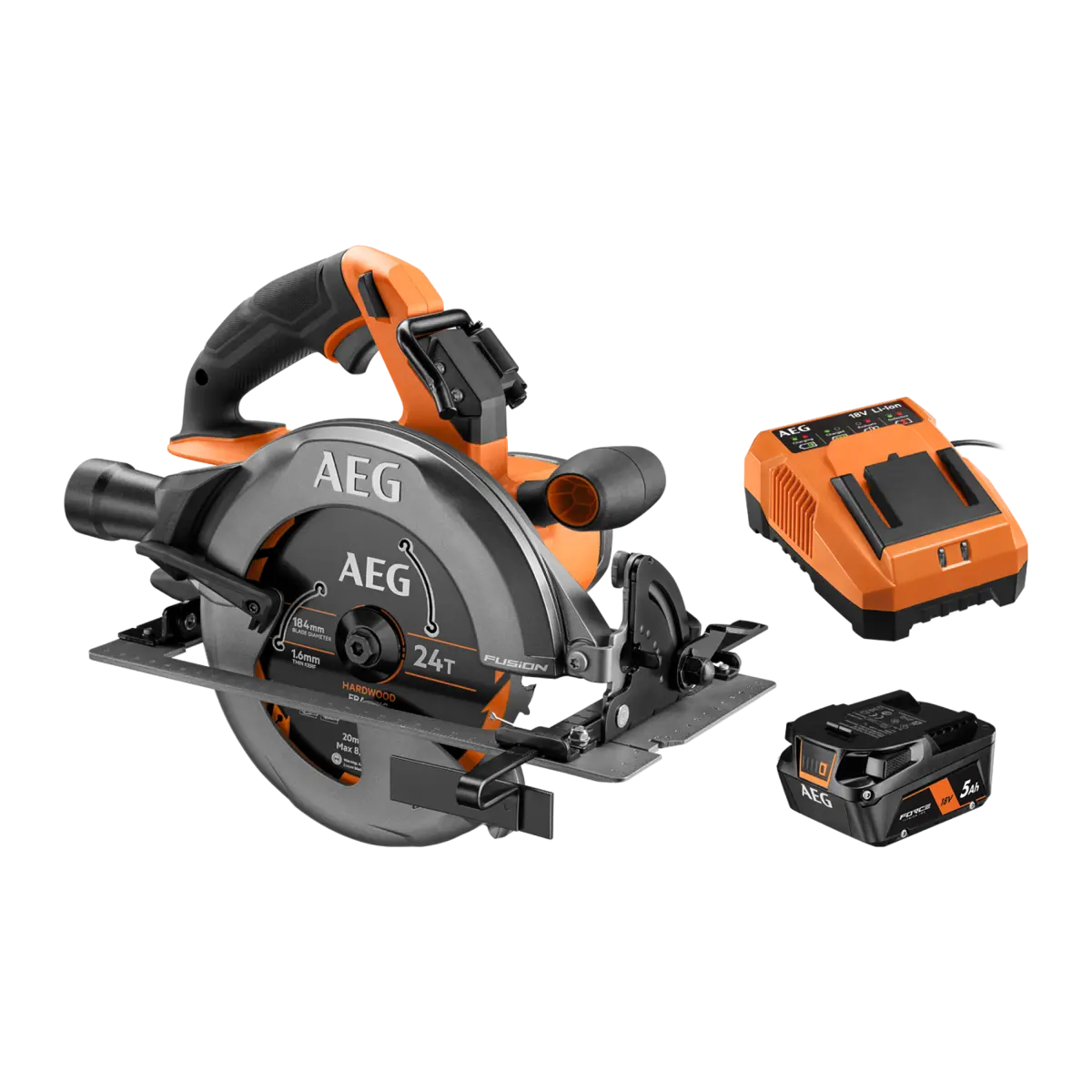
Exact AEG A18FCS6851 kit shown: A18FCS680 saw, 5Ah FORCE battery and charger.
The A18FCS680 uses AEG's FUSION brushless motor to drive a 184mm blade at 5,400rpm. Its 65mm maximum cut at 90° covers common framing and sheet work, while the 56° bevel range and 44.5mm depth at 45° provide useful flexibility for angled cuts. An anti-jam fin, aluminium upper and lower guards, tool-free depth adjustment, LED cut-line light and parallel guide make the specification appropriately construction-focused.
The reason it beats several excellent skins is the A18FCS6851 package. At the research-date $399 price it includes the exact A18FCS680 saw, a 5Ah FORCE battery and 3.2A charger. The $349 skin makes little financial sense for anyone who needs another battery. Buyers starting a platform also avoid comparing an apparently cheaper tool-only price with a ready-to-work kit.
The rafter hook, onboard wrench and dust-port adaptor are practical rather than decorative. A 65mm cut still will not pass through every oversized timber in one cut, and this framing-oriented 184mm design is bulkier than a compact 165mm Makita. AEG's platform is also narrower than Ryobi ONE+, Makita LXT or Milwaukee M18, so households with a deep existing battery collection should include that lock-in cost.
What owners say
Pros
- 184mm blade and 65mm cut depth
- Strong 5,400rpm FUSION brushless platform
- Excellent $399 battery-and-charger kit value
- Very strong Australian owner evidence
- Six-year registered tool warranty
Cons
- Bulkier than compact 165mm saws
- AEG ecosystem is narrower than major rivals
- Skin is poor value beside the current kit
- No integrated guide-rail shoe
- Registration is required for extended warranty
Ryobi 18V ONE+ HP Brushless 184mm Circular Saw RCS18X1
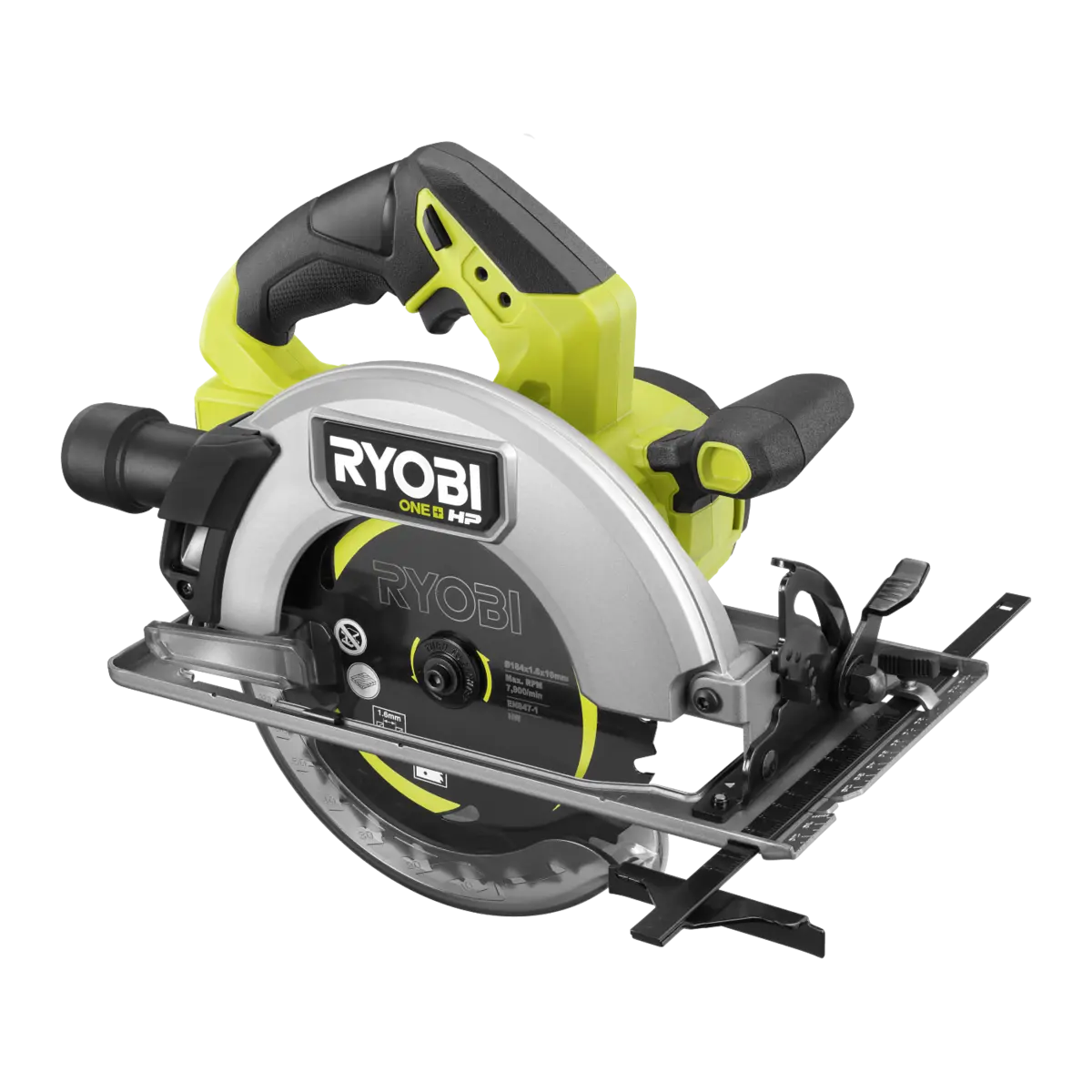
Exact Ryobi RCS18X1 tool-only saw shown. Battery and charger are not included.
RCS18X1 is Ryobi's current 184mm HP brushless model, not an older R18CS or earlier HP generation. It runs at 5,000rpm and cuts to 65mm at 90°, 46mm at 45° and 35mm at its maximum 56° bevel. A die-cast upper guard, LED, dust port and edge guide support normal building and renovation work, while the broad ONE+ ecosystem makes its $289 skin price especially attractive for existing owners.
The price needs context. No battery or charger is supplied, so a first-time buyer may spend more getting it ready to use than on the complete AEG kit. Ryobi also states that suitable HP or EDGE packs help the tool deliver its intended output. A small battery may run the saw but can change sustained-load performance and balance.
Independent professional hands-on testing of the current-generation 7¼-inch HP brushless architecture found stronger cutting power than the prior generation, effective dust collection and good ergonomics in normal construction cuts. It could still slow in particularly demanding compound cuts. That is consistent with its positioning: a genuinely capable serious-DIY saw, not a promise of unlimited daily trade abuse.
What owners and testers say
Pros
- Strong $289 skin value for ONE+ owners
- 184mm blade with 65mm cut depth
- HP brushless motor and good ergonomics
- Large, flexible battery ecosystem
- Strong Australian exact-model evidence
Cons
- Battery and charger cost extra
- Best output needs a suitable higher-output pack
- Not positioned for constant heavy trade abuse
- Current exact model is relatively new
- 16mm arbor differs from some professional blades
Milwaukee M18 FUEL 184mm Circular Saw M18FCS66G30
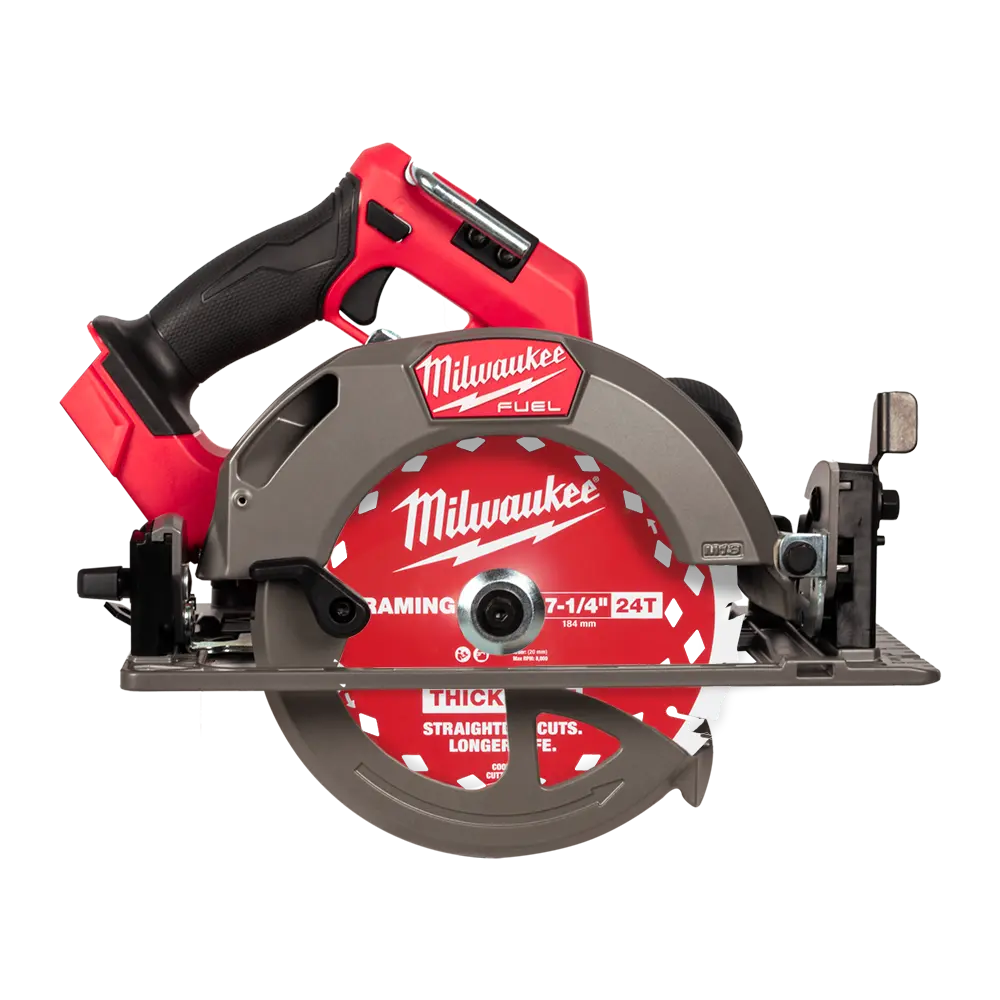
Exact Milwaukee M18FCS66G30 tool-only saw shown. Battery, charger and guide rail are not included.
The M18FCS66G30 uses Milwaukee's POWERSTATE brushless architecture to reach 6,000rpm. Its 184mm blade cuts 64mm at 90° and 50mm at 45°, with a 50° maximum bevel. Magnesium guards and shoe reduce unnecessary mass in a heavy-duty design, while the electric brake, rafter hook, LED, cut-line blower and positive depth and bevel detents support repeated site work.
Its standout difference is the track-compatible shoe. A suitable rail can improve repeatability on sheet goods without turning this conventional circular saw into a dedicated plunge saw. Rails cost extra. At roughly 4.2kg before a battery, the tool is already substantial, and a large M18 FORGE pack makes the ready-to-use setup heavier still.
Milwaukee claims up to 750 cuts per charge using an M18 FORGE 12Ah battery in its specified OSB test. That is a controlled manufacturer claim, not a promise of 750 full-depth cuts in arbitrary framing timber or with every M18 pack. The platform's strongest case is professional integration, not universal runtime or low entry cost.
What owners and the evidence say
Pros
- Fast 6,000rpm professional platform
- Track-compatible magnesium shoe
- Electric brake, detents and rafter hook
- Mature M18 trade ecosystem
- Five-year Australian tool warranty
Cons
- About $500–$550 tool-only
- Battery and charger add substantial cost
- Exact-model Australian evidence is small
- About 4.2kg before battery
- Guide rails are additional
What matters when buying a cordless circular saw
165mm vs 184mm blades
A 165mm saw is usually lighter and more compact. A 184mm saw cuts deeper, which can matter with common framing timber. Blade diameter alone does not decide cutting speed, accuracy or overall saw quality.
Cut depth matters more than watts
Cordless saws are not meaningfully ranked by input wattage. Compare the blade, maximum depth, speed, motor architecture and sustained-load behaviour. All three recommendations provide roughly 64–65mm at 90°.
Kit price vs skin price
A tool-only price excludes the battery and charger. For existing platform owners that can be excellent value. A new buyer may spend less overall on AEG's $399 kit than on Ryobi's $289 or Milwaukee's premium skin after suitable power packs are added.
Battery size affects performance
Higher-output packs can support stronger sustained cutting, but they also add weight and alter balance. A compatible battery does not necessarily deliver the same peak performance as the platform's recommended high-output pack.
Brushless is worth prioritising
Brushless motors generally improve efficiency, reduce maintenance and support better sustained output. In 2026 it is the sensible choice for regular circular-saw work unless the budget is extremely constrained.
The blade changes the result
Tooth count, kerf and material suitability affect speed, finish, tear-out and battery use. Use an appropriate blade for framing, plywood, laminates or fibre cement rather than expecting one supplied timber blade to do everything.
Dust extraction needs context
A dust port can improve normal timber cleanup when connected to a suitable extractor. It does not make an ordinary vacuum appropriate for hazardous silica or fibre-cement dust. Follow the material, tool and workplace-control guidance.
Electric brakes improve control
An electric brake reduces blade coast-down after the trigger is released. It is useful, but it does not replace guards, correct support, appropriate PPE or keeping hands clear of the cutting path.
Dust and material safety
A general-purpose wet and dry vacuum can help with ordinary workshop debris, but fine hazardous construction dust may require a correctly classified extractor and additional controls. Never use a timber blade on an unsuitable material merely because it fits the arbor.
Which one should you buy?
Choose the AEG A18FCS6851 kit for the best current balance of full-size capability, mature owner evidence and ready-to-work value. The 5Ah FORCE battery and charger are central to the recommendation.
Choose the Ryobi RCS18X1 when you already own ONE+ batteries or want a capable serious-DIY skin with broad ecosystem flexibility.
Choose the Milwaukee M18FCS66G30 when the saw will earn its premium through regular site work, M18 integration and guide-rail compatibility.
Frequently asked questions
Is a 165mm or 184mm circular saw better?
A 165mm saw is typically lighter and easier to handle, while a 184mm saw provides more cutting depth. Choose around the timber sizes and handling you actually need. A well-designed 165mm saw can be better than a mediocre 184mm model for lighter, accurate work.
Is a cordless circular saw powerful enough for framing?
A capable modern brushless saw with an appropriate battery and sharp framing blade can handle substantial framing work. Maximum timber size, cut depth, duty cycle and battery capacity still matter. A 65mm cut does not pass through every oversized member in one pass.
Does battery size affect circular-saw performance?
Yes. Capacity, cell design and discharge capability can affect sustained power and runtime. Higher-output packs can improve demanding cutting but also make the saw heavier. Follow the manufacturer's recommended battery range rather than assuming every compatible pack performs identically.
Is brushless worth paying extra for?
For regular circular-saw use, usually yes. Brushless designs commonly deliver better efficiency, less motor maintenance and stronger sustained performance. Occasional users can save with a brushed saw, but all three recommendations use brushless motors for good reason.
Which battery platform should I choose?
Start with the tools you expect to own, not the saw alone. Existing compatible packs can make a tool-only purchase economical. New buyers should compare the ready-to-work cost, battery sizes, charger, warranty registration and the quality of other tools in the ecosystem.