
How we chose
Detailed methodology
We compared exact current Australian gasless battery framing nailers for 90mm capability, firing response, drive evidence, fastener compatibility, bare and working weight, depth control, sequential and contact modes, dry-fire protection, platform cost, warranty, service, local availability, exact-model owner evidence and professional evidence. Scores are editorial judgements, not blended customer-star calculations. Manufacturer claims remain attributed to the manufacturer unless independently measured.
Serious contenders and alternatives
Ryobi RFN1830X: is a strong lower-cost choice for serious DIY and lighter-duty buyers, with 50–90mm support and substantial Australian owner feedback. Ryobi positions the platform for DIY use and the exact warranty contains nail-count limits, so DeWalt is the stronger professional-value recommendation.
Makita DBN900ZK: is a credible 18V LXT tool with 50–90mm nails, sequential and bump modes and a large magazine. At about 4.7kg bare, it is heavier than Milwaukee and markedly heavier than HiKOKI without a clear performance advantage.
Makita BN001G: confirms that 40V Max belongs in the competitive class, but higher voltage is not automatically better. Fastener support, drive, firing response, weight and system cost matter more than the label.
Paslode FrameMaster NightWolf NW580: remains a valid alternative technology when lower carried weight is central. It uses a battery plus fuel cell, so it sits outside this guide's formal gasless ranking and brings fuel cost, cartridge availability and a different maintenance model.
HiKOKI NR1890DCA(H4Z): is the outgoing generation. It may remain attractive at a substantial discount, but the ranked DCB is lighter, much faster on paper and expands fastener and magazine-system flexibility.
AEG A18F10FN: is not ranked. Certain production batches were recalled because firmware could permit unintended discharge without the intended two-stage actuation; repair action was provided. This does not mean every current unit is unsafe, but the safety history weakens its recommendation case.
Milwaukee M18 FUEL 30–34° Framing Nailer M18FFN-0C

Exact Australian M18FFN-0C tool-only model shown. Battery and charger are not included.
Milwaukee specifies a nitrogen-spring drive, 50–90mm nail range, 51-nail magazine, tool-free depth control, dry-fire lockout and sequential or contact actuation. It can fire up to three nails per second with effectively zero ramp-up and weighs about 4.4kg before a battery.
Extended product analysis
Credible manufacturer and practical evidence supports strong performance in dense and engineered timber, but no framing nailer should be described as able to sink every 90mm nail into every Australian hardwood. Timber density, nail diameter and shank, grain, depth setting and battery condition all affect the result.
Australian owner feedback repeatedly supports drive strength and immediate response; weight is the repeated negative. Add a battery and a strip of nails and the real working mass is substantial, especially overhead. The tool makes most sense for professional users and existing M18 owners.
What owners say
Australian exact-model retailer history is meaningful. Positive themes include drive power, hardwood capability and firing response; the consistent drawback is weight. Manufacturer-hosted or retailer feedback is treated as owner evidence, not independent laboratory testing.
Pros
- Immediate zero-ramp firing
- Strong framing drive
- Up to 3 nails/sec
- 50–90mm range
- Sequential and contact modes
- Mature M18 ecosystem
Cons
- Heavy at about 4.4kg bare
- More tiring overhead
- Substantial system cost outside M18
- Battery and charger cost extra
DeWalt 18V XR Brushless 33° 90mm Framing Nailer DCN930N-XJ
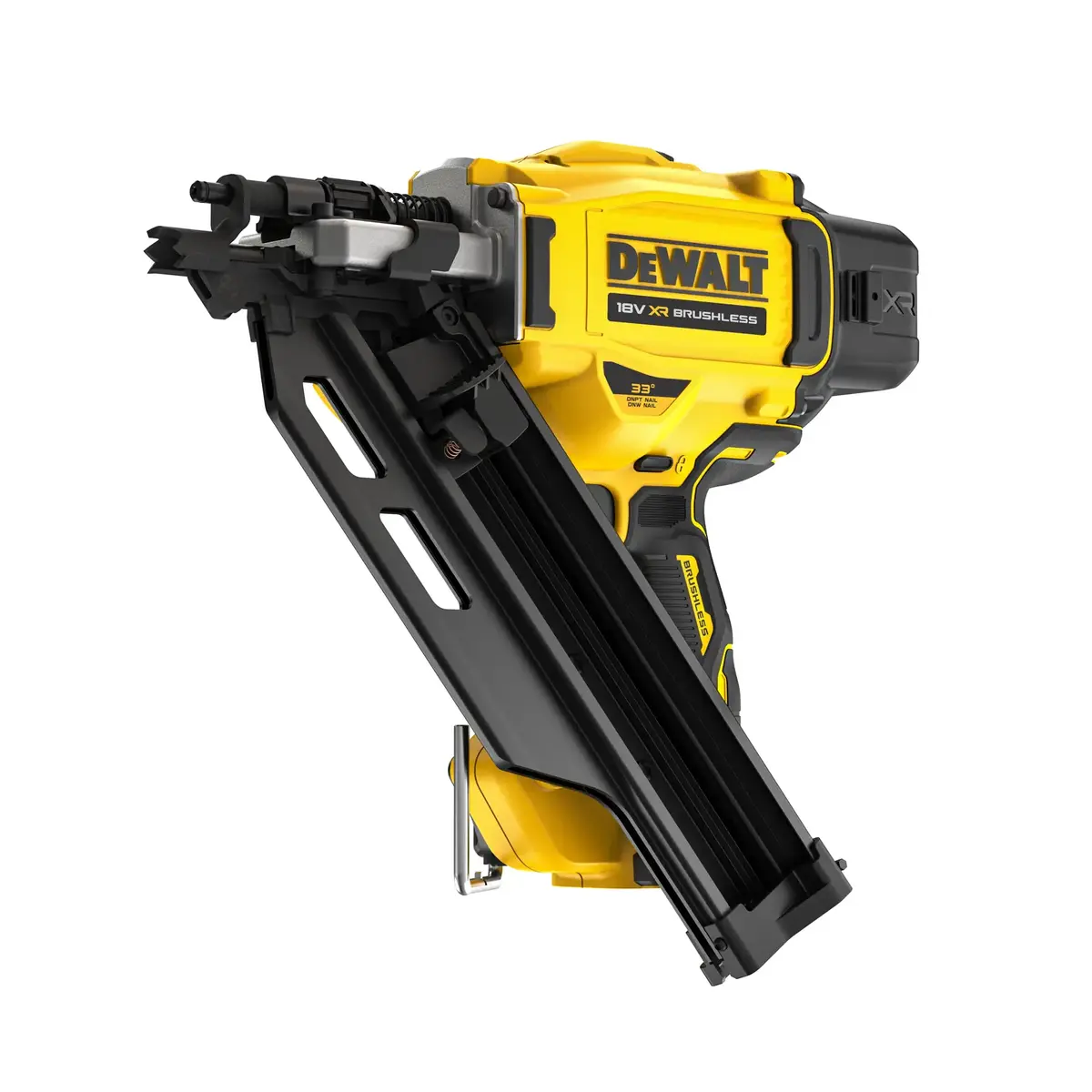
Exact Australian DCN930N-XJ current-generation bare tool shown.
DeWalt specifies 50–90mm fasteners, about 33° collation, sequential and contact modes, tool-free depth adjustment and up to two nails per second. At roughly 3.9kg bare, it saves about half a kilogram against Milwaukee. DeWalt states it can drive 90mm ring-shank nails flush in medium-density timber.
Extended product analysis
The redesigned magnesium magazine and nose improve the current tool over its predecessor, but the mechanism retains more spool or ramp character than nitrogen- or air-spring competitors. That difference matters most to users who prioritise instant response and rapid cadence.
Its value award is not a claim that it is cheapest—Ryobi costs less. It wins because the step from high-end prosumer pricing to a current professional XR platform is comparatively modest. Existing XR owners avoid much of the battery and charger cost.
What owners say
Exact DCN930 Australian owner history is still less mature than long-running models. Older DCN692 comments may provide product-family context, but are not used as proof of exact-model reliability.
Pros
- Professional XR platform
- About 3.9kg bare
- Strong 90mm capability
- Current-generation design
- Sequential and contact modes
- Strong professional value
Cons
- More ramp-up character
- Exact-model owner history is developing
- Not the cheapest skin
- Battery and charger cost extra
HiKOKI Speed Series 18V Gasless 90mm Framing Nailer NR1890DCB(W6Z)

Exact current NR1890DCB(W6Z) Speed Series model shown, not the outgoing NR1890DCA.
HiKOKI specifies 50–90mm, 2.8–3.3mm 30–34° D-head or offset-round-head nails, a 54-nail magazine, full sequential and contact firing, tool-less depth adjustment, dry-fire lockout and a 43ms response. Published cycle rate is up to 4.5 nails per second intermittently.
Extended product analysis
The DCB is about 0.38kg lighter than the outgoing DCA and much faster on paper. HiKOKI's optional Speed Series magazine architecture may support extended framing, round-head, metal-connector and duplex configurations, but this guide judges the power unit as a framing nailer. Optional magazines and conversion procedures must follow the exact manufacturer instructions.
Australian retail is in an early-launch or preorder transition. Exact retailer order paths are active while HiKOKI's own page still says “Coming soon”. Stock may therefore be less predictable than for established models. The approximately $1,049 observed launch position is also materially higher than the outgoing DCA, but no transient price is used as an evergreen promise.
What owners say
Meaningful exact-model Australian owner and long-term professional evidence has not yet developed. DCA history is product-family context only and is not presented as proof of DCB durability.
Pros
- About 3.4kg bare
- 120J driving energy
- Up to 4.5 nails/sec
- 43ms published response
- Broad D-head / offset-round support
- Interchangeable magazine architecture
Cons
- High launch pricing
- Immature exact-model owner evidence
- Inconsistent launch messaging
- Stock may be less predictable
Cordless framing nailer buying advice
Buying advice
Framing nailers are first-fix tools
These tools drive large nails for framing, studs, battens, sub-frames, fencing and other first-fix timber work. Finish and brad nailers use smaller fasteners for trim, mouldings and cabinetry; they are not substitutes for framing duty.
Gasless battery vs fuel-cell
A gasless battery nailer avoids compressor hoses and fuel cartridges. Fuel-cell framers such as Paslode can offer lower carried weight, but add cartridge cost, availability and a different maintenance model. Neither technology is automatically best for every user.
Nail angle and compatibility
Angle describes the magazine and collation geometry, not a universal nail standard. Check nail length, diameter, paper, plastic or wire collation, clipped/D-head, offset- or full-round head, smooth or ring shank and corrosion protection. The selected tools broadly occupy the 30–34° and 50–90mm class, but that does not make every strip interchangeable.
Why 90mm capacity matters
A 90mm ceiling covers common structural framing lengths, but rated length alone does not guarantee flush driving in every material. Timber density, fastener diameter and shank, grain, angle, depth setting and battery condition all matter.
Weight vs drive and speed
Milwaukee prioritises immediate drive response despite a 4.4kg bare weight. HiKOKI's new Speed Series targets both low weight and high cadence at about 3.4kg. DeWalt sits between them. Add the intended battery and a loaded magazine before comparing realistic working mass.
Sequential vs contact firing
Sequential mode requires the workpiece contact and trigger to operate in the required sequence for each nail. Contact or bump mode can fire as the nose contacts the work while the trigger is held, subject to the exact tool's Australian configuration and safety instructions. Learn the selected mode before starting and never defeat the contact mechanism.
Skin-only economics
A nominally cheaper skin can cost more once a suitable battery, charger and second pack are added. Existing M18, XR or HiKOKI ownership can materially change the real purchase decision. Battery size also changes balance and fatigue.
Professional vs serious DIY
Daily trade work places a premium on service, warranty, durability, fastener availability and platform support. Ryobi's RFN1830X is a strong serious-DIY alternative, but its intended-use and warranty position differ from the selected professional tools.
Framing nailer safety
Wear eye protection and keep hands and every body part away from the fastener path. A nail can deflect in dense grain, exit thin timber or miss during toe-nailing. Maintain stable footing and control: a loaded cordless framer is heavy and awkward overhead.
Understand sequential and contact firing before use, keep disciplined trigger control while repositioning and never defeat the workpiece-contact mechanism. Use only compatible nails, follow the exact loading procedure and reject damaged or distorted strips. Remove the battery before servicing or clearing jams where the manufacturer instructs, and follow its jam-clearing steps rather than improvising.
Which cordless framing nailer should you buy?
Buy the Milwaukee M18FFN-0C for the strongest established all-round professional package and immediate firing response. Buy the DeWalt DCN930N-XJ for the best current professional-value balance, especially if you own XR batteries. Buy the HiKOKI NR1890DCB(W6Z) if low carried weight and published firing speed justify early-launch pricing and evidence uncertainty.
Frequently asked questions
What size nails do cordless framing nailers use?
The selected tools broadly support 50–90mm nails in the 30–34° class, but diameter, head, shank and collation rules differ. Check the exact Australian manual before buying nails.
Is a 30° framing nailer the same as a 34° framing nailer?
Products may specify a working range such as 30–34°, but that does not make every 30° or 34° strip interchangeable. Head style, gauge and collation also control compatibility.
Can cordless framing nailers drive 90mm nails into hardwood?
Some exact models have credible hardwood or engineered-timber evidence, but performance depends on timber density, nail design, depth setting and battery condition. No tool should be promised to sink every 90mm nail into every Australian hardwood.
What is the difference between a framing and finish nailer?
A framing nailer drives larger structural or first-fix fasteners. Finish and brad nailers use smaller nails for trim and second-fix work and are not substitutes.
Is a gasless nailer better than a Paslode?
Gasless tools avoid fuel cartridges; fuel-cell Paslode tools can reduce carried weight. The better choice depends on weight, consumable cost, maintenance, stock and your existing battery platform.
Do I need the same brand battery as the tool?
Yes. Use only batteries explicitly supported by that exact tool and manufacturer. Battery systems are not generally interchangeable across Milwaukee, DeWalt and HiKOKI.
Is bump firing safe?
Contact or bump firing demands training and strict trigger discipline. Use it only where the exact Australian model and manual allow it, never defeat the workpiece contact and prefer sequential mode when placement control matters.
Why are cordless framing nailers so heavy?
They carry a motor, drive mechanism and battery instead of relying on a hose or fuel cell. Battery size and a loaded magazine add further working weight.