How we chose
We assessed exact current Australian models, availability, price, 125mm versus 150mm format, orbit diameter, speed range and control, brushless architecture, bare weight, head height, vibration control, braking, switch sealing, dust collection, vacuum compatibility, abrasive availability, battery ergonomics, warranty, service and spares, exact-model owner evidence and attributed professional testing. Worth Buying scores are editorial judgements, not calculations from customer stars. Manufacturer vibration, runtime and dust-collection figures remain manufacturer data unless independently measured.
Serious contenders reassessed
Bosch Professional GEX 18V-125: is an excellent 1.1kg brushless AMPShare option with a 2.5mm orbit, Click & Clean compatibility and strong parts support. Its tiny local review pool and roughly $309 price make DeWalt and AEG easier broad recommendations.
HiKOKI SV1813DA(H4Z): is a technically strong near-miss with a 3mm orbit, electronic brake, dust-sealed switch and unusually transparent vibration, runtime and dust-collection data. Its smaller ecosystem and thin local owner pool keep it outside the top three.
Makita DBO180Z: remains a capable mature LXT sander with three speeds, a 2.8mm orbit and useful exact-model evidence. Its brushed, battery-on-top architecture and recurring dust-collection criticism make the newer brushless finalists more compelling.
Metabo SXA 18 LTX 150 BL: is the 150mm large-surface specialist. It covers panels and tabletops faster, but its larger footprint, higher price and less universally stocked abrasives make it a different proposition from the three 125mm winners.
Ozito PXBROS-125 and Ryobi RROS18: are credible ultra-budget choices. The newer RROS18C earns the formal value slot through brushless efficiency, speed control, broader refinement and deeper long-term ownership confidence.
DeWalt 18V XR Brushless 125mm Random Orbital Sander DCW210N-XJ
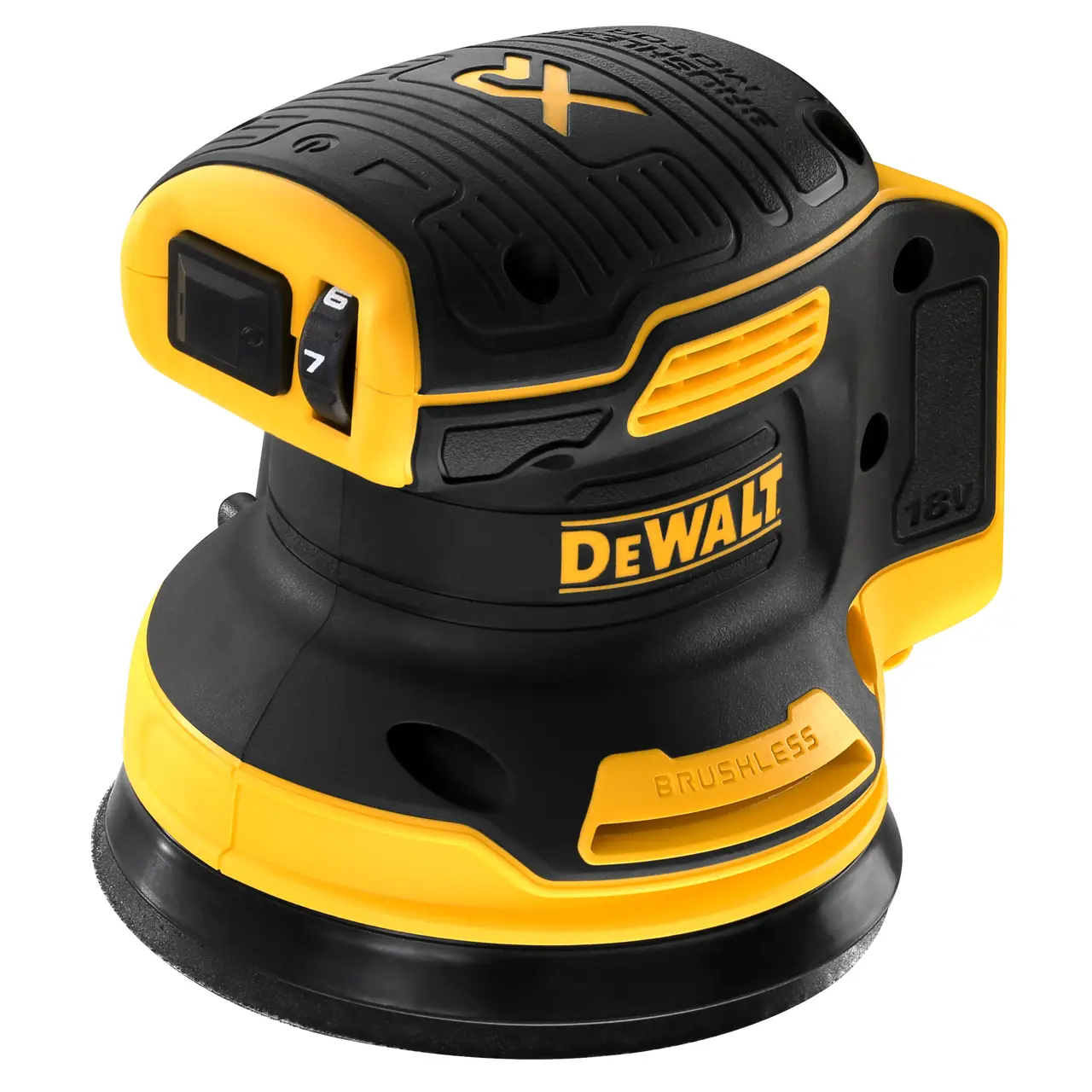
Exact official DCW210N-XJ product architecture shown. Tool only; battery and charger are not included.
The exact Australian DCW210N-XJ combines an 18V XR brushless motor, 125mm hook-and-loop pad, 2.6mm orbit and variable-speed dial. DeWalt's current Australian page does not publish a numeric speed range, so none is borrowed from an overseas SKU. Its dual-plane counterbalance, overmould grip and low-vibration positioning help during longer surface-prep sessions.
Dust control is the differentiator. The included bag handles short work; the AIRLOCK-compatible outlet connects to supported DeWalt extractors, and Wireless Tool Control can switch supported WTC extraction equipment. The dust-sealed switch and sealed ball-bearing construction also support professional durability.
At $249 skin-only it costs $80 more than Ryobi. DeWalt lists a three-year limited repair warranty, one-year free service and 30-day satisfaction guarantee under current terms—not a three-year replacement warranty. Battery size affects working balance, and extraction is strongest within DeWalt's system.
What owners say
Bunnings showed 4.0/5 from 21 reviews; Total Tools showed 98% from 10. These exact-model Australian retailer pools stay separate and are not averaged.
Professional evidence
Attributed international professional testing praises performance, runtime and ergonomics while noting that vibration remains noticeable compared with some competitors. This is international professional evidence, not Australian owner feedback or Worth Buying testing.
Pros
- Brushless 18V XR architecture
- 2.6mm general-purpose orbit
- Variable-speed control
- AIRLOCK and WTC extraction support
- Dual-plane counterbalance
- Dust-sealed switch and sealed bearings
Cons
- Costs more than Ryobi
- Only three-year repair warranty
- Owner ratings are not uniformly excellent
- Battery size changes balance
- Best extraction fit is DeWalt-centric
Ryobi 18V ONE+ HP Brushless 125mm Random Orbital Sander RROS18C

Exact official Australian RROS18C product image shown. Bunnings I/N 0539761; tool only, with battery and charger sold separately.
The exact RROS18C uses a 125mm hook-and-loop pad, HP brushless motor and three selectable settings across its published 7,000–11,000 OPM range. It weighs 1.1kg bare and includes a dust bag, vacuum port, LED and 80, 120 and 240-grit discs. Ryobi's separate “22,000 sanding strokes” language is not mixed into the OPM comparison.
Ryobi's claimed runtime of up to about 25 minutes with a 4Ah battery is a manufacturer example under specified conditions, not a universal promise. The product remains light, but a very large pack can make it feel top-heavy. A workshop vacuum is preferable to the small bag for long sanding sessions.
The warranty is four years standard and up to six years for eligible ONE+ tools registered within 30 days. It is replacement-oriented, with battery coverage separate; trade users who prioritise repair and parts may prefer DeWalt, Bosch or HiKOKI.
What owners say
Ryobi's exact-model Australian pool was about 4.8/5 from 134 reviews. Bunnings mirrors can show different counts and may overlap, so they are not added to produce a fabricated combined total.
Pros
- Excellent $169 price
- HP brushless motor
- Only 1.1kg bare
- Three speed settings
- Dust bag and vacuum port
- Deep exact-model Australian feedback
- Large ONE+ ecosystem
Cons
- Only three speeds
- Replacement-oriented warranty
- Large packs alter balance
- Less professional service infrastructure
- Small bag fills quickly on large jobs
AEG 18V Brushless Sub Compact 125mm Random Orbital Sander A18SROSBL0

Exact official A18SROSBL0 product image shown. Bunnings I/N 0585301; tool only, with battery and charger sold separately.
The exact A18SROSBL0 uses a 125mm hook-and-loop pad, brushless motor, 2.5mm orbit and six settings across 7,000–11,000 OPM. AEG lists a 103mm head height, electronic brake, low-vibration positioning, ergonomic top grip, lock-on switch, dust bag and workshop-vac connection.
That low-profile shape is particularly useful on doors, shelves, cabinetry, benchtops and vertical faces. The 2.5mm orbit favours finish control over maximum stock removal; buyers stripping large areas may prefer a more aggressive orbit or a 150mm specialist.
At $269 skin-only it is the most expensive formal pick and the AEG battery ecosystem is smaller than ONE+ or XR. Eligible tools can receive up to a six-year warranty with registration within 30 days under current Rapid Response terms.
What owners say
AEG's exact page showed 5.0/5 from 38 reviews; a separate Bunnings snapshot showed a smaller count. Those snapshots are not combined. Feedback is strong, but the evidence pool remains much smaller than Ryobi's.
Pros
- Very low 103mm head height
- Brushless and only 1.2kg bare
- Six speed settings
- Electronic brake
- 2.5mm finishing-focused orbit
- Dust bag and vacuum port
- Long registered warranty
Cons
- Highest price of the winners
- Smaller battery ecosystem
- Retail choice is Bunnings-centric
- Not the most aggressive removal tool
- Owner pool smaller than Ryobi
Cordless orbital sander buying advice
Random orbital vs sheet sander
A random orbital pad rotates and orbits, helping reduce obvious directional scratch patterns across broad flat surfaces, furniture, doors and paint preparation. A sheet sander uses a different action and conventional sheet abrasives for lighter finishing and, depending on pad shape, corners. They are not interchangeable categories.
125mm vs 150mm
A 125mm sander is compact, light and uses a widely stocked Australian abrasive size. A 150mm tool covers tabletops, doors and panels faster, but is larger, usually dearer and its discs are less universally stocked. All three winners are 125mm; the Metabo 150mm is a specialist near-miss.
Orbit diameter and speed
Smaller orbits generally favour finer control; larger orbits generally remove material faster. AEG uses 2.5mm, DeWalt 2.6mm and the near-miss HiKOKI 3.0mm. Orbit alone does not decide finish quality: abrasive, speed, pressure and motor behaviour all matter. Variable speed helps with paint, veneer, fillers, soft timber and delicate finishes, while lower speeds can reduce heat or surface damage.
Brushless motors
Brushless designs can improve efficiency, runtime and compactness while reducing motor maintenance, but the motor label is not the whole ranking. Makita's brushed DBO180 remains a capable mature tool; the three winners combine brushless architecture with stronger overall packages.
Vibration and ergonomics
Random orbital sanders generate continuous hand-arm vibration. Counterbalancing, low-profile geometry and rubber overmould can reduce it, but no model is vibration-free. Keep a relaxed grip, take appropriate breaks during prolonged work and follow occupational exposure guidance where sanding is frequent.
Dust collection and hazardous dust
Small bags are convenient for brief jobs; a correctly connected workshop vacuum or dust extractor is generally better for long sessions, MDF, filler and large timber work. Align disc holes with the backing pad and keep ports clear. Bags and extractors do not capture every fine particle.
MDF, old paint, silica-containing fillers, lead paint, treated timber and some hardwoods can create serious hazards. Determine whether older paint may contain lead before sanding, use appropriate source extraction and respiratory protection, and follow Australian WHS controls for professional work. Never assume a dust bag alone makes the job safe.
Sanding pressure and abrasive grit
Do not press hard. Excess pressure can slow pad rotation, increase swirl marks and vibration, overheat abrasives and shorten pad or bearing life. Let the abrasive, speed and orbit work. As a broad guide, 40–80 grit is coarse stripping, 100–150 grit is preparation and 180–240+ is fine finishing, but the correct progression depends on material and coating.
Pad care
Never run the sander without an abrasive disc or with a badly damaged disc. Align extraction holes, replace worn hook-and-loop backing pads, and avoid aggressive edge use unless the exact manual allows it. Disconnect the battery before pad inspection, cleaning or accessory changes.
Battery size and tool-only cost
Compact packs generally improve balance and reduce fatigue; large packs add runtime but more top or rear weight. There is no universally best capacity. The formal prices are tool-only, so first-time platform buyers must calculate the tool, battery and charger together. A promotional bonus is not a reduction in the sander's ticket price.
Random orbital sander safety
Wear eye and hearing protection, plus suitable respiratory protection for the material. Secure the workpiece, keep the tool's ventilation and dust ports clear, inspect the backing pad and abrasive before use, and remove the battery before changing discs, cleaning or maintenance. Follow the exact tool, extractor and abrasive manuals.
Identify coatings and substrate hazards before sanding. Do not dry-sand suspected lead paint without the correct assessment and controls, and use suitable extraction for MDF, treated timber, fillers and hardwood dust. Keep sparks, flames and ignition sources away from collected dust, empty collection systems safely, and do not use a wood-dust extractor for materials it is not rated to collect.
Allow the pad to reach operating speed before contacting the surface, keep control with a stable stance and do not force the tool. Keep hands, fingers, loose clothing and other body parts clear of the moving sanding pad while the tool is operating. Stop if vibration changes sharply, a disc tears or the pad no longer retains abrasives. After releasing the trigger, wait until the sanding pad has fully stopped before placing the tool down; do not assume it stops instantly. Take rest periods during sustained work and keep children and bystanders clear.
Which cordless orbital sander should you buy?
Buy the DeWalt DCW210N-XJ for the strongest overall combination of finish control, extraction integration, ergonomics and professional support. Buy the Ryobi RROS18C for excellent brushless performance at a much lower price, especially if you already own ONE+ batteries. Buy the AEG A18SROSBL0 when a low-profile shape, six-speed control, electronic braking and long-session ergonomics matter most.
Frequently asked questions
What is a random orbital sander best for?
It suits furniture, doors, timber preparation, paint preparation and broad flat surfaces where good finish quality and reduced directional scratching matter.
Is 125mm or 150mm better?
125mm is lighter, more compact and uses widely stocked discs. A 150mm sander covers large panels and tabletops faster but is larger and usually costs more.
Should I buy brushless?
Brushless models can improve efficiency, runtime and compactness, but a good brushed tool can still sand well. Judge the complete tool, extraction and platform—not the motor label alone.
Why do I get swirl marks?
Common causes include worn abrasive, excess pressure, moving too quickly, skipping grit stages, contaminating the surface or poor dust removal. Let the tool work and keep discs clean and correctly fitted.
Do I need a dust extractor?
It is strongly recommended for long sessions and hazardous dust. Small bags mainly provide convenience collection and do not make MDF, old paint, filler or treated-timber dust safe.