How we chose
We assessed exact current Australian models, legitimate local availability, street price, petrol and diesel suitability, published starting-current data, clamp-current data where supplied, battery chemistry and capacity, recharge method, storage maintenance, clamp build, reverse-polarity and spark protection, surge protection, cold-weather considerations, USB and torch usefulness, 12V/24V scope, warranty, source-specific owner evidence and field or professional evidence. Worth Buying scores are editorial judgements, not customer-star calculations. Manufacturer current and engine-size ratings remain manufacturer specifications unless independently tested.
Serious contenders reassessed
iTechworld JS80: is technically compelling at roughly $299, with a 3000A manufacturer rating, 60W USB-C and up to 10L petrol / 8L diesel claims. Its manufacturer-hosted pool was about 4.9/5 from more than 1,100–1,200 reviews, while ProductReview's small exact-model pool was about 2.5/5 from 11 and included capacity and longevity complaints. Those sources are not averaged, and the conflict is material for emergency equipment.
NOCO GB70: remains a strong older-platform option with a large Australian retailer pool and 2000A manufacturer rating. GBX55's newer USB-C architecture and much faster recharge make it the more modern recommendation unless GB70 is discounted below it.
NOCO GB40: is a long-established compact choice for engines up to 6.0L petrol and 3.0L diesel, but CAROSS T18PRO currently publishes more engine headroom for less money.
CAROSS T18MAX: adds a 2000A manufacturer peak rating and larger 8L petrol / 6L diesel coverage for $214.99. T18PRO is materially cheaper and already covers a broad vehicle range.
CAROSS T14: adds a 150PSI compressor and is the all-in-one roadside alternative. That extra function also adds weight and complexity, so it was not allowed to dominate a guide specifically about starting vehicles.
CTEK RB 3000: offers a premium safety and power-bank package with a two-year warranty, but around $579–$599 is difficult to justify over Projecta's more transparent touring-focused architecture.
Matson MA35000: is a specialist 12V/24V LiFePO4 unit. It is appropriate for buyers who genuinely need both voltages, not ordinary passenger vehicles and 4WDs that use 12V starting systems.
NOCO Boost X GBX55
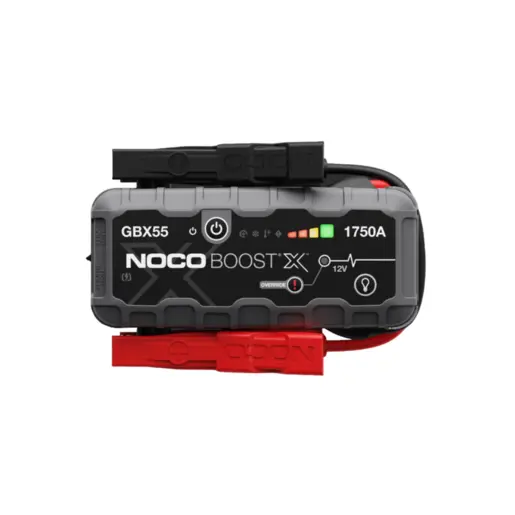
Exact GBX55 product image.
NOCO rates the GBX55 at a manufacturer-claimed 1750A peak for petrol engines up to 7.5L and diesels up to 5.0L. UltraSafe 2.0 provides spark-proof and reverse-polarity protection, while the housing is rated IP65 with its ports closed. The 200-lumen torch and power-bank output are useful secondary functions rather than the reason it wins.
The standout feature is 60W USB-C Power Delivery. NOCO quotes about 1.2 hours for a full recharge and about five minutes from empty to enough energy for a jump attempt—but only with a compatible USB-C PD source up to 60W. A basic low-output phone charger will take much longer, and suitable high-power charging hardware may not be included.
Autopro listed the exact GBX55 at $339.99 during the current check. Its limitations are a one-year warranty, 12V-only operation and the same maintenance reality as every stored lithium pack: recharge after use, check it periodically and do not assume years in a hot vehicle leave it ready.
What owners say
No cross-source average or combined count is created.
Pros
- 7.5L petrol / 5.0L diesel rating
- 60W USB-C PD input and output
- Fast recharge with suitable charger
- Spark and reverse-polarity protection
- IP65 with ports closed
- Broad Australian availability
Cons
- One-year warranty
- Much dearer than CAROSS
- Fastest recharge needs suitable USB-C hardware
- Needs periodic charge checks
- 12V only
CAROSS T18Pro Compact Smart Lithium Jump Starter T18PRO
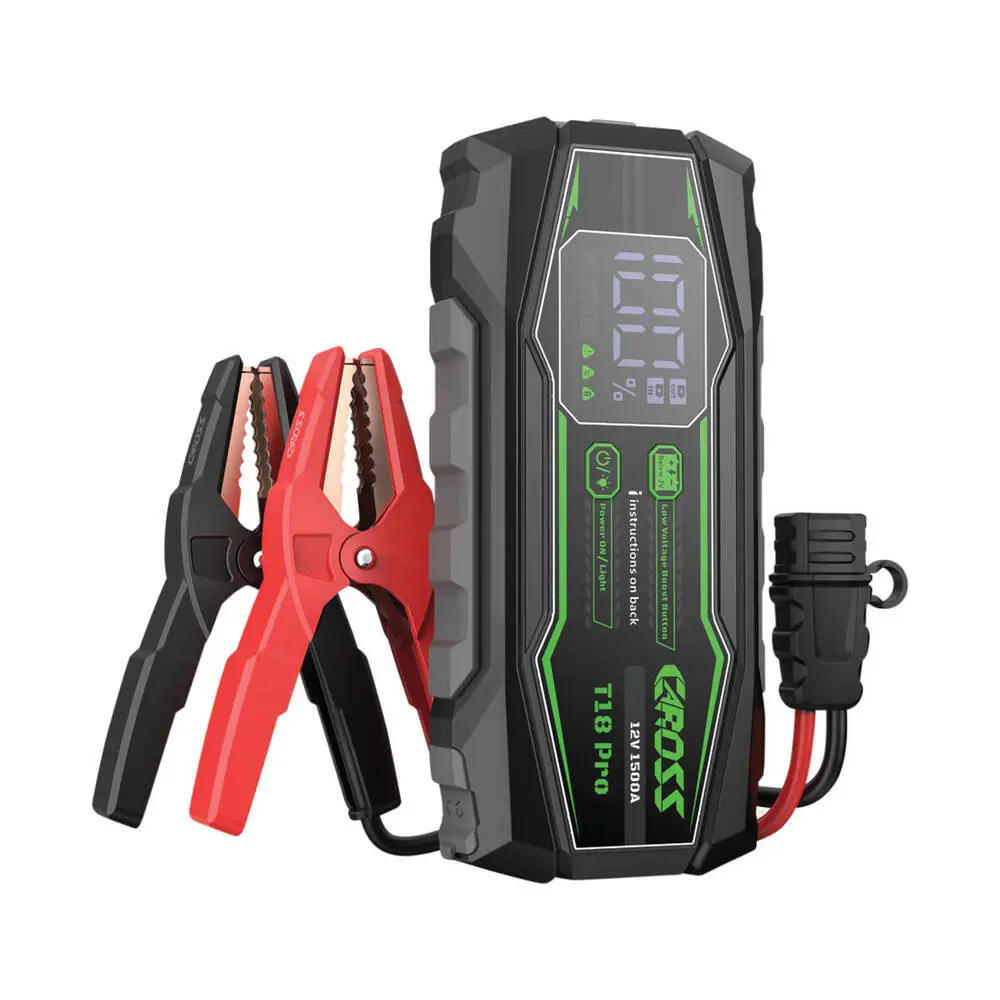
Exact T18PRO product image.
Supercheap Auto and CAROSS specify a 12V lithium-ion pack with a manufacturer-rated 1500A peak, 16,000mAh capacity, petrol coverage up to 7.0L and diesel coverage up to 4.5L. It includes heavy-duty clamps, reverse-polarity and spark protection, a 2.3-inch digital display, QC3.0 / 18W-class USB, flashlight, SOS and strobe modes, and a hard carry case.
The current exact-model price was $159.99. The display gives more useful status information than a basic four-LED indicator, while the 1.21kg weight remains manageable. CAROSS claims up to 30 starts per full charge; that is a manufacturer maximum, not a universal expectation.
Its trade-offs are conventional lithium-ion rather than Projecta's LiFePO4 chemistry, much slower charging than NOCO's 60W USB-C system, one-year warranty and primarily single-retailer distribution. No IP rating or independently measured clamp-current figure is claimed here.
What owners say
Supercheap Auto displayed approximately 209–210 exact-product reviews during research, unusually substantial Australian evidence for this category. No star average is shown because the exact live figure was not independently verified during preparation. The pool is retailer evidence—not laboratory testing—and is not combined with manufacturer claims or another source.
Pros
- Excellent $159.99 price
- Broad published engine coverage
- Large Australian retailer-review pool
- Clear digital display
- Spark and reverse-polarity protection
- Hard case included
Cons
- One-year warranty
- Slower charging than NOCO
- Lithium-ion rather than LiFePO4
- Primarily one-retailer distribution
- 12V only
- Peak rating not independently measured
Projecta Intelli-Start IS1400
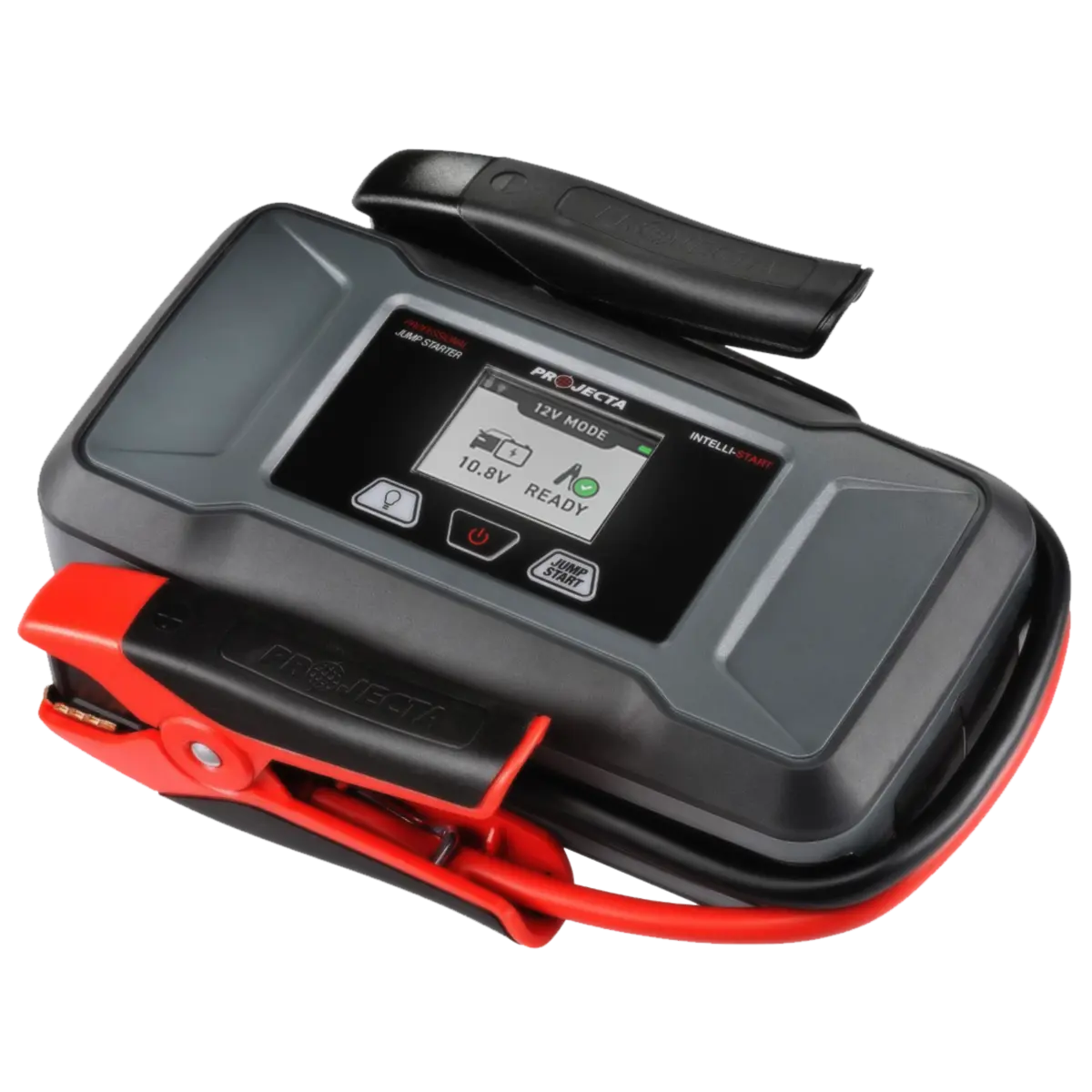
Exact IS1400 product image.
Projecta specifies 12V operation, 1400A peak and a separate 500A maximum clamp-power figure. It rates the IS1400 for petrol engines up to 7.0L and diesels up to 5.0L. The 51.2Wh LiFePO4 pack has a manufacturer-rated 2000-cycle life, while the 400mm 4AWG leads, spark-free clamps, MCU-controlled polarity protection, overload and surge protection, LCD diagnostics and IP65 rating strengthen the serious-use case.
Rapid Recharge is the defining touring feature. After a successful start, Projecta says leaving the unit connected to the running vehicle can replace the energy used in that jump in about 40 seconds. This does not mean a completely flat IS1400 fully charges in 40 seconds.
Repco listed the exact IS1400 at $411 during the current check. Projecta direct was $418 but sold out, so that direct price is not presented as immediate availability. The compromises are price, 1.7kg weight, 12V-only scope and basic 5V/3A USB output compared with NOCO.
What owners say
Australian Caravan World has reported successful diesel and staged vehicle starts with the IS1400 in touring use. That is useful field/editorial experience, not controlled laboratory testing and not owner-rating evidence.
Pros
- LiFePO4 chemistry
- Transparent 500A clamp-power figure
- Rapid Recharge after a jump
- Published 2000-cycle rating
- IP65 and rugged 4AWG leads
- Two-year warranty
Cons
- Expensive
- 12V only
- Basic USB charging
- Heavier than CAROSS
- Small exact-model owner pool
- Direct stock was inconsistent
Jump starter buying guide
Peak amps versus clamp power
Peak amps are not a universal real-world starting test. Definitions and durations differ, so use the manufacturer's engine-size guidance alongside cable gauge, clamp construction, battery architecture and protection systems. Projecta's separate 500A clamp-power specification is valuable transparency; neither NOCO nor CAROSS is assigned an invented equivalent.
12V versus 24V
Most passenger cars, SUVs, utes and ordinary 4WDs use 12V starting systems. A large diesel is not automatically 24V. Trucks, heavy equipment and some commercial or agricultural machines may use 24V. All three winners here are 12V products: never connect one to a 24V system.
Petrol and diesel ratings need headroom
Manufacturer engine-size ratings are selection guides, not guarantees. Battery condition, internal failure, oil viscosity, temperature, glow-plug load, cable connection and engine health all influence the start. Diesels generally demand more starting energy; extra published headroom is sensible for cold, remote or ageing-battery use.
Battery chemistry
Conventional lithium-ion provides high energy density in a compact pack. Projecta's LiFePO4 design adds a detailed manufacturer cycle-life claim and is well suited to repeat-use architecture. That does not make every conventional lithium-ion pack unsafe; engineering, protection and correct storage still matter.
Storage, self-discharge and Australian heat
Check charge periodically, recharge after use, follow the exact manufacturer's interval and do not store a badly depleted pack. Vehicle cabins become extremely hot, so observe storage-temperature guidance, avoid direct sun, keep open ports dry and stop using any pack that is damaged or swollen. A jump starter is not a charge-once-and-forget-for-years product.
Cold-weather performance
All batteries lose available performance as temperature falls. Projecta warns that IS1400 starting performance is reduced below about 15°C, while NOCO lists a wider operating range. An operating-temperature limit does not mean full rated performance is available at the extreme.
Clamp quality and electrical protection
Look for reverse-polarity protection, spark protection, short-circuit or over-current protection, adequate cable gauge and a firm clamp bite. Do not judge a clamp from appearance alone. Projecta publishes 400mm 4AWG leads and a clamp-current figure; those details are not invented for rivals that do not publish them.
Manual override requires extra care
Some units provide force-boost or override for batteries too flat for automatic detection. This can bypass part of the normal safety logic. Use it only exactly as the manufacturer instructs: incorrect polarity can cause sparks, vehicle damage, battery damage or injury.
USB power banks and torches are secondary
NOCO's 60W USB-C PD is the strongest power-bank implementation here; CAROSS uses 18W-class QC and Projecta has basic 5V/3A USB. A built-in torch helps with terminals at night, but it does not replace hazard lights, warning triangles or safe roadside positioning. Starting reliability remains the primary job.
When a jump starter will not fix the problem
A jump starter helps a flat or weak 12V starting battery. It cannot repair a failed starter motor, seized engine, fuel fault, serious charging-system fault, broken terminal, immobiliser issue or catastrophic internal battery failure. If the vehicle repeatedly needs a jump, have the battery and charging system diagnosed.
Jump-start safety basics
Verify the vehicle voltage and follow both the vehicle owner's manual and the exact jump-starter instructions. Identify the specified battery or remote jump terminals, switch off vehicle electrical loads, connect positive and negative exactly as directed, keep clamps apart and never attach them to fuel lines. Do not use a damaged or swollen pack, expose open ports to water or make repeated rapid crank attempts beyond the manufacturer's limits. After starting, disconnect in the stated sequence and recharge the pack. Manual override should be used only under the manufacturer's exact procedure.
Which one should you buy?
Choose the NOCO Boost X GBX55 for the strongest mainstream mix of engine coverage, protection and fast USB-C charging.
Choose the CAROSS T18PRO for credible, heavily reviewed Australian-retail roadside backup around $160.
Choose the Projecta IS1400 for remote touring, LiFePO4 chemistry, detailed electrical specifications, Rapid Recharge and a two-year warranty.
Frequently asked questions
How many amps should a jump starter have?
There is no single reliable answer from peak amps alone. Match the published petrol or diesel engine-size rating with useful headroom, then compare clamp construction, battery architecture, protections and warranty. Treat headline current as a manufacturer specification unless independently tested.
Can a jump starter start a completely dead battery?
Sometimes. A battery with voltage below the unit's automatic detection threshold may require a manufacturer-approved override mode. Override can reduce normal protection, so use it only under the exact instructions and never guess the polarity.
How often should I charge a jump starter?
Follow the exact manufacturer's storage and recharge guidance, check it periodically and recharge after every use. Temperature, age and parasitic losses affect readiness, so do not assume a unit stored for years will work.
Can I leave a lithium jump starter in my car?
Only within the manufacturer's stated storage-temperature and handling limits. Australian cabin heat can be severe. Avoid direct sun, inspect the pack for damage or swelling, keep ports closed and dry, and move it if the vehicle environment exceeds its guidance.
Can I use a 12V jump starter on a 24V truck?
No. Use equipment explicitly designed for the vehicle's 24V system. The three formal recommendations in this guide are 12V-only products.