How we chose
We assessed exact current Australian models, legitimate availability and pricing, published airflow and inflation claims, maximum pressure, duty cycle, gauge-accuracy evidence, automatic shut-off, hose and cable reach, direct-battery versus socket versus cordless power, heat management, passenger-car and 4WD suitability, deflation functions, portability, source-specific owner evidence, warranty and current CHOICE test inclusion. Worth Buying scores are editorial judgements, not customer-star calculations. Manufacturer LPM and inflation-time claims remain manufacturer claims unless independently measured. Worth Buying Australia did not perform CHOICE's laboratory testing.
Serious contenders reassessed
XTM WM102-15B / Item 580442: is a very strong $199.99 4WD value alternative with a claimed 160L/min, 45-minute duty cycle at 40psi, 8m hose, thermal protection and roughly 882 exact-listing reviews. Its 12-month warranty is much shorter than Bushranger's, and its headline flow remains manufacturer free-flow data.
XTM Item 695927: is a separate newer 160L/min listing, recently $149.99 or $99.99 on club promotion, with a 2m battery lead and around 90 reviews. Its specifications, pricing and reviews are not merged with Item 580442.
CAROSS Q15: is the strongest self-contained rechargeable near-miss at $149.99, with a 7500mAh internal battery, digital presets and USB-C charging. Published LPM, duty-cycle and large-tyre speed data are less transparent.
SCA Hurricane and Thunder: remain straightforward wired budget alternatives. Hurricane publishes 50L/min at $99.99; Thunder publishes 25L/min at $79.99. Bushranger has the stronger dedicated 4WD case, while Ryobi is easier for everyday top-ups.
TJM 013TJMCOMP, Mean Mother MMACA3 and Dr Air AC402: are in CHOICE's current exact test cohort. Member-locked performance is not inferred, and none is described as poor. Bushranger's five-year warranty and complete 4WD package are clearer from public evidence.
Ozito PXC high-pressure inflator: is an excellent low-price power-tool alternative at about $59.98 skin with strong retailer feedback. Ryobi's clearer exact tyre-inflation specification and established ONE+ positioning make it the cleaner formal value pick.
Bushranger Black Max Air Compressor 55X12
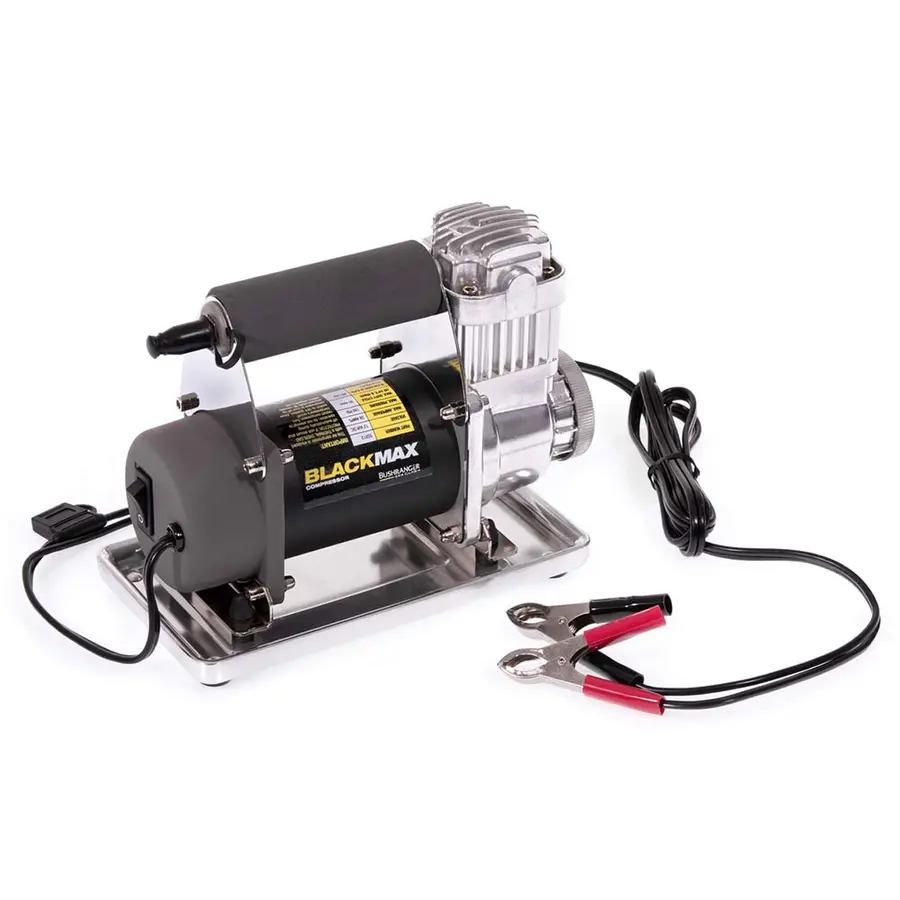
Exact 55X12 official Bushranger product image.
Bushranger specifies a 12V motor, 66L/min manufacturer maximum flow, 150psi maximum pressure and a 30-minute duty cycle at 40psi and 24°C. It draws up to 28A through direct battery clamps and a 30A fuse, avoiding the limitations of a typical accessory socket. The 2.4m lead and 7.5m coiled hose provide 9.9m combined reach, so the compressor can remain near the engine bay while reaching rear tyres.
The built-in deflator is especially useful for a 4WD routine: air down for suitable terrain, then reinflate before sustained road speed. Thermal overload protection, a carry bag, removable base plate and supplied hard-mount kit complete the package. It weighs about 3.9kg alone or 4.9kg as a kit, and it does not provide a digital preset or automatic shut-off.
Bushranger listed the exact 55X12 at $280 during preparation, but its direct page showed back order at the exact check. The product remains available through Australian retail channels; confirm live stock before purchase.
Customer evidence
Bushranger does not expose a large conventional exact-model public owner-star pool, so none is invented. The recommendation rests on the exact technical architecture, five-year warranty, specialist product history and current CHOICE test inclusion.
Professional evidence
CHOICE includes the exact Bushranger Black Max 55X12 in its 2026 portable-air-compressor cohort and publicly confirms its hose, cord, kit weight, carry bag, gauge, thermal cut-out and hands-free deflator. Member-only performance scores, inflation time, noise and gauge-accuracy results are not inferred, and the product is not called CHOICE Recommended.
Pros
- Dedicated 4WD-capable architecture
- 7.5m hose and built-in deflator
- 30-minute stated duty cycle
- Thermal overload protection
- Direct battery power
- Five-year warranty
Cons
- Expensive for basic top-ups
- Wired and heavy
- No digital preset shut-off
- Lower headline flow than XTM
- Requires correct clamp connection
Ryobi 18V ONE+ High Pressure Inflator RPI18
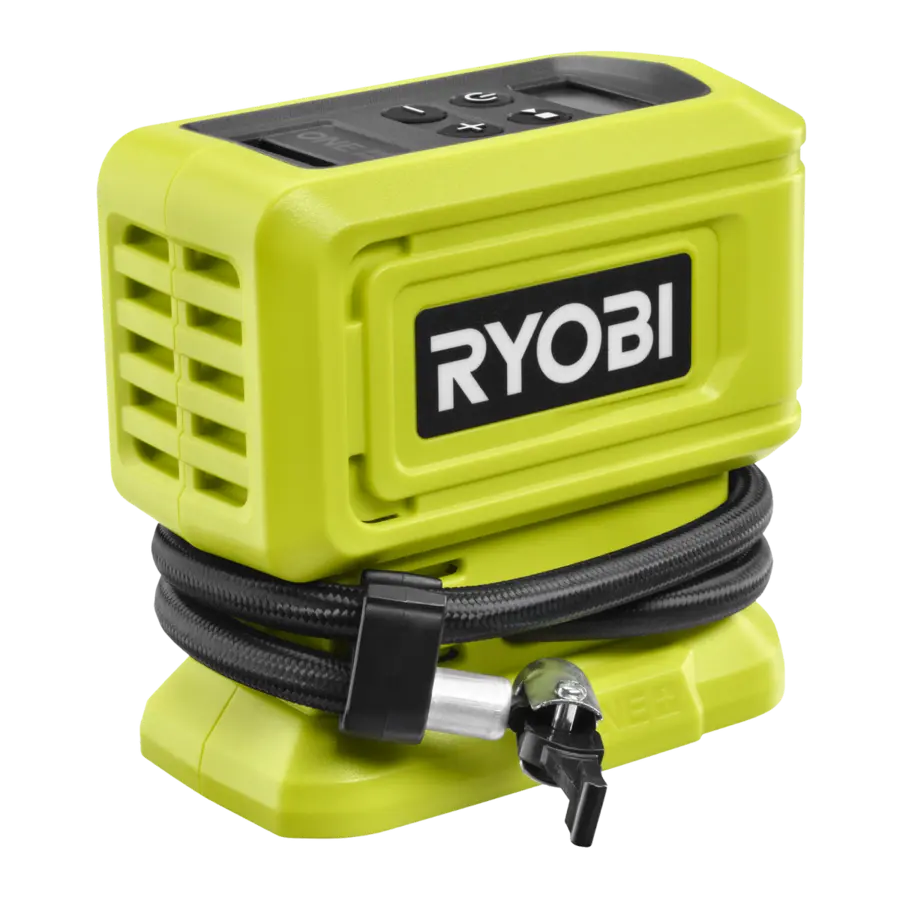
Exact RPI18 Australian retailer product image.
Ryobi specifies 160psi / 11bar / 1100kPa maximum pressure, more than 16L/min free-air flow at 0psi, a 0.6m hose and a backlit display in PSI, bar or kPa. Preset pressure, hands-free operation and automatic shut-off make it much easier than a manual-gauge compressor for routine maintenance. An inflation needle, Presta adaptor and toy-valve nozzle are included.
The exact RPI18, Bunnings I/N 0575934, was $79 during preparation. That is a tool-only price: battery and charger are not included. For an existing ONE+ household it is a cheap incremental purchase; for a new buyer, the battery and charger must be added before comparing it with Bushranger's complete kit.
Its >16L/min free-air figure and short hose suit top-ups, not repeatedly raising four large 4WD tyres from low off-road pressure. Battery runtime depends on pack size, and prolonged large-tyre work creates more heat and a slower workflow.
What owners say
Bunnings displayed 4.6/5 from 83 reviews on the exact RPI18 listing at the research snapshot. That exact-model Australian retailer evidence is not combined with RMI18, older Ryobi inflators or international variants.
Pros
- $79 skin price
- Digital preset and auto shut-off
- Cordless and compact
- Strong exact-model owner pool
- ONE+ ecosystem
- Four-year / six-year registered warranty
Cons
- Battery and charger extra
- Modest free-air flow
- Not ideal for four 4WD tyres
- Short 0.6m hose
- Platform lock-in
Milwaukee M18 Inflator M18BI0
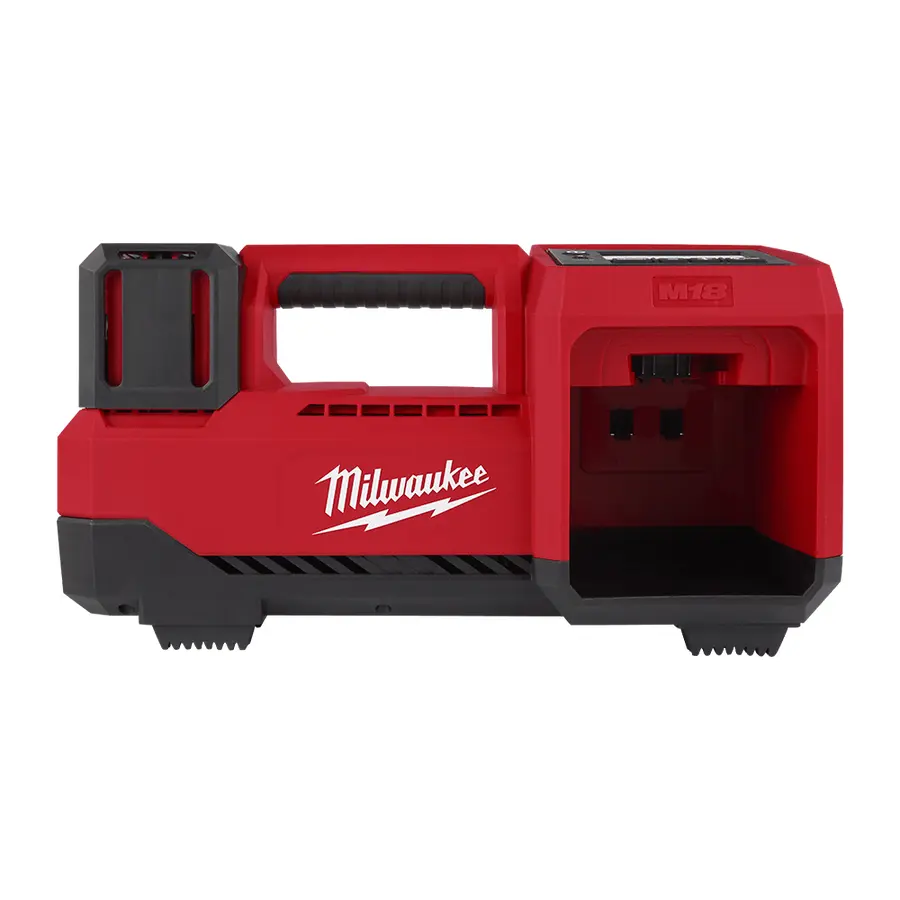
Exact M18BI0 official Milwaukee Australia product image.
Milwaukee Australia specifies 0–150psi, 1.41 SCFM free air at 0psi and a 33% duty cycle at 80psi. TRUEFILL automatically rechecks pressure before stopping, while four memory presets and PSI, kPa and bar units suit repeat work across cars, trailers, utes and light-truck tyres.
Milwaukee claims the M18BI0 can top off a 33-inch truck tyre in under one minute. That is the manufacturer's claim, not Worth Buying testing. The product is positioned for passenger, light-truck and medium-duty tyres, but it is not the same as a high-flow battery-clamp compressor used to air up four large tyres from very low pressure.
Total Tools listed the exact model at about $275 tool only during research. Battery and charger are extra. The bare tool already weighs 3.2kg, and the 33% duty cycle at 80psi is useful transparency—not permission for unlimited continuous operation.
What owners say
Total Tools displayed 30 exact-model reviews with a 100% rating snapshot during research. That Australian specialist-retail pool remains separate from Milwaukee-hosted and overseas feedback; it is not merged into a cross-source score.
Pros
- Fast cordless workflow
- Published 33% duty cycle at 80psi
- TRUEFILL pressure recheck
- Four memory presets
- Light-truck positioning
- Five-year warranty
Cons
- Expensive skin
- Battery and charger extra
- 3.2kg before battery
- Not a dedicated high-flow 4WD compressor
- M18 platform lock-in
What to know before buying a tyre inflator
Cordless versus direct-battery 12V
Cordless tool inflators are convenient, portable and commonly provide automatic shut-off. Their cost and readiness depend on a charged proprietary battery, and their sustained airflow is usually lower. Direct-battery compressors can draw more current and suit repeated 4WD reinflation, but they are heavier and require correct clamp connection. Neither format is universally better.
Accessory socket versus battery clamps
Small 12V socket inflators are limited by the vehicle socket, fuse and wiring. Serious compressors use direct battery clamps because their current draw can exceed that circuit: Bushranger specifies up to 28A, while some XTM units publish about 45A. Never improvise an accessory-socket adaptor for a battery-clamp compressor.
Airflow and duty cycle
Free-air LPM is measured with little or no back pressure, so delivered flow falls as tyre pressure rises. Prefer independent measured inflation time where available. Duty cycle states how long a compressor may run relative to cooling time under specific pressure and temperature conditions. Bushranger's 30 minutes at 40psi / 24°C and Milwaukee's 33% at 80psi are not directly equivalent test conditions.
Automatic shut-off and gauge accuracy
Ryobi and Milwaukee let you set a target and stop automatically; Milwaukee also rechecks pressure. This is convenient but not a promise of permanent calibration. Check pressure periodically with a trusted gauge. CHOICE measures gauge accuracy at 40psi, but current exact-model results are member locked.
4WD tyres, heat and hose reach
Adding 3psi to a car tyre is a much easier job than raising four large 4WD tyres from 15–20psi to road pressure. For that workload, sustained airflow, duty cycle, thermal management, long hose reach and deflation capability matter. Observe cooling requirements, keep vents clear, avoid dry grass around hot parts and let fittings cool before packing.
Battery ecosystem cost
Ryobi's $79 and Milwaukee's roughly $275 prices exclude batteries and chargers. For an existing ecosystem owner, the skin price may be the incremental cost. A new buyer must add the battery and charger before comparing either with Bushranger's complete $280 kit.
Tyre pressure and airing down
Inflate to the vehicle manufacturer's recommended pressure, typically on the tyre placard, door jamb or owner's manual—not automatically to the maximum printed on the sidewall. Check cold where specified. Lower off-road pressures can improve traction, but there is no universal sand or trail PSI: tyre, load, terrain and speed all matter. Reinflate appropriately before sustained road driving.
Portable tyre inflator safety basics
Follow the exact compressor, battery and vehicle manuals. Park on stable ground away from moving traffic, apply the parking brake and keep the tool, cable and hose clear of hot, rotating or moving vehicle parts. For direct-battery models, switch the compressor off before connecting, identify the correct 12V terminals, observe polarity and keep clamps apart. Do not use an improvised accessory-socket adaptor.
Observe the stated duty cycle and cooling time, keep vents clear and never defeat a thermal cut-out. The compressor head, hose and fittings can become hot; avoid immediate contact and let them cool before packing. Keep dry grass and debris away from hot components. Inspect the hose, lead, clamps, battery pack and casing before use, stop if damaged, and keep electrical connections dry.
Use the vehicle placard pressure rather than the tyre sidewall maximum for normal inflation, check pressure cold where specified, and never exceed the safe pressure limits specified for the tyre and wheel or rim. Do not leave the inflator unattended merely because it has automatic shut-off, and verify final pressure with a reliable gauge when accuracy matters.
Before cleaning, inspecting, clearing, servicing or performing maintenance, disconnect a 12V inflator from its power source or remove the cordless battery. Inflation is not a substitute for repairing a damaged tyre: cuts, bulges, exposed cords, serious puncture damage, or bead or structural damage require professional assessment and appropriate repair or replacement rather than simply reinflating and driving. Keep children and bystanders clear during operation.
Which one should you buy?
Choose the Bushranger Black Max 55X12 for a 4WD or SUV, repeated reinflation, long hose reach and the strongest complete-package warranty.
Choose the Ryobi RPI18 if you already own ONE+ and mainly want convenient automatic everyday top-ups.
Choose the Milwaukee M18BI0 if you already own M18 or use an inflator frequently enough to justify a heavier, faster, more sophisticated cordless tool.
Frequently asked questions
How many litres per minute do I need for a 4WD?
There is no universal threshold because free-air ratings use different conditions. For four large tyres, compare independent inflation time where available, duty cycle, thermal protection and hose reach—not one LPM number.
Can I run a 4WD compressor from the cigarette-lighter socket?
Only if the exact compressor is designed for that socket and circuit. High-current units generally connect directly to the battery. Follow the manufacturer's wiring instructions.
Is a cordless inflator good enough for 4WD tyres?
Often for occasional top-ups. For repeatedly inflating four large tyres from low off-road pressure, a dedicated high-flow direct-battery compressor is usually the more suitable tool.
Should I inflate to the PSI on the tyre sidewall?
No. Use the vehicle manufacturer's recommended operating pressure unless a specific application calls for something else. The sidewall figure is generally a maximum, not the normal target.
Why does an air compressor need a duty cycle?
The motor and pump create heat. Duty-cycle limits define permitted running and cooling time under stated conditions, reducing the risk of overheating and premature damage.