
Pool cleaner assessments
Dolphin M400
CB 99991049-AUI23 / WB 99991048-AUI23
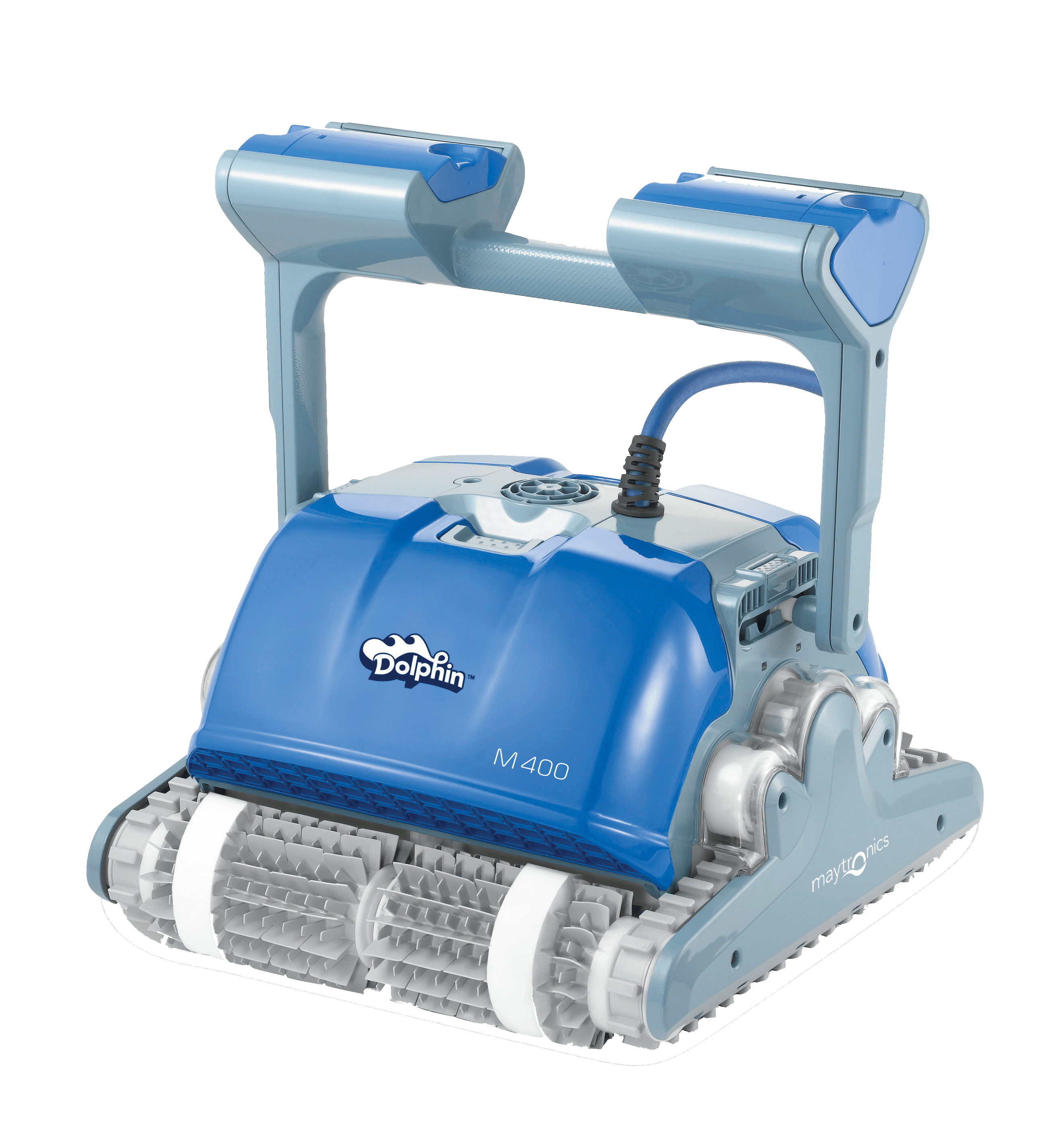
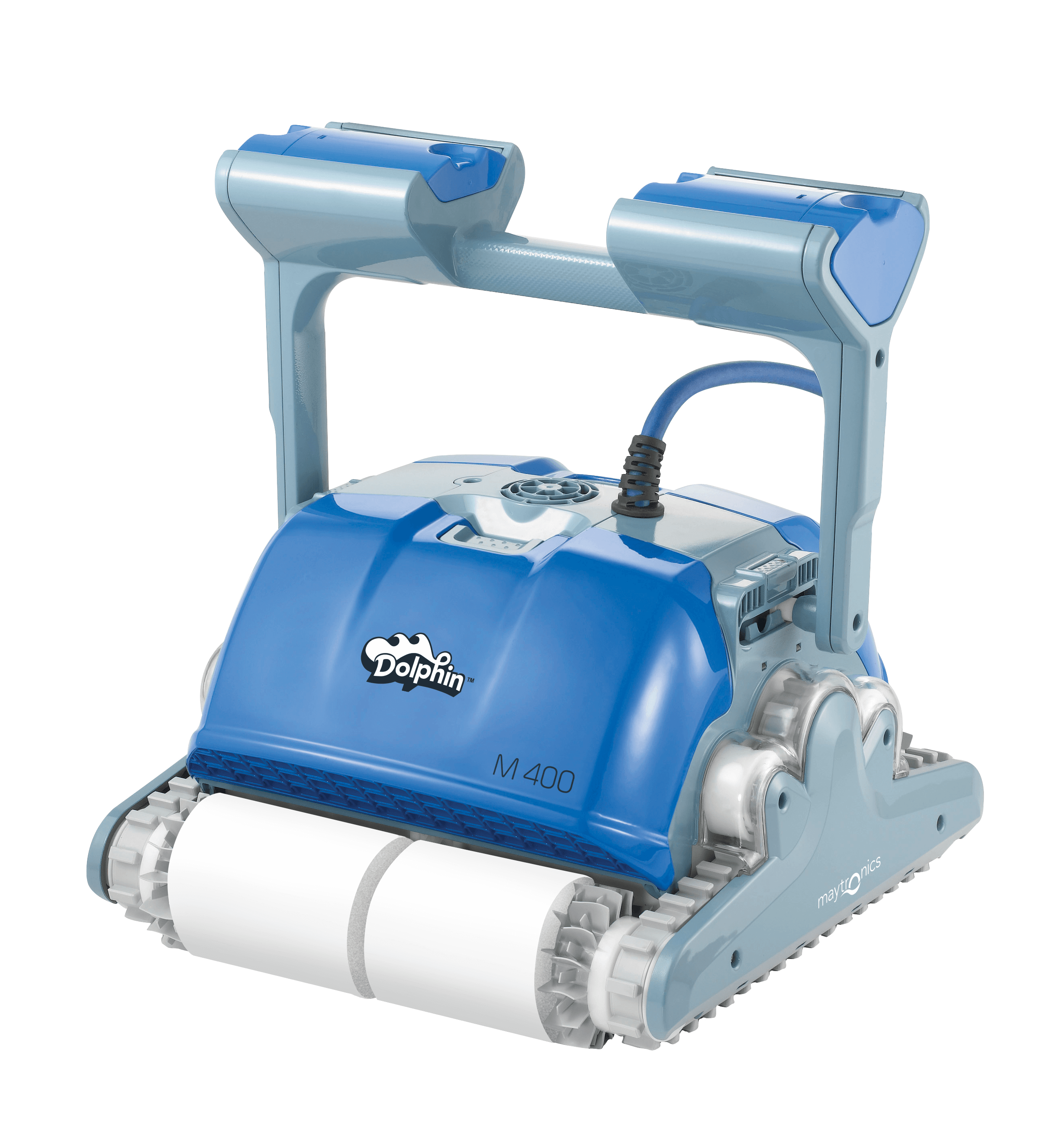
Our Best corded choice combines supplied fine filtration, surface-specific brush options, an included caddy and three-year qualifying-defect cover. Choose the correct brush version and confirm you can manage the heavy lift; cable care and potentially substantial repair costs remain trade-offs.
Specifications
| Australian model and equipment | CB 99991049-AUI23 (rough finishes) or WB 99991048-AUI23 (smooth finishes); supplied AU power unit, caddy and filters. |
|---|---|
| Power system | Corded low-voltage cleaner; supplied Australian mains power unit. |
| Pool size | Up to 15 m pool length, manufacturer-rated; confirm usable cable reach. |
| Surface choice | Combined Brush: rough finishes. Wonder Brush: smooth concrete, fibreglass and tile. Confirm exact pool/liner suitability. |
| Cleaning coverage | Floor, walls and waterline; triple active scrubber. Steps and ledges are not guaranteed. |
| Operating depth | 0.8–3 m: conservative overlap of differing manufacturer documents. |
| Cycles and scheduling | 1.5 / 2.5 / 3.5 hours; cycle selector, weekly timer, cleaning modes and delay start. |
| Filtration | Supplied fine and ultra-fine cartridges, removable through upper covers. |
| Cable | 17 m with swivel in current Australian documentation; older seller revisions may differ. |
| App and retrieval | MyDolphin Plus settings, scheduling and remote driving via connected power unit; manual handle retrieval. |
| Handling | 11 kg dry; caddy included. Drain before lifting; dry foam brushes require saturation. |
| Operating conditions | Water 6–34°C (document overlap); pH 7.0–7.8; chlorine ≤4 ppm; salt ≤5,000 ppm. Follow stricter supplied instructions. |
| Australian warranty | 36 months for qualifying manufacturing defects; conditions and exclusions apply. Statutory rights remain. |
Extended product analysis
Match the brushes to the pool
Combined Brush suits rough finishes; Wonder Brush is the maker's option for smoother surfaces such as tile and fibreglass. That choice helps match grip, but does not guarantee complete coverage. Owners report effective floor, wall and waterline cleaning alongside step snagging, poor climbing and deep-end bias. Demonstrate the exact version around your pool's awkward transitions. Liner-damage allegations remain unresolved and warrant checking contact points and suitability.
Fine filtration needs regular cleaning
The supplied fine and ultra-fine media are useful for mixed leaves, sand and settled sediment. Some owners prefer a more open filter for an initial dirty pass, followed by finer panels. Concentrated leaves can obstruct the intake or load the filters before the pool is finished. Reduced flow can also affect climbing. Empty promptly and handle the panel fittings carefully; broken clips and costly replacement media appear in the ownership record.
Upper access, with a substantial lift
Both cartridges lift through upper covers, with more removable pieces than S250's single basket. Owners also describe cleaning them as straightforward. At 11 kg dry before retained water, M400 needs a substantial lift. The caddy helps transport, not retrieval over coping: try lifting a drained machine from your pool edge. No controlled same-pool test establishes superior pickup to S250.
Serviceable does not mean inexpensive
The record includes successful multi-year cleaning, helpful repairs and substantial motor, cable and power-supply bills. Parts availability and three-year qualifying-defect cover improve the proposition without establishing predictable repair costs or reliability. Confirm where assessment occurs and how diagnosis, labour and freight are handled. Older power-supply parts are not necessarily replacements for current connected units.
Pros
- Supplied fine/ultrafine media in upper-access removable cartridges.
- Brush variants help match rough and smooth pool finishes.
- Repeat powered cleaning without a recharge interval.
- Included caddy and established Australian service parts.
- Longer voluntary manufacturing-defect cover than S250.
Cons
- Heavy lifting and difficult pool-edge handling can rule it out.
- Cable positioning, untwisting and storage remain chores.
- Steps, liners and difficult curves require a demonstrated fit.
- Panel fittings and brushes are maintenance expenses.
- Major electrical repairs and downtime can be substantial.
You can manage the lift and want a supported mixed-debris cleaner with the right brush option for your pool finish.
The reach over the pool edge is difficult, you need reliable shallow-shelf cleaning, or a lighter machine performs the same task in your pool.
Choose the brush version for your pool finish. Current maker cable length is 17 m; some seller descriptions say 18 m. Confirm the supplied revision before purchase.
Dolphin S250
99996220-AUI
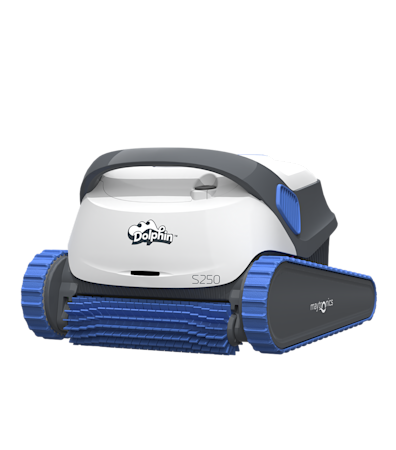
Our Best for easier handling combines a lighter corded body, one removable basket and supplied ultrafine filtration. Cable care, variable pool coverage and potentially substantial repair costs remain trade-offs, while its customer-rating evidence concerns the S200 predecessor platform.
Specifications
| Australian model and equipment | 99996220-AUI; supplied AU power unit and coarse/ultra-fine basket. Caddy optional. |
|---|---|
| Power system | Corded low-voltage cleaner; supplied Australian mains power unit. |
| Pool size | Up to 15 m pool length, manufacturer-rated; confirm usable cable reach. |
| Surfaces | All-terrain PVC brush and active scrubber. Confirm grip and exact pool/liner suitability. |
| Cleaning coverage | Floor, walls and waterline; steps, benches and ledges are not guaranteed. |
| Operating depth | 0.4–5 m in the model manual; minimum depth does not guarantee shallow-shelf cleaning. |
| Cleaning cycle | Two hours; on/off and weekly scheduling. MyDolphin Plus supports remote operation through the connected power unit. |
| Filtration | Supplied top-access multilayer basket with coarse and ultra-fine media; removable panels for cleaning. |
| Cable | 17 m with swivel in current Australian documentation; older seller revisions may differ. |
| App and retrieval | MyDolphin Plus via connected power unit; basic on/off without a phone. Manual handle retrieval, without automatic waterline parking. |
| Handling | 7.5 kg dry; drain before lifting. Transport caddy sold separately. |
| Operating conditions | Water 6–35°C; wall climbing may decline below 15°C. pH 7.0–7.8; chlorine ≤4 ppm; salt ≤5,000 ppm. |
| Australian warranty | 24 months for qualifying manufacturing defects; conditions and exclusions apply. Statutory rights remain. |
Extended product analysis
A single basket simplifies the routine
The supplied coarse and ultra-fine arrangement provides a practical starting point for leaves mixed with settled dirt. The basket lifts out from above, with fine panels removed for more thorough cleaning. Earlier-platform owners report useful fine pickup, but also intake blockages and reduced coverage as filters load. Clear heavy piles first and choose the media for the debris rather than assuming the finest filter is best for every pass.
Less weight, with equipment trade-offs
At 7.5 kg dry, S250 is materially lighter than M400, though retained water still adds to the lift. It is not claimed to be the lightest cleaner. One basket can simplify emptying compared with separate cartridge panels; M400 also has upper filter access. S250's caddy is optional and its voluntary warranty is shorter. M400's dedicated brush choices can also matter on slippery finishes. Try both the lifting task and traction before choosing on weight alone.
Useful history, qualified current ownership
S200 predecessor-platform experience supports the core cleaning and maintenance assessment, including good multi-year service and reports of cable twist, deterioration, missed areas and expensive repairs. Current S250 controls, supplied filtration and advertised reach differ from older configurations. That history does not establish the life of the present power unit or app. Connected controls add convenience when useful; they do not prove better pickup or coverage.
Check reach and difficult areas
The current pool-length rating is a manufacturer specification, not an independent guarantee. Allow for depth, obstacles and a safely positioned power supply when checking cable reach. Owners describe good cleaning on varied finishes alongside step, shelf and curved-transition problems. Some issues improved with maintenance or filter changes; others persisted. A demonstration should include those difficult areas rather than only a clear, flat floor.
Supported repairs still carry a cost
Australian suppliers list motors, cables, brushes and drive components for the shared service architecture. That offers a maintenance route without proving identical original assemblies or inexpensive fitted repairs. Helpful local service and support disputes both occur. Confirm diagnosis, labour, transport and downtime costs; no universal fitted repair price is established.
Pros
- Supplied coarse and ultrafine filtration for varied settled debris.
- Single top basket supports straightforward emptying.
- Lighter lifting than M400 or Robo-Plus V2.
- Repeat cleaning without battery recharging.
- Documented Australian parts and repair support.
Cons
- Cable care and safe power-unit placement remain necessary.
- Intake blockage and missed steps, curves or shelves can require manual cleaning.
- Caddy costs extra and voluntary cover is shorter than M400's.
- Current controls have less long-use evidence; major repairs can be expensive.
A manageable daily lift, a single basket and a lower purchase commitment suit your routine better than M400's extra equipment and cover.
You need assured cleaning of a difficult beach entry, cannot provide a safe corded setup, or expect historical platform experience to guarantee the current electronics' service life.
Current maker cable length is 17 m; some seller descriptions say 18 m. Confirm the supplied revision before purchase.
Beatbot AquaSense 2
PRCSDE02-AU-G
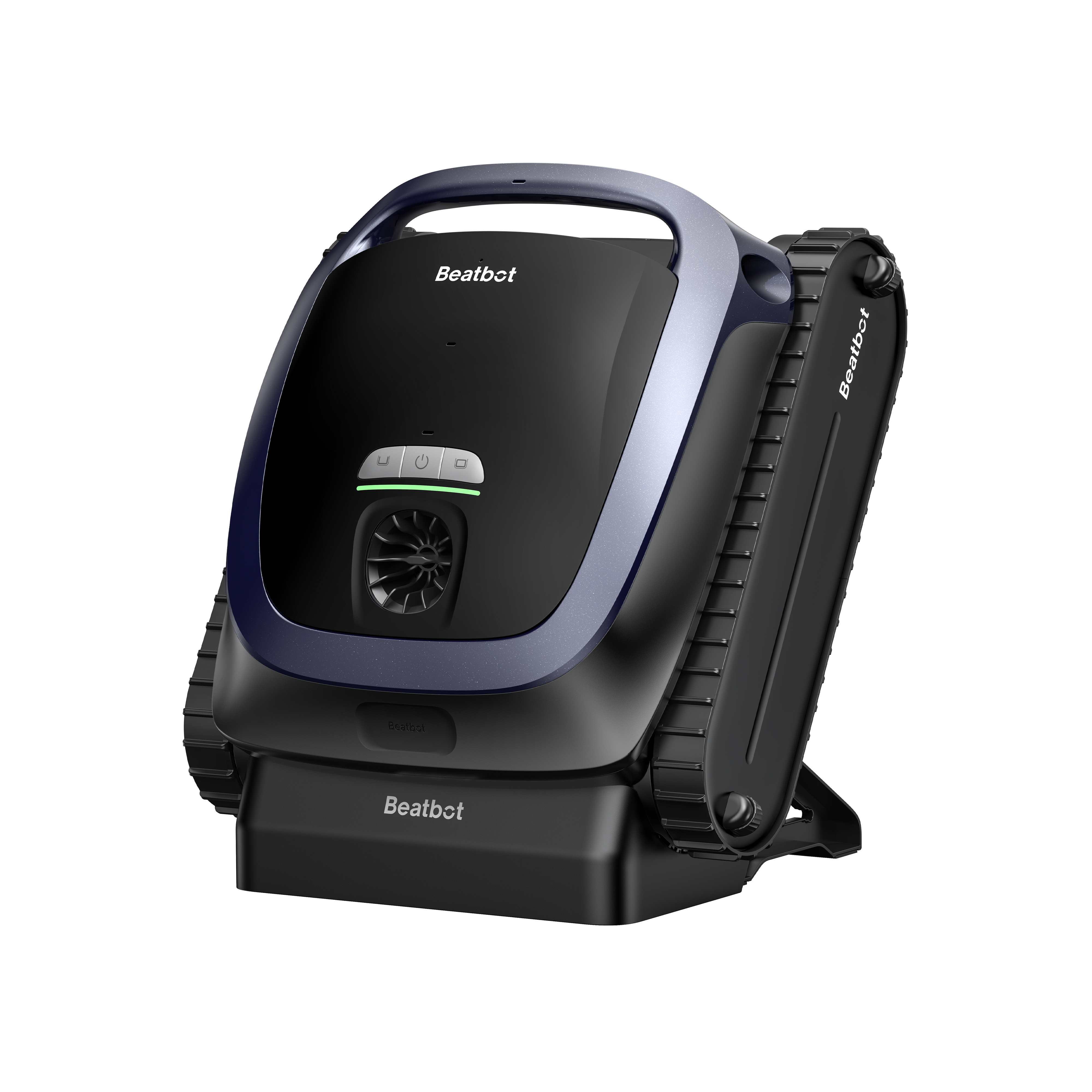
Our Best for cable-free convenience uses waterline parking and dock charging to simplify retrieval and recharging. Accept its coarse supplied filtration, small basket and substantial lifting weight, with manual touch-ups still possible around difficult pool shapes.
Specifications
| Australian model and equipment | Base PRCSDE02-AU-G; robot, dock/adapter, basket and hook. Pole not included; not Pro or Ultra. |
|---|---|
| Power system | Cordless; 21.6 V, 10,000 mAh rechargeable battery. |
| Pool size and depth | Up to 300 m² pool-bottom area, manufacturer-rated; general depth 0.5–3 m. |
| Surfaces and coverage | In-ground/above-ground use; floor, walls and waterline. Coverage depends on finish and geometry. |
| Steps and ledges | Broad submerged steps only where the robot is supported; no assured shallow-shelf coverage. |
| Modes and runtime | Floor or Standard floor/walls/waterline modes. Up to four hours in floor mode; actual runtime varies. |
| Charging | Approximately four hours at 25°C. Dock input 100–240 V AC, 50/60 Hz; output 28 V, 3 A. |
| Battery servicing | Qualified repair required; no owner-replacement procedure or established fitted Australian renewal price. |
| Filtration | 2 L top-access basket; nominal 150 µm standard screen. |
| App and retrieval | Wi-Fi setup/settings at surface; automatic waterline parking and hook fallback. No dependable live underwater remote control. |
| Handling and dimensions | 10.47 kg dry; 451 × 435 × 233 mm. Drain before lifting. |
| Operating conditions | Water 6–35°C; pH 7.0–7.8; chlorine ≤4 ppm; salt ≤5,000 ppm. Charge 0–40°C. Robot IP68; dock IPX4, kept clear of water. |
| Australian warranty | 36 months main body, including battery and power supply; three months basket/brush. Conditions apply; replacement may be refurbished. |
Extended product analysis
Parking helps you reach the handle
Waterline parking can spare you locating the robot on the bottom, but depends on grip, battery reserve and parking position. A missed window or failed climb requires the supplied hook and your own pole. Dependable submerged app control is not promised. Its 10.47 kg dry body still needs a substantial lift.
Useful cleaning, limited fine capture
Original tests and owners support useful floor, wall and waterline cleaning in compatible pools. BobVila's test was favourable; FreshlyCharged found obstacle and missed-area problems, while PoolNerd reported weak fine pickup and debris escaping during removal. Trial it in your pool: the standard 150 µm screen compromises persistent silt or pollen capture, and the 2 L basket may need repeated emptying among leaves.
Runtime is different from complete coverage
Maximum runtime concerns floor cleaning; walls, obstacles and recovery use time and energy, so one session may not cover everything. Owners report successful free-form cleaning as well as difficulty around drains, ladders and corners. Shallow shelves and narrow steps may not provide enough submerged room. Cable-free operation adds charging between runs and eventual battery servicing. Floating debris needs separate attention: this model does not skim.
The dock simplifies charging, not repairs
The upright dock avoids reconnecting a charging plug, but damage or loss interrupts use. Follow drying and placement instructions. Australian main-body cover expressly includes the battery and power supply, while basket and brush cover is shorter. A warranty replacement may be refurbished. A fitted Australian battery-renewal price and assured turnaround remain unknown; confirm the seller's assessment and freight arrangements rather than assuming economical lifetime renewal.
Pros
- Surface parking can reduce deep hooking and reaching.
- Charging dock simplifies routine recharge handling.
- Useful floor, wall and waterline cleaning in compatible pools.
- Australian main-body warranty explicitly includes the battery.
Cons
- Supplied 150 µm screen is a limitation for very fine debris.
- Small 2 L basket needs attention in leafy pools.
- Corners, steps and fittings can defeat coverage.
- Submerged app recall and successful parking are not guaranteed.
- Significant lifting weight and unknown future fitted battery cost.
You clean frequently, can reach the pool edge safely and place more value on a dock and surface retrieval than on collecting the finest dust.
You need a large leaf basket, dependable shallow-shelf cleaning, continuous repeat sessions or a confirmed economical Australian battery replacement service.
Australian base AquaSense 2. Confirm regional supply and the applicable warranty with your seller.
What matters when choosing a robot pool cleaner
Buying advice
Start with the debris
Match filters to the debris. Coarse baskets collect leaves but can pass fine sediment; finer media load sooner and may need mid-run rinsing. Micron ratings do not establish whole-pool pickup: seals, flow and coverage matter too. Remove branches and concentrated piles before starting.
Test the difficult areas
Demonstrate drains, tight corners, floor-to-wall curves, steps and swim-outs. Wall climbing does not guarantee shallow-shelf coverage. Confirm brush and liner suitability for the exact finish, rather than an all-surfaces slogan. Allow for manual cleaning where the robot cannot reach.
Compare the lifting and filter task
Dry weight excludes retained water. Try reaching the handle from your coping and lifting a drained machine safely. Compare basket or cartridge washing and removable fittings. A caddy helps transport after retrieval; it cannot lift the cleaner over the edge.
Choose the cable or charging routine
Corded models can repeat a run without recharging but need safe lead positioning, inspection and storage. Cordless models add charging and eventual battery servicing. Parking helps reach the handle, without guaranteeing collection; check submerged-control limits and keep the prescribed retrieval fallback available.
Check support beyond the warranty headline
Ask who diagnoses faults and what labour, freight and downtime involve. Body, battery and wear-component cover can differ. Listed parts do not guarantee affordable fitted repairs or quick turnaround. Check the battery-renewal route and written service obligations before purchase.
Pay for useful functions
Pay for scheduling or parking that saves work in your pool. Apps, mapping displays and advertised pump rates do not prove better cleaning. Check whether ordinary operation needs a phone. Established designs remain worth considering when cleaning and maintenance suit your needs.
Electrical safety, charging and care
Use the supplied power equipment, suitable RCD protection and the exact manual's placement requirements. For both Dolphins, keep the power supply dry, at least 3.5 m from the pool edge and 11 cm above ground; do not use an extension lead. Do not assume older power supplies are interchangeable with current connected units.
Drain the cleaner and lift by its handle, never its cable. Beatbot must be drained and dried as instructed before docking; keep the dock clear of water and charge within its specified temperature range. Stop using damaged cables, chargers or batteries. Keep swimmers and pets out during cleaning. Follow chemical-treatment, rinsing and storage instructions: the robot does not replace circulation, water treatment or manual cleaning of inaccessible areas.
Which cleaner should you buy?
Dolphin M400: Choose our Best corded choice when its surface-specific brushes, supplied fine filters, caddy and three-year qualifying-defect cover justify the heavier lift. Confirm the correct brush version and demonstrate steps, curves and wall grip.
Dolphin S250: Choose our Best for easier handling when regular lifting and emptying are the main chores you want to reduce. Its 7.5 kg dry body and single basket are practical advantages; its cable, two-year cover and limited direct current-model history remain trade-offs.
Beatbot AquaSense 2: Choose our Best for cable-free convenience when cable handling is a persistent nuisance and waterline parking works in your pool. Accept the coarse standard basket, charging interval and unknown future battery-repair price rather than expecting the convenience award to mean superior fine-dirt cleaning.
Also considered
Other pool cleaners assessed
HY-CLOR S5 — a lower-cost corded alternative
A lighter, simpler corded option for compatible pools, with useful leaf pickup. Fine sediment can remain and basket cleaning takes effort; track, wheel and stopping complaints also feature. The maker excludes vinyl and above-ground pools. Consider it when lower cost outweighs those compromises and the pool meets its size limits.
Robo-Tek Robo-Plus V2 — fine-debris options, heavier upkeep
Supplied general and fine bags make it worth considering for leaves, seeds and settled dirt. Its roughly 12.5 kg dry body and laborious bag washing are significant drawbacks. Scheduled paid seal servicing and hour-limited motor-box cover add ownership commitments. Demonstrate pool fit and understand the written service terms before buying.
Mammotion SPINO E1 — a lower-cost cordless alternative
A lower initial price makes SPINO worth comparing, but cleaning and endurance findings are mixed. Standard filtration is relatively coarse; the finer Australian accessory costs extra. Missed areas and component-cover concerns remain. Consider it only when demonstrated cleaning, supplied equipment and battery support justify the saving.
Dolphin Liberty 600 — finer cordless filtration
Supplied fine and ultrafine media offer a reason to consider Liberty over coarser-filtered cordless options. Reports of incomplete cycles and unreliable retrieval temper that appeal. Its heavy lift and unestablished fitted Australian battery-renewal route and price remain material drawbacks. The manual’s wording alone does not establish inevitable whole-unit disposal.
How we chose
We prioritised debris removal, pool compatibility, supplied filtration, lifting, cleaning after use and realistic Australian ownership. Manufacturer documents, original professional tests and applicable customer experiences inform these research-based editorial assessments. We did not physically test the cleaners or establish a controlled same-pool performance ranking. Scores are editorial judgements, separate from customer stars.
Detailed methodology
M400's customer figure includes applicable historical controls and brush variants. S250's figure explicitly concerns the S200 predecessor cleaning platform, supported by manufacturer documents and service compatibility; it does not represent S250 purchases or prove current-control longevity. Current specifications are checked separately.
AquaSense 2 uses international manufacturer-hosted evidence; mirrored storefronts are not added. Screened averages use retained individual ratings after model and duplicate checks. Incentive-labelled ratings remain eligible with disclosure. Neither a higher mean nor a larger count establishes better national reliability. Full source records and limitations are retained in our research records. How customer ratings work.
Displayed customer averages are WBA-calculated from screened individual ratings; their source, model applicability and checked date are shown alongside them.
Frequently asked questions
Which M400 brush should I buy?
The maker directs Combined Brush to rough surfaces and Wonder Brush to smoother finishes such as tile and fibreglass. Confirm the exact surface with the seller and demonstrate transitions, steps and grip. Neither option guarantees every pool or liner application.
Will a robot clean every step and ledge?
No. Depth, tread size, traction and the route from the floor all matter. Test the exact areas and keep a manual brush or vacuum for places the robot misses.
Which should I consider for fine dust?
Start with M400's supplied fine/ultra-fine cartridges and S250's coarse/ultra-fine basket. No controlled comparison establishes a universal winner between them. AquaSense 2's standard 150 µm basket is a compromise for persistent fine silt. Fine filters may need more frequent cleaning.
Can I leave the cleaner in the pool?
Follow its manual and scheduled-mode instructions. A weekly timer does not cancel rinsing, storage or chemical-exposure requirements. Keep swimmers out during operation and remove the robot as directed for treatment and storage.
Why does S250 show predecessor-platform ratings?
Combined documentation supports using historical core cleaning experience, while current controls and supplied equipment are assessed separately. The label makes that distinction visible rather than presenting older purchases as current S250 owners.
What should I check about warranty and repair costs?
Coverage differs for the main body, battery and wear components. Ask who pays for diagnosis, labour and freight, and allow for downtime; no universal fitted repair price is established. An Australian fitted AquaSense 2 battery-renewal price and assured turnaround remain unestablished. Read the supplied Australian terms: statutory consumer rights remain separate from voluntary warranty cover.