How we chose
We assessed exact current Australian models, availability, current price, extraction rating and test conditions, compressor versus desiccant architecture, operating temperature, humidistat, continuous drainage, tank capacity, noise, power use, laundry functions, airflow, filtration, connectivity, maintenance, warranty and source-specific Australian owner evidence. We also considered current CHOICE testing where the exact model is publicly identifiable.
Worth Buying scores are editorial judgements, not calculations from owner stars. Manufacturer extraction, room-size, power and noise figures remain manufacturer ratings unless a named independent source measured them. Worth Buying Australia did not perform CHOICE's laboratory tests, and we do not infer member-only scores.
Serious contenders reassessed
Breville Smart Dry Plus Connect LAD308WHT2IAN1: is a strong smart-home near-miss at about $467, with app control, laundry mode and continuous drainage. Appliances Online's roughly 4.2/5 pool and the smaller, more mixed ProductReview exact-model pool stay separate; noise, humidistat accuracy and drain-hose quirks prevent it displacing AusClimate.
De'Longhi DDSX220WF-WH: combines 21L/day positioning, Wi-Fi, laundry mode, continuous drainage and EPA 12/carbon/dust filtration around $618–$649. Some retailer reviews originate from De'Longhi, and its lower headline capacity plus higher price weaken the value case against ACD235.
AusClimate ACD200 10L Smart Desiccant: adds Wi-Fi and a four-year domestic warranty for cool-season use, but its 610W rating, quoted 50dB noise, direct-stock inconsistency and unresolved product-page/manual temperature wording keep it behind the lighter, better-established ION610.
Ionmax ION630 and ION632: remain credible larger desiccant alternatives and appear in current CHOICE testing. ION610 wins this shortlist on price, weight and deeper exact-model ownership evidence, not because the bigger models are universally worse.
De'Longhi DD230P: is the specialist option when an integrated pump is genuinely needed to move condensate to a drain above the outlet. Most households can use simpler gravity drainage and get stronger value from AusClimate.
AusClimate Large 35L Smart Dehumidifier
Exact model: ACD235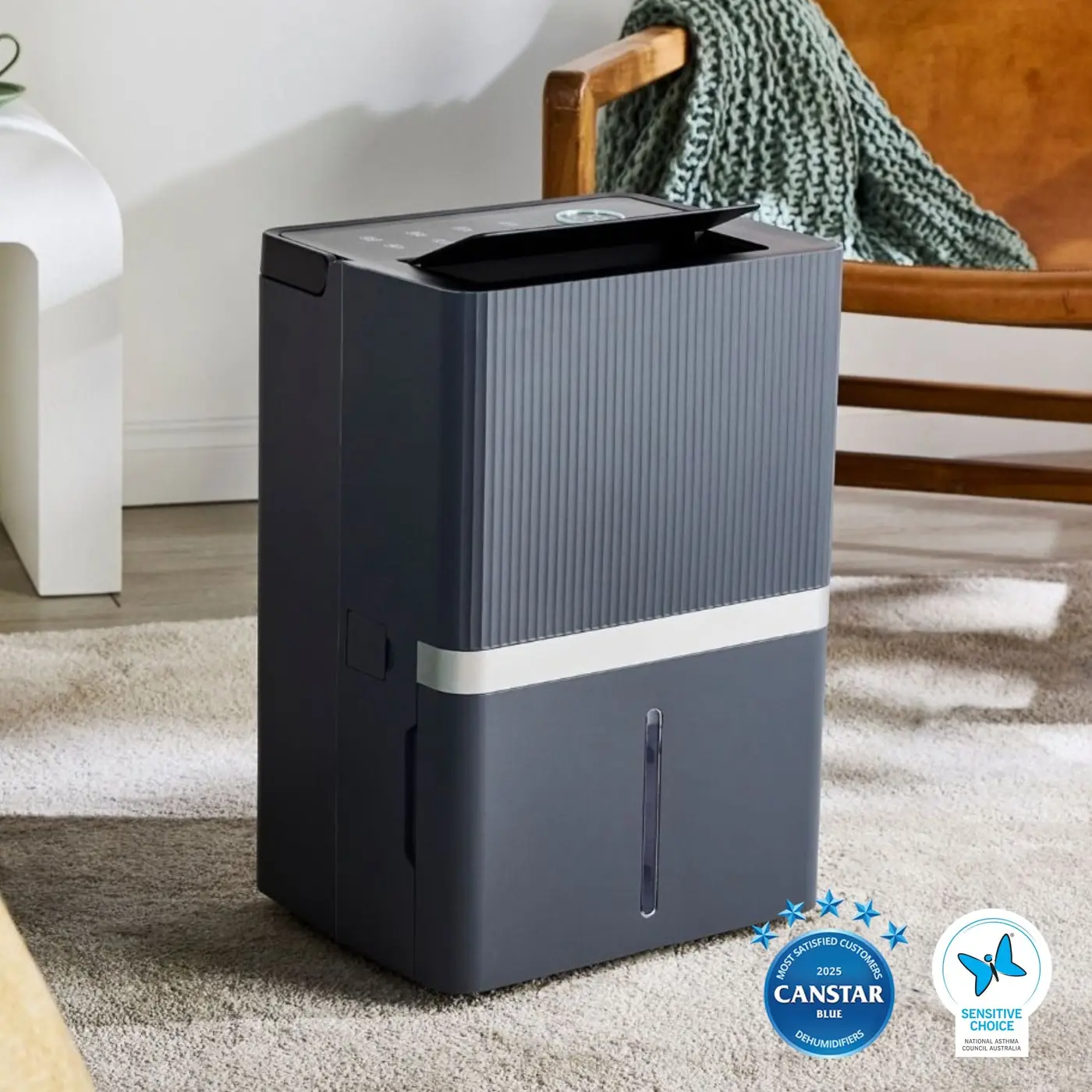
Exact ACD235 product image.
AusClimate rates the ACD235 to remove up to 35L/day at 30°C and 80% RH and positions it for areas up to 50m². Its 5L tank reduces emptying frequency, while the supplied drainage options suit a longer-term installation where a gravity drain is available. A variable humidistat, 24-hour timer, auto shut-off, Wi-Fi, app control and Alexa/Google Home support make remote schedules and full-tank alerts genuinely useful rather than decorative.
The 485W rotary-compressor platform suits coastal humidity, warm living areas and persistent condensation better than very cold rooms. AusClimate lists a 5–35°C operating range, 45dB noise, R290 refrigerant, 14.1kg weight and 530 × 355 × 275mm dimensions. The four-year domestic warranty is a major advantage at this price.
Owner evidence
The current ACD235's exact-model pool is still developing. AusClimate's broader compressor-dehumidifier range sits around 4.6/5 across hundreds of ProductReview submissions, which is useful support and reliability context—but it is not an ACD235 rating. Current-family comments also include instruction-quality, control, cord-length and mode-noise complaints. Appliances Online showed no meaningful exact-model review pool during research.
Pros
- Powerful mainstream capacity
- Good current value
- Large tank and continuous drain
- Wi-Fi, humidistat and 24-hour timer
- Four-year domestic warranty
Cons
- Thin exact-model owner history
- Compressor output drops as rooms cool
- Heavy at 14.1kg
- 45dB is audible, not silent
- Manufacturer-direct stock was sold out
Ionmax ION610 6L Desiccant Dehumidifier
Exact model: ION610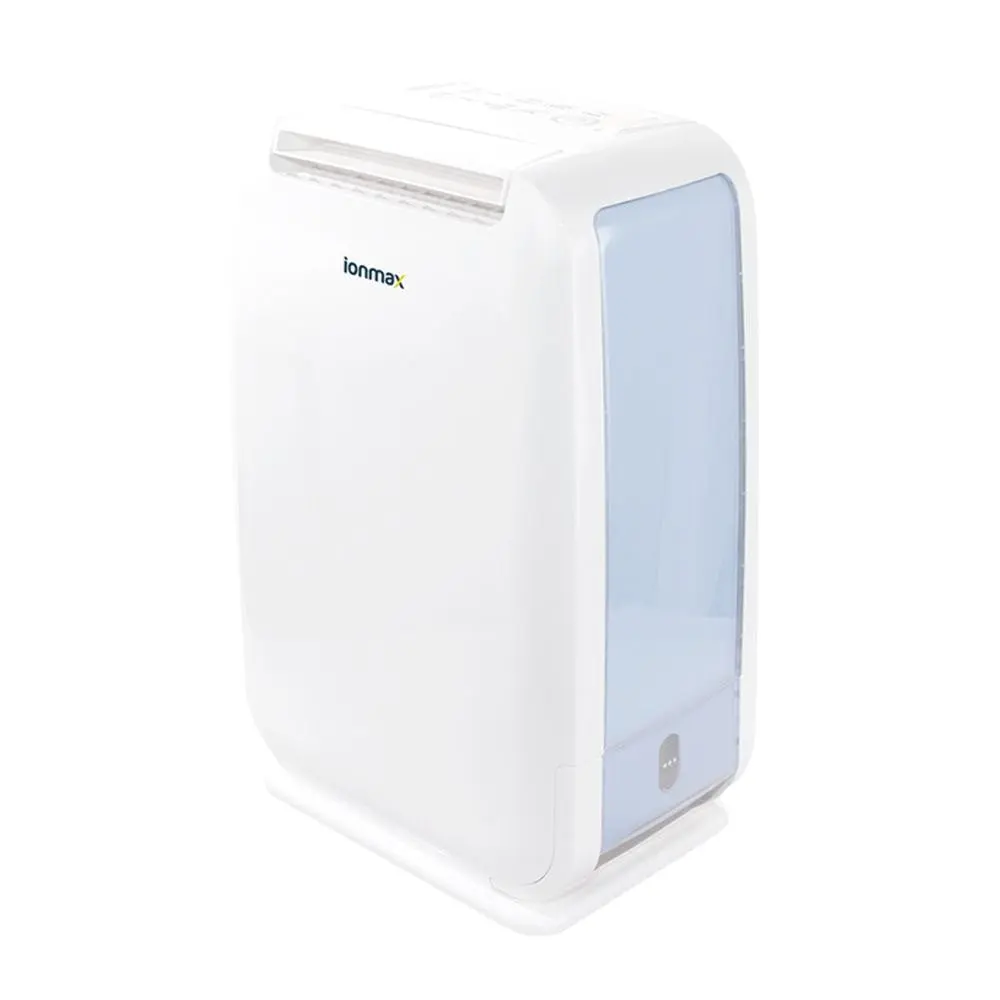
Exact ION610 product image.
Ionmax publishes a roughly 6L/day headline, including 5.6L/day at 20°C and 60% RH, with operation across 1–40°C. That lower-looking number is measured under much less moisture-rich conditions than the 30°C/80% compressor ratings, so it should not be read as a simple one-sixth comparison. The ION610 is particularly well suited to southern Australian winters, cold bedrooms, unheated laundries, caravans and boats.
A 1.8L tank, continuous drainage, laundry mode, timer up to eight hours, electronic louvre and 280–460W rating round out the practical package. Desiccant operation deliberately releases more heat into the room: welcome in winter, less attractive in tropical summer.
Owner evidence
Pros
- Useful performance in cool rooms
- Compact 5.1kg body
- Strong exact-model owner evidence
- Laundry mode and continuous drainage
- Wide 1–40°C claimed range
Cons
- Small 1.8L tank
- Adds more heat to the room
- Less attractive warm-climate efficiency
- No Wi-Fi
- Some fan/noise complaints
Mitsubishi Electric 38L Dehumidifier
Exact model: MJ-EV38HR-A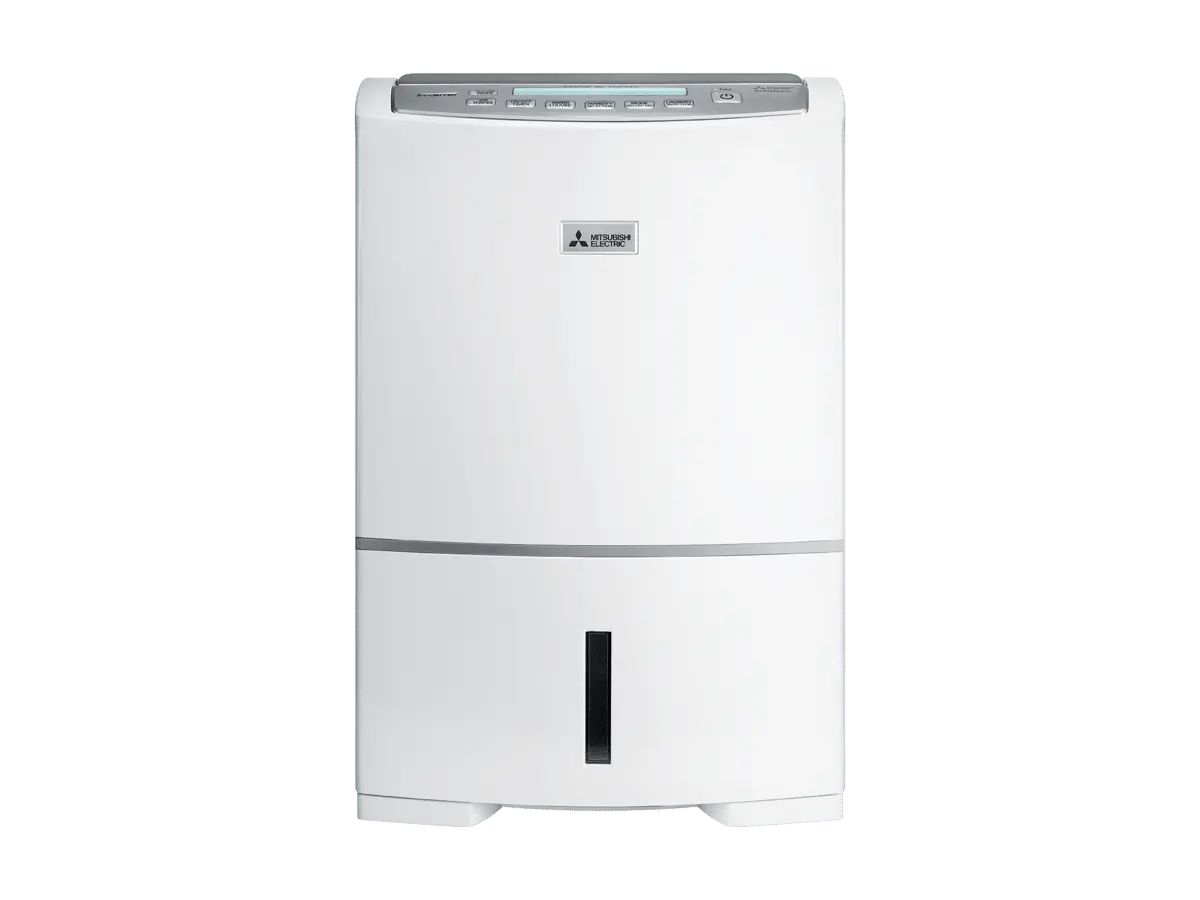
Exact MJ-EV38HR-A product image supplied on Mitsubishi Electric Australia's model page.
Mitsubishi rates the MJ-EV38HR-A at up to 38L/day at 30°C and 80% RH. Its Intelligent Laundry mode monitors humidity, manages airflow, estimates drying progress and stops automatically once the cycle is judged complete. Wide, upward and rear airflow options help distribute dry air across racks, shoes and delicate items. It helps line-dry laundry indoors; it does not tumble or heat clothing like a clothes dryer.
The inverter compressor modulates its speed as conditions change rather than always operating at maximum. Mitsubishi lists 500W in high mode, 34dBA on low, 47dBA high and 48dBA in maximum/laundry operation. The 5.5L tank, continuous drainage, 5–35°C range, Eco Auto, Mildew Guard, PM2.5 filtration, child lock, 1–12-hour timer and Drying Inside mode make this the most sophisticated appliance here.
Evidence boundary
ProductReview has exact-model MJ-EV38HR-A feedback, but the sample remains small. Owners praise extraction, laundry performance, mobility and automatic modes while also noting higher-mode noise, energy concern and the price. CHOICE has tested this exact model, but its detailed scores and measured operating costs are member-only and are not reproduced or inferred here.
Pros
- High 38L/day warm-condition capacity
- Inverter compressor
- Excellent automatic laundry workflow
- Large tank and continuous drainage
- 34dBA manufacturer low-mode figure
- Made-in-Japan positioning
Cons
- Extremely expensive
- Very heavy at 18.1kg
- Small exact-model owner pool
- Only two-year warranty
- No major Wi-Fi/app proposition
- Overkill for one bedroom
Compressor vs desiccant dehumidifiers
Compressor or refrigerant models are usually the better fit for warm humid rooms, coastal and Queensland conditions, summer moisture and larger extraction loads. In suitable warm conditions they normally remove more water per unit of energy, but their output declines as the room temperature falls.
Desiccant models use a moisture-absorbing rotor and a regeneration heater. They remain useful in cool bedrooms, winter, unheated spaces, caravans, boats and cold laundries, but generally add more heat and consume more energy per litre in warm conditions. Neither architecture is universally better.
Room size and humidity control
Manufacturer square-metre guidance is approximate. Ceiling height, outdoor humidity, air leakage, open doors, room temperature and the moisture source can matter more than floor area alone. A severely damp 30m² room can demand more capacity than a mildly humid 50m² room, and one portable unit should not be promised as whole-house treatment without specific evidence.
A practical goal is sustained moisture control rather than forcing the lowest possible humidity reading. A dehumidifier can make conditions less favourable for mould growth, but it does not remove established mould, repair plumbing or roof leaks, fix rising damp or replace ventilation. Severe contamination may need professional remediation.
Laundry drying
Dehumidifiers speed indoor line drying by removing the water evaporating from fabrics and keeping relative humidity lower. Drying time still depends on room size, temperature, airflow, fabric and spacing. Mitsubishi provides the strongest automatic workflow here; Ionmax is the more compact cold-room option.
Continuous drainage and energy
Most portable dehumidifiers use gravity drainage. The hose needs a continuous downhill path without loops, kinks or upward sections. A gravity outlet cannot pump water uphill; De'Longhi's DD230P is a specialist near-miss partly because it includes pump capability.
Do not compare wattage alone. A lower-wattage machine may run much longer, so real efficiency depends on moisture removed per unit of energy under the room's actual temperature and humidity. CHOICE evaluates removal, efficiency and operating cost, but its member-only values are not inferred here.
Placement and airflow
Place a dehumidifier upright on a stable, flat surface with unrestricted airflow around its inlet and outlet. Do not push it tightly against walls or furniture, put it inside a confined cupboard or cover the outlet with clothes or other objects. Follow the exact model manual for its required clearances; a central, open position will generally improve room moisture removal.
For continuous drainage, give the hose a safe, continuous downhill fall without kinks, loops or upward runs. Secure it to reduce leak risk and route it where it cannot become a trip hazard.
Routine maintenance
Unplug the appliance before cleaning, tank maintenance or filter servicing. Empty and clean the water tank regularly, keep inlet and outlet grilles free of dust, clean or vacuum washable or reusable filters as the model instructions direct, and inspect drainage hoses for blockages and kinks. Follow each exact model's maintenance schedule rather than assuming one interval applies to every dehumidifier.
Ionmax says the ION610's anti-allergen filter can be maintained by vacuuming it periodically; the self-regenerating desiccant material itself does not need replacement.
Noise
Compressor models create fan noise, vibration and occasional refrigerant or gurgling sounds. Desiccant models remove compressor noise but still use fans and heated regeneration airflow. None should be called silent; Mitsubishi's 34dBA low-mode figure is a manufacturer-controlled result.
Powered-appliance safety
- Keep the unit upright on a stable, level surface and keep all air paths and manual-specified clearances unobstructed.
- Do not position it where water can enter the powered unit. Use particular caution around bathrooms and other wet areas, and follow the exact model manual's placement and electrical instructions.
- Route any drain hose safely downhill, without kinks, loops or trip hazards.
- Unplug before cleaning, maintenance or filter servicing, and never immerse the powered unit or base.
- Do not operate the appliance with a damaged power cord or plug; stop using it and follow the manufacturer's service guidance.
- Supervise children where relevant and do not allow them to play with the appliance.
Do not drink collected water. Condensate can contain dust, microorganisms and residues from the tank or coil. Treat it as non-potable, and only reuse it where sensible and consistent with manufacturer and local guidance.
Which dehumidifier should you buy?
Buy the AusClimate ACD235 for the strongest overall mix of warm-room capacity, features, warranty and price. Buy the Ionmax ION610 when winter condensation, a cool room or portability drives the decision. Buy the Mitsubishi MJ-EV38HR-A when intelligent laundry drying and premium automation justify the very large price premium.
Frequently asked questions
What size dehumidifier do I need?
Start with the manufacturer's room guidance, then account for temperature, ceiling height, air leakage and the severity and source of the moisture. A smaller, wetter room can require more capacity than a larger mildly humid room.
Is a desiccant or compressor dehumidifier better?
Compressor models generally suit warm humid rooms and efficient high-volume extraction. Desiccant models are usually more effective in colder spaces, though they add more heat and can use more energy per litre in warm conditions.
Will a dehumidifier stop mould?
It can control excess moisture and make regrowth less likely, but it does not remove established contamination or fix leaks, rising damp or poor ventilation.
Can I use a dehumidifier to dry clothes?
Yes. In an enclosed room with airflow it can remove the water released by wet laundry. Mitsubishi offers the strongest automatic laundry workflow here, while Ionmax is useful in cold rooms.
How much electricity does a dehumidifier use?
It depends on rated wattage, duty cycle and actual water-removal efficiency at your room's temperature and humidity. Wattage alone does not reveal the running cost per litre removed.