How we chose
We assessed exact current Australian models, live AU pricing and availability, included hardware, physical channel layout, Dolby Atmos, DTS:X, eARC, HDMI inputs, 4K120 passthrough, surround and height localisation, dialogue, bass, music, room correction, streaming, apps, TV-brand integration, expansion cost, exact-model owner evidence, professional testing and warranty support. Worth Buying scores are editorial judgements, not customer-star calculations. Worth Buying Australia did not perform RTINGS, WIRED or other third-party listening tests.
Serious contenders reassessed
Samsung HW-Q930H/XY: is a very strong 9.1.4 step-down system around $1,179. The Q990H upgrade is unusually attractive while its street price remains close; a large pricing reversal would require value reassessment.
Samsung HW-Q800H/XY: includes a bar and subwoofer but not rear speakers. Hisense supplies physical rears and four height channels around the same or lower price.
Sony BRAVIA Theatre Bar 9 / HT-A9000: is a premium standalone alternative with DTS:X, room optimisation, an HDMI input and 4K120 passthrough. Arc Ultra is stronger for music and multi-room simplicity, while Q990H provides better complete-system value.
JBL Bar 1300MK2 / 1300XMK2: offers detachable wireless rears, Dolby Atmos, DTS:X and strong bass, but Australian pricing sits closer to $2,000.
LG S95TR: remains a strong 9.1.5 match for compatible LG TVs, but Q990H currently presents the stronger overall value. Hisense AX5125H is an older 5.1.2 predecessor; its awards and owner evidence are not transferred to AX5140Q.
Samsung Q-Series HW-Q990H 11.1.4ch Soundbar System
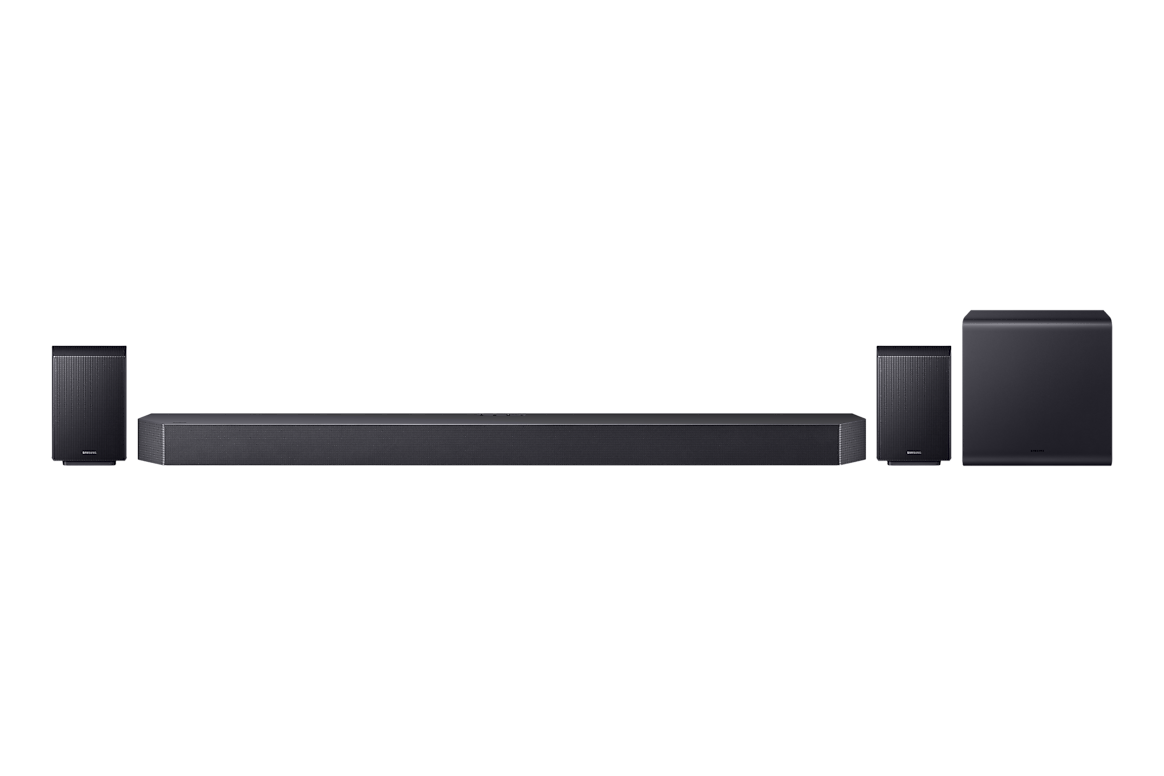
Exact HW-Q990H official Samsung product image showing the complete bar, subwoofer and rear-speaker package.
The exact Australian HW-Q990H/XY is an 11.1.4-channel system comprising the soundbar, wireless subwoofer and wireless rear-speaker system. It supports Dolby Atmos, DTS:X and Eclipsa Audio, plus SpaceFit Sound Pro, Q-Symphony, Active Voice Amplifier Pro, Voice Enhance, Night Mode and Adaptive Sound.
Connectivity is unusually complete: HDMI eARC, two HDMI inputs, optical, Wi-Fi, Bluetooth, AirPlay, Chromecast, Spotify Connect, Tidal Connect and Roon Ready. Samsung specifies HDMI 2.1 passthrough up to 4K120 with HDR10+, making this the most flexible formal pick for game consoles. Q-Symphony and wireless Atmos add the most value with compatible Samsung TVs, but the core soundbar system is not limited to them.
The rear speakers receive audio wirelessly but still require mains power. The full system needs room, placement effort and several outlets. RTINGS found excellent mixed-use, dialogue, music and surround performance with powerful dynamics, while identifying some bass-range compression near maximum output. Those are RTINGS findings, not Worth Buying measurements.
Current legitimate street pricing was approximately $1,389 promotional against an RRP around $2,099.
Customer evidence
Professional evidence
RTINGS independently tested the exact HW-Q990H and supports its dialogue, music, surround, dynamics and broad format strengths. External testing stays separate from owner evidence.
Pros
- Complete 11.1.4 package
- Physical rear surrounds and powerful subwoofer
- Dolby Atmos and DTS:X
- Two HDMI inputs and 4K120 passthrough
- Excellent dialogue and localisation
- Outstanding current street value
Cons
- Large multi-speaker footprint
- Rears still require mains power
- Several power outlets needed
- Some compression near maximum output
- Hosted reviews have mixed provenance
Hisense AX5140Q 5.1.4 Channel Soundbar System
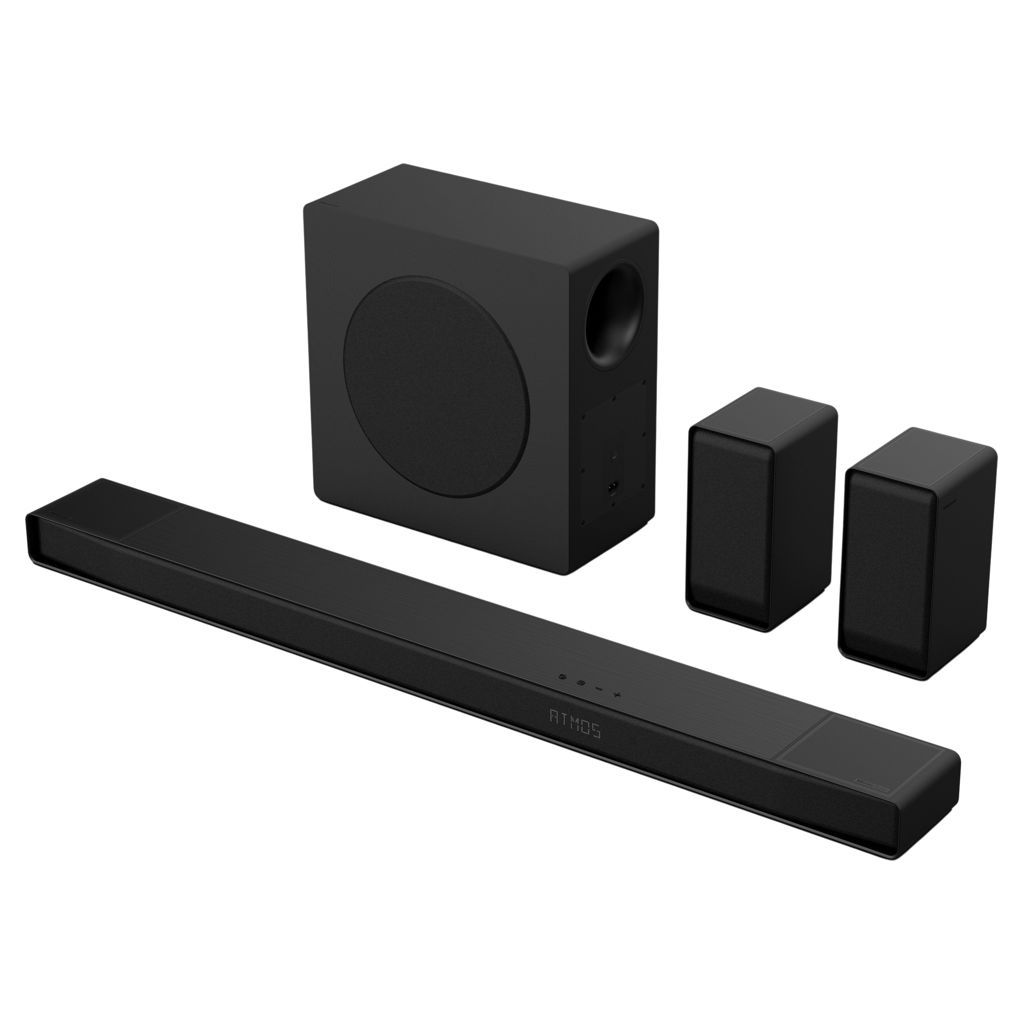
Exact AX5140Q retailer product image showing the bar, subwoofer and rear-speaker package.
The exact AX5140Q includes the soundbar, wireless subwoofer and rear surround speakers. Hisense specifies 5.1.4 channels, a 600W manufacturer maximum system-power figure, Dolby Atmos, DTS:X, Hi-Concerto and Room Fitting Tuning. Independent testing confirms a dedicated centre, HDMI input, HDMI eARC, optical, graphic EQ, channel-level control and voice enhancement.
RTINGS found strong dialogue, convincing Atmos for the price, useful channel control, good maximum output and broad Dolby/DTS support. Its limits are no 4K120 passthrough, weaker deepest bass than flagship systems, a limited network-music ecosystem and room fitting that depends on a compatible Hisense TV. Connect a current console directly to the TV and return audio by eARC.
The Good Guys promotional snapshot was approximately $599, with a $699 RRP and other legitimate pricing in the mid-$600s.
Customer evidence
Professional evidence
RTINGS independently tested the exact AX5140Q. Its listening and format findings remain attributed and separate from customer evidence.
Pros
- Exceptional complete-system price
- Real 5.1.4 with rear speakers
- Subwoofer and dedicated centre included
- Dolby Atmos and DTS:X
- Four height channels and useful EQ
Cons
- No 4K120 passthrough
- Room fitting tied to compatible Hisense TVs
- Limited network-music platform
- Less deep bass than flagship systems
- Small owner sample
Sonos Arc Ultra

Exact Arc Ultra official Sonos product image. The formal recommendation is the standalone bar; no subwoofer or rear speakers are included.
Arc Ultra uses Sound Motion technology and 14 Sonos-engineered drivers to create a broad virtualised immersive presentation from one bar. It supports Dolby Atmos, Dolby TrueHD Atmos through a compatible eARC path, Dolby Digital Plus, Dolby Digital, multichannel PCM and DTS Digital Surround. It does not support DTS:X.
Features include Trueplay, Advanced Speech Enhancement, Night Sound, Wi-Fi 6, Bluetooth 5.3, AirPlay 2 and Sonos multi-room. Optional Sub, Sub Mini and Era surrounds can expand the system later. Arc Ultra has one HDMI eARC/ARC connection and no separate HDMI input or video passthrough; sources connect to the TV, which returns audio through eARC.
RTINGS found balanced sound, excellent dialogue, impressive standalone bass, strong music performance, low compression and wide wireless connectivity. A dedicated sub reaches deeper, and full surround requires optional speakers. Broader older Sonos ownership complaints about app changes, Wi-Fi and support are ecosystem context only—not an Arc Ultra rating.
The current Sonos Australia snapshot was approximately $1,499 promotional against a $1,799 regular price.
Customer evidence
Professional evidence
RTINGS and WIRED support Arc Ultra's premium standalone positioning. Their listening findings stay attributed and separate from owner evidence.
Pros
- Excellent standalone dialogue and music
- Strong built-in bass
- Dolby Atmos and Trueplay
- AirPlay, Bluetooth and Wi-Fi 6
- Excellent Sonos multi-room ecosystem
- Expandable later
Cons
- Expensive for one bar
- No subwoofer or rears included
- No HDMI input or passthrough
- No DTS:X
- App and ecosystem dependent
- Exact Australian owner sample is tiny
What to know before buying a soundbar
Standalone bar versus complete system
A standalone bar keeps setup clean but uses virtualisation for much of its rear presentation and has less deep bass without a subwoofer. Complete systems add physical rear localisation and dedicated bass, but require more space, cables and outlets.
Dolby Atmos and height effects
Atmos compatibility alone does not guarantee convincing height. Up-firing hardware, rear-height drivers, ceiling height and material, room geometry and seating position all matter. Samsung and Hisense supply physical rear and height speakers; Arc Ultra relies more on front-bar drivers and processing when used alone.
DTS:X and DTS support
Samsung and Hisense support DTS:X. Arc Ultra supports DTS Digital Surround but not DTS:X. That distinction matters most for Blu-ray, UHD Blu-ray and local media libraries; streaming services are more heavily Dolby-oriented.
HDMI eARC
eARC is the preferred TV-to-soundbar connection and can carry Dolby TrueHD, lossless Atmos and multichannel PCM where the full device chain supports them. It does not automatically guarantee every format: TV settings and passthrough support still matter.
HDMI passthrough and gaming
Samsung provides two HDMI inputs and 4K120 passthrough. Hisense has an HDMI input but no 4K120, so current consoles should normally connect to the TV and return audio by eARC. Arc Ultra has no HDMI input or video passthrough; all sources connect to the TV.
Rear speakers still need power
“Wireless rear speakers” usually means wireless audio, not battery operation. Samsung and Hisense rear speakers still need mains power, as do their subwoofers. Check outlet positions before buying.
Subwoofers and dialogue
A dedicated subwoofer improves deep bass, impact and headroom. Samsung and Hisense include one; Sonos does not. Dialogue also depends on centre-channel design, tonal balance, room and content mix. Voice features can help, but no soundbar completely repairs a poor source mix.
Room correction
Samsung uses SpaceFit Sound Pro and Sonos uses Trueplay. Hisense Room Fitting Tuning depends on a compatible Hisense TV and is not universal standalone calibration across every TV brand.
Music, streaming and TV-brand features
Sonos is strongest for music and multi-room use. Samsung also supports Chromecast, AirPlay, Spotify Connect, Tidal Connect and Roon Ready. Brand features such as Samsung Q-Symphony and Hisense Hi-Concerto can add value, but should not outweigh core performance and package value.
Soundbar setup and safety basics
Follow the exact TV, soundbar, subwoofer and rear-speaker manuals. Place or mount every unit on a stable surface or correctly rated bracket, preserve required ventilation and keep up-firing drivers unobstructed. Do not place equipment where it can fall, block a screen's vents or be exposed to moisture.
Switch off and unplug components before cleaning, inspecting connections or changing installation hardware. Route HDMI and mains cables so they are not pinched, stretched or trip hazards. Remember that “wireless” subwoofers and rear speakers still require mains power, and use correctly earthed outlets or approved power boards within their ratings.
Keep children from pulling cables or climbing speaker stands. Start at moderate volume and avoid prolonged exposure to levels that cause discomfort or ringing. If wall mounting or concealed mains work is required, use appropriate qualified help and follow Australian electrical and building requirements.
Which one should you buy?
Choose the Samsung HW-Q990H/XY for the strongest complete home-theatre package with rear speakers, subwoofer, Atmos, DTS:X and 4K120 passthrough.
Choose the Hisense AX5140Q for genuine physical 5.1.4 surround around $600–$700.
Choose the Sonos Arc Ultra for one premium visible bar, excellent dialogue and music, multi-room audio and expansion later.
Frequently asked questions
Do I need rear speakers for Dolby Atmos?
No, but physical rear and rear-height speakers generally create stronger wraparound localisation than a standalone bar relying mainly on virtualisation.
Should I buy the same brand soundbar as my TV?
Not automatically. Matching-brand features can help, but core sound quality, included hardware, format support and value matter more.
What is the difference between HDMI ARC and eARC?
eARC provides greater bandwidth and can support lossless formats and multichannel PCM where the whole device chain is compatible. ARC is more limited.
Do I need DTS:X?
It matters most for compatible discs and local media. Streaming platforms are more heavily Dolby-oriented, so many streaming-only households will not consider it essential.
Do I need a subwoofer?
Not for clear dialogue or casual TV, but a dedicated subwoofer materially improves deep bass, movie impact and low-frequency headroom.