How we chose
We assessed exact Australian models, local availability and pricing, input latency, pixel response, HDMI bandwidth and port count, 4K120, 144/165Hz PC gaming, VRR, ALLM, FreeSync, G-Sync, HGiG, HDR and Dolby Vision gaming, Game Mode behaviour, brightness, reflections, static-image considerations, Australian owner evidence and credible professional testing.
Worth Buying scores are editorial judgements, not calculations from retailer star ratings. External latency and response measurements remain attributed to the publications that performed them. Worth Buying Australia did not conduct RTINGS, TechRadar or Tom's Guide laboratory measurements.
Why these three won
LG C6 has virtually no major gaming-feature hole and suits the broadest mix of consoles, PC and movies. Samsung S90H concentrates on four-input 4K165 flexibility and OLED motion clarity for demanding PC players. Hisense U7S brings an unusually complete native-165Hz Mini-LED specification below premium OLED pricing and is the conservative option for very heavy static desktop or HUD use.
Serious near-misses
TCL C7L 65C7L is a strong Google TV value alternative with 4K144, FreeSync Premium Pro and Dolby Vision gaming; its 288Hz Game Accelerator is not native 4K288. TCL C8L 65C8L is a superb premium Mini-LED but sits between U7S value and OLED response quality. Sony BRAVIA 8 II K65XR80M2 has useful PS5 integration and outstanding picture quality, but two full-bandwidth gaming ports—with eARC sharing one—reduce multi-device flexibility. LG G6 and Samsung S95H are excellent ultra-premium choices whose price premiums buy more picture performance than gaming connectivity. LG B6 is a credible cheaper OLED, but C6's brightness and refresh ceiling make the specialist recommendation clearer.
LG OLED evo AI C6 65-inch OLED65C6PSA
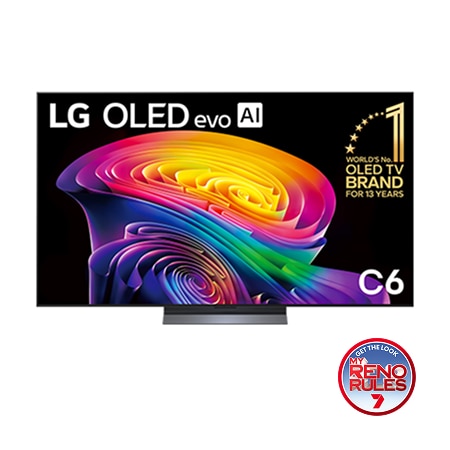
LG Australia confirms 4K high-frame-rate support up to 120fps, VRR up to 165Hz, ALLM, NVIDIA G-Sync compatibility, AMD FreeSync compatibility, HGiG, Game Optimiser, Game Dashboard, Quick Frame Transport and Dolby Vision gaming at 4K120. LG's quoted sub-0.1ms response is a manufacturer claim, not an independent Worth Buying measurement.
RTINGS independently found extremely low input lag, nearly instantaneous pixel response, clear motion, 4K up to 165Hz, HDMI 2.1 bandwidth on all four inputs and broad VRR support. TechRadar Australia's testing measured about 9.2ms input lag under its methodology and selected C6 as its current overall gaming recommendation. Those are the publications' findings, not ours.
The real trade-offs are price, OLED's non-zero static-image risk and lower full-screen brightness than strong Mini-LED sets. Near-instant pixel response can also expose low-frame-rate stutter. The exact 65-inch OLED65C6PSA must not be confused with larger C6H hardware, and we do not transfer C6H panel claims to it.
Gaming fit
| Exact model | OLED65C6PSA · 65-inch OLED |
|---|---|
| Console | 4K120, VRR, ALLM; Dolby Vision gaming up to 4K120 |
| PC | Up to 165Hz VRR, G-Sync Compatible, FreeSync |
| HDMI | Four modern gaming-capable inputs |
| Price snapshot | About $3,995 at The Good Guys |
Owner and professional evidence
Pros
- Exceptional response and very low latency
- Four strong HDMI gaming inputs
- 4K120 consoles and up-to-165Hz PC gaming
- G-Sync, FreeSync, VRR, ALLM and HGiG
- Dolby Vision gaming and perfect OLED blacks
Cons
- Expensive
- OLED static-image risk is not zero
- Full-screen brightness trails Mini-LED
- No HDR10+
- Low-frame-rate OLED stutter can appear
Samsung OLED S90H 65-inch QA65S90HAWXXY
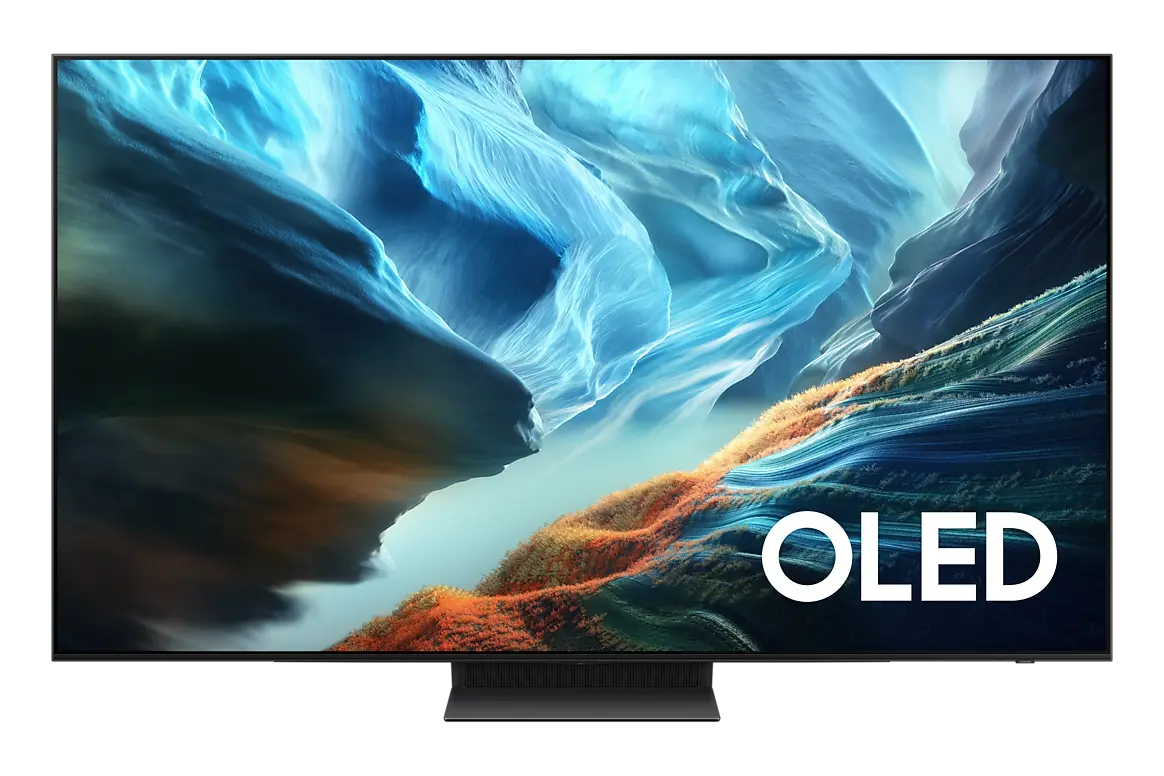
Samsung Australia specifies Motion Xcelerator 165Hz, VRR, NVIDIA G-Sync compatibility, AMD FreeSync Premium Pro, HGiG, ALLM, Game Motion Plus, Game Bar, Dynamic Black EQ, Ultra Wide Game View, Gaming Hub and AI Gaming Optimiser. The exact Australian product page lists a maximum 4K165 input rate on HDMI 1, 2, 3 and 4, reducing port juggling around multiple sources and eARC equipment.
RTINGS independently reports outstanding gaming responsiveness, very low input lag, nearly instantaneous response, 165Hz support, strong VRR and 4K165 across all four HDMI 2.1 ports. Tom's Guide selected S90H in its 2026 gaming-TV awards. These remain external findings. We also do not guess whether the exact Australian QA65S90HAWXXY uses a particular QD-OLED or WOLED panel subtype.
Samsung omits Dolby Vision and uses HDR10+ Gaming instead, which is the main reason C6 is the broader recommendation. OLED static-image risk remains, Tizen is feature-rich but busy, and the attractive snapshot price was promotional. Samsung-hosted review pools can include other sizes, markets and incentives, so they are not presented as exact Australian 65-inch owner evidence.
Gaming fit
| Exact model | QA65S90HAWXXY · 65-inch OLED |
|---|---|
| Console | 4K120, VRR, ALLM, HGiG; no Dolby Vision |
| PC | Up to 165Hz, G-Sync Compatible, FreeSync Premium Pro |
| HDMI | Four inputs; 4K165 maximum input rate on all four per Samsung AU |
| Price snapshot | About $3,295 promotional at The Good Guys |
Owner and professional evidence
Pros
- 4K165 on all four HDMI inputs
- Outstanding OLED response and low latency
- G-Sync Compatible and FreeSync Premium Pro
- HGiG, VRR, ALLM and excellent Game Bar
- Strong multi-device and PC flexibility
Cons
- No Dolby Vision
- OLED static-image trade-off remains
- Exact Australian panel subtype should not be guessed
- Tizen can feel busy
- Current price may be promotional
Hisense U7S 65-inch ULED MiniLED 165Hz 4K TV 65U7SAU
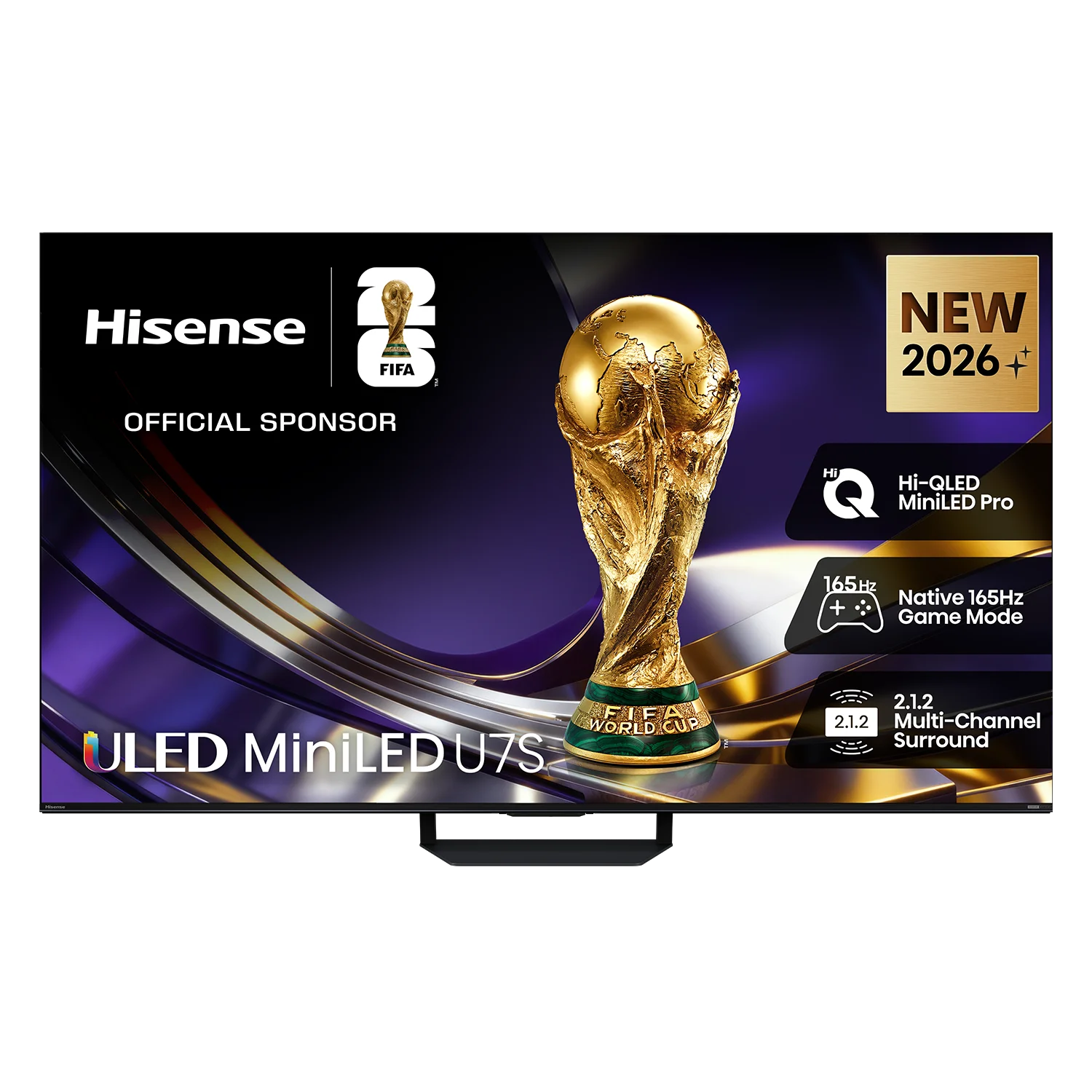
Hisense Australia confirms a native 165Hz panel, VRR, ALLM, AMD FreeSync Premium Pro, four HDMI inputs all listed as HDMI 2.1, Game Bar, Dolby Vision IQ, HDR10+ Adaptive, Mini-LED backlighting and anti-reflection treatment. We do not claim G-Sync because the exact Australian evidence does not establish it.
The value case is simple: it retains the high-refresh, variable-refresh and connection features most gamers need at less than half the C6 snapshot price. Mini-LED avoids OLED's organic-pixel burn-in mechanism, making it the conservative choice for fixed PC UI, persistent HUDs and very long cumulative desktop use. That does not mean an LCD cannot develop other image or backlight faults.
It cannot be assumed to match OLED pixel response, black uniformity or freedom from blooming, and local dimming in Game Mode can involve picture-quality compromises. Exact-Australian independent latency measurements are also thinner. International U7S Pro brightness, lag or local-dimming measurements are not transferred to 65U7SAU without proven hardware equivalence.
Gaming fit
| Exact model | 65U7SAU · 65-inch Mini-LED LCD |
|---|---|
| Console | 4K high refresh, VRR, ALLM and Dolby Vision support |
| PC | Native 165Hz, FreeSync Premium Pro; no unverified G-Sync claim |
| HDMI | Four HDMI 2.1 inputs per Hisense Australia |
| Price snapshot | About $1,595 promotional; Hisense RRP $2,199 |
| Warranty | 3 years; terms apply |
Owner and professional evidence
Pros
- Exceptional gaming specification for the price
- Native 165Hz and four HDMI 2.1 inputs
- FreeSync Premium Pro, VRR and ALLM
- Dolby Vision and HDR10+
- Bright-room Mini-LED design and 3-year warranty
Cons
- Not OLED-level response or black performance
- Thinner exact-model independent measurement evidence
- VIDAA rather than Google TV or webOS
- Potential blooming and Game Mode dimming trade-offs
- Promotional price may expire
Gaming TV buying advice
4K120 versus 144/165Hz
PS5 and Xbox make 4K120 the important ceiling. A 144Hz or 165Hz mode matters much more to compatible gaming PCs; it does not make a console render at 165fps.
Count the HDMI inputs
PS5, Xbox, PC and an eARC soundbar can quickly consume four connections. LG, Samsung and Hisense provide stronger multi-device flexibility here than models with only two full-bandwidth ports.
VRR smooths variable frame rates
Variable Refresh Rate synchronises the display with supported game output to reduce tearing and judder. It cannot increase the console or PC's actual rendering performance.
ALLM is useful, not sufficient
Auto Low Latency Mode lets a compatible source trigger the TV's low-latency mode. It does not by itself guarantee low input lag or good Game Mode image quality.
Input lag and pixel response differ
Input lag is the delay between a source input and its visible result. Pixel response is how quickly the screen changes. A TV can be strong in one and weaker in the other; OLED is especially fast in pixel response.
Dolby Vision gaming is a format choice
LG supports Dolby Vision gaming up to 4K120, Samsung uses HDR10+ Gaming instead, and Hisense supports Dolby Vision-family HDR. Samsung remains a highly capable HDR gaming TV despite omitting Dolby Vision.
Judge HDR inside Game Mode
Peak-nit claims alone are not enough. Low latency, tone mapping, local dimming and picture quality must continue to work acceptably in the mode used for gaming.
OLED versus Mini-LED
OLED brings instant response, pixel-level blacks, no local-dimming halos and wide angles. Mini-LED can be brighter, cheaper and more conservative for fixed desktop or HUD use. Neither universally wins.
OLED burn-in and static images
Modern OLED TVs use pixel refresh, logo mitigation, screen shift and panel-care systems. For normal mixed gaming and television use, permanent image retention should not be presented as inevitable. Risk rises with thousands of hours of the same HUD, fixed taskbars, productivity software, menus left displayed or signage-like use. Leave panel-care features enabled and follow the manufacturer instructions. For unusually heavy static PC use, Hisense U7S-style Mini-LED is the more conservative recommendation.
Console and PC notes
PS5 and PS5 Pro
Prioritise 4K120, VRR and ALLM. Sony's own BRAVIA integration is useful, but does not by itself outweigh the connection flexibility of four capable gaming inputs.
Xbox Series X
4K120, VRR and FreeSync matter, with Dolby Vision gaming a useful preference for some owners. LG is the strongest all-round Xbox match; Samsung remains excellent without Dolby Vision.
Gaming PC
Consider 4K144/165, adaptive-sync compatibility, chroma handling, connection count and static desktop use. S90H is the high-refresh specialist, C6 the complete option and U7S the value/static-use choice.
Which gaming TV should you buy?
Buy the LG C6 OLED65C6PSA if you want the best complete gaming TV for mixed PS5, Xbox, PC and movie use, including Dolby Vision gaming.
Buy the Samsung S90H QA65S90HAWXXY if high-refresh competitive or PC gaming and four 4K165-capable HDMI inputs matter more than Dolby Vision.
Buy the Hisense U7S 65U7SAU if you want an extremely strong gaming feature set for much less, especially in a bright room or for heavy PC and static-HUD use.
Frequently asked questions
Do I need a 120Hz TV for PS5 or Xbox Series X?
You do not need one for ordinary 60fps games, but 120Hz enables supported high-frame-rate modes and can reduce latency. Pair it with VRR for smoother games whose frame rate varies.
Is 165Hz useful on a TV?
Mostly for a compatible gaming PC capable of outputting above 120fps. PS5 and Xbox do not become 165fps systems simply because the television accepts 165Hz.
Is OLED or Mini-LED better for gaming?
OLED has faster pixel response, perfect blacks and no backlight blooming. Mini-LED can be brighter, cheaper and better suited to extremely long fixed-desktop or static-HUD use. Your room and workload decide.
Does HDMI 2.1 mean every port supports 4K120?
No. Port bandwidth and features vary by model, and eARC can share a high-bandwidth input. Check the exact Australian model and each input rather than relying on the HDMI label alone.
Can OLED burn in from gaming?
The risk is not zero, but normal mixed use should not be treated as inevitably damaging. Risk increases with thousands of hours of repeated static HUDs, taskbars or signage-style use; built-in panel-care features should remain enabled.